
27-04-2026 18:48
Tony MoverleyCollected 23rd April 2026, Norfolk, EnglandSwarms
27-04-2026 17:41
 Lothar Krieglsteiner
.. Algarve, same leaf than the last post. The con
27-04-2026 18:05
Lothar Krieglsteiner
... still attached at standing tree. The green con
27-04-2026 17:16
Lothar Krieglsteiner
.. Algarve, moist lying.The conidiomata look like
27-04-2026 12:54
Steve ClementsBonjour. Ce petit champignon blanc résupiné et
27-04-2026 09:59
Pauline. PennaBonjour Can anyone advise me on these pycnidia fo

22-04-2026 20:54
 Enrique Rubio
Hi to everybody.This Pyrenopeziza grew in moist le
24-04-2026 03:16
 David Chapados
Found while looking at something else from wood in
 Bonjour tous
This time of year is not the best time to collect these fungi, but a recent species-rich collection has encouraged me to draw the attention (or remind) ASCOFrance members to this branch of mycological study (Alain G is clearly 'on the case'!). I know many on here have made excellent collections of teleomorphs of aquatic and semi-aquatic ascos.
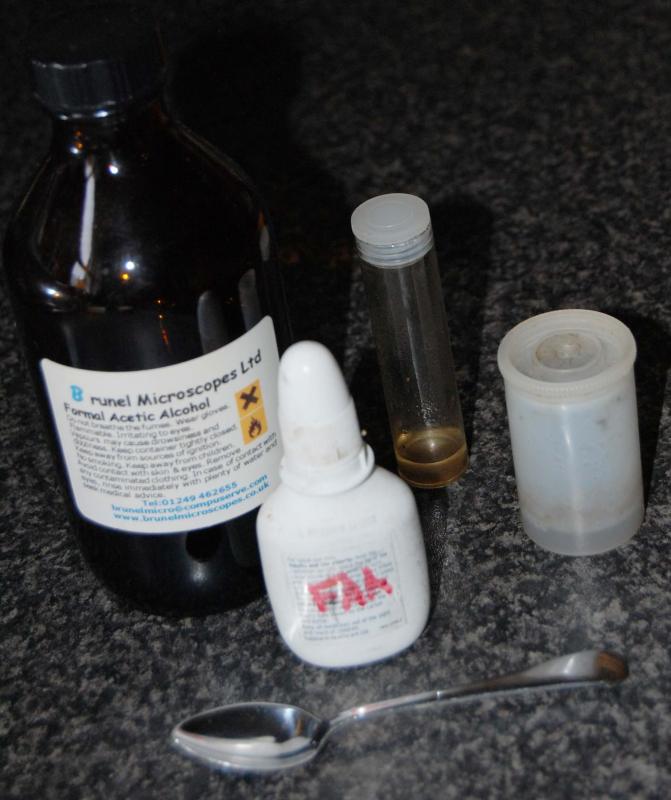
All that is needed is naturally-formed foam in streams, or sometimes at the edge of standing water, and the simplest of materials:
~ a teaspoon
~ a water-tight container
~ a botanical fixative (otherwise the conidia start to germinate when they touch a solid object) Formol Acetic Alcohol is the one normally used
~ literature - this http://www.ascofrance.com/uploads/document/1989DescalsAquaticHyphos-0001.pdf which I have uploaded to ASCOFrance was produced for a workshop I helped organise many years ago, and is still the first one I consult when identifying conidia
Most of the fungi encountered are anamorphs of ascomycete fungi; for a number the teleomorph is also now known. Occasionally one comes across fungi from other groups: in the foam in these photographs were also the coronate conidia of a zygomycete (Erynia rhizospora) and those of a member of the tiny basidiomycete order the Classiculales http://en.wikipedia.org/wiki/Classiculomycetes. I have included images of three fungi here, before I submit them to the Database.
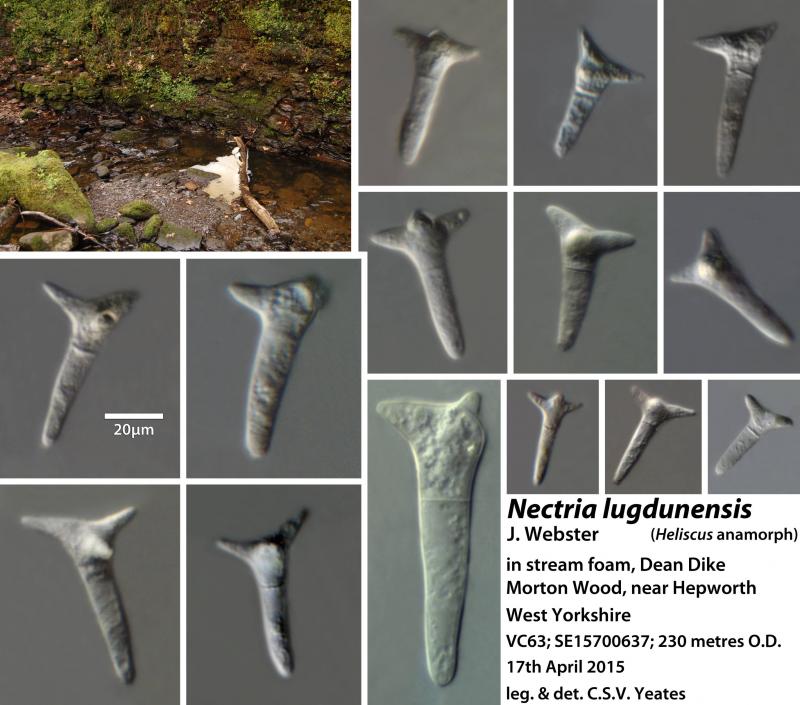
Nectria lugdunensis - these are conidia of the Heliscus anamorph, they are characteristically shaped like cloves (clous de girofle /Gewürznelken); once, many years ago, I collected a semi-submerged branch with both the anamorph and teleomorph growing together.
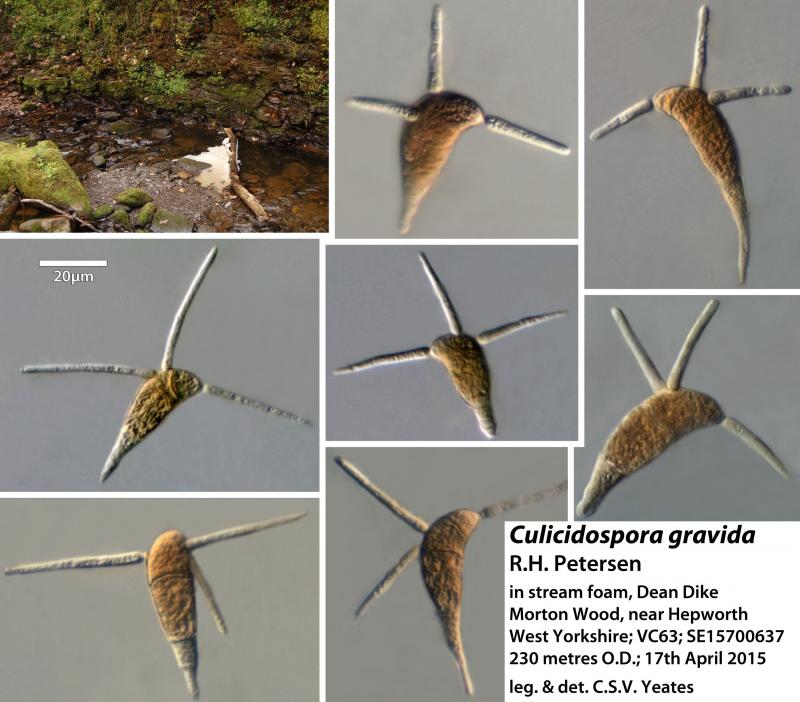
Culicidospora gravida - these remarkable conidia have been described by Ingold as looking like penguins, to me they also resemble hummingbirds. The granular contents are characteristic, I have not found a reference yet to the coloured contents - these are not stained.
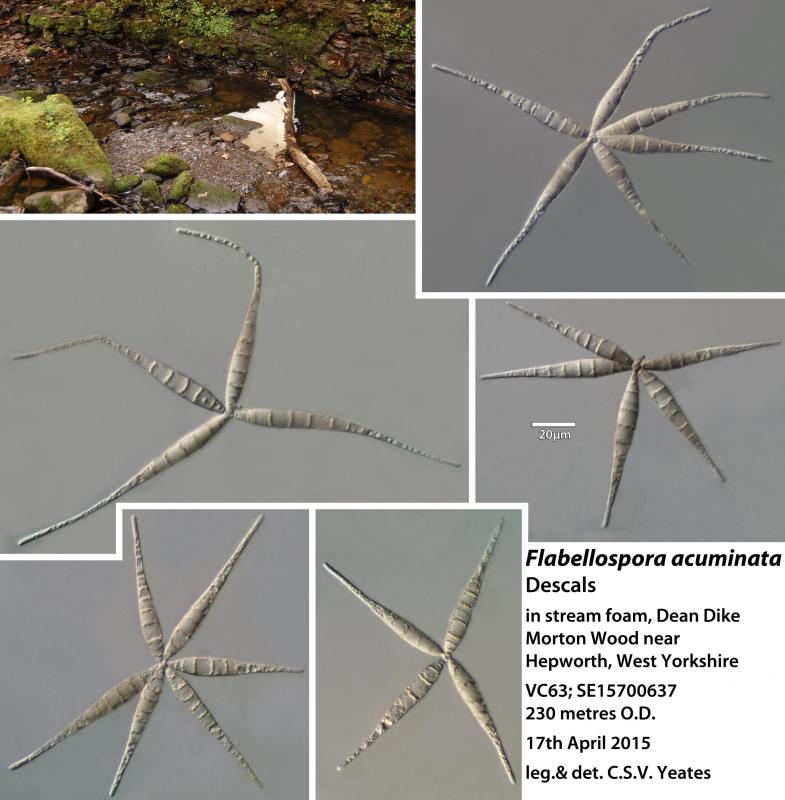
Flabellospora acuminata - another species with large remarkably shaped (and large) conidia - an aquatic lifestyle evolves its own solutions.
I hope this may encourage others to dip their toes into this fascinating area of study.
Cordialement
Chris

these fungi are mostly unnoticed by me although they are lovely.
cheers,
Stip
Very nice Chris :)
Thanks for sharing these beautiful images,
Nick

I have a collection of sexual state of Neonectria lugdunensis (Sacc. & Therry) L. Lombard & Crous 2014 = Heliscus lugdunensis Sacc. & Therry, collected by Yannick Mourgues on 20.Feb. 2010, France, Hautes-Alpes, Jourcins, St André d'Embrun. I attach some images of this collection.
Cheers,
Christian
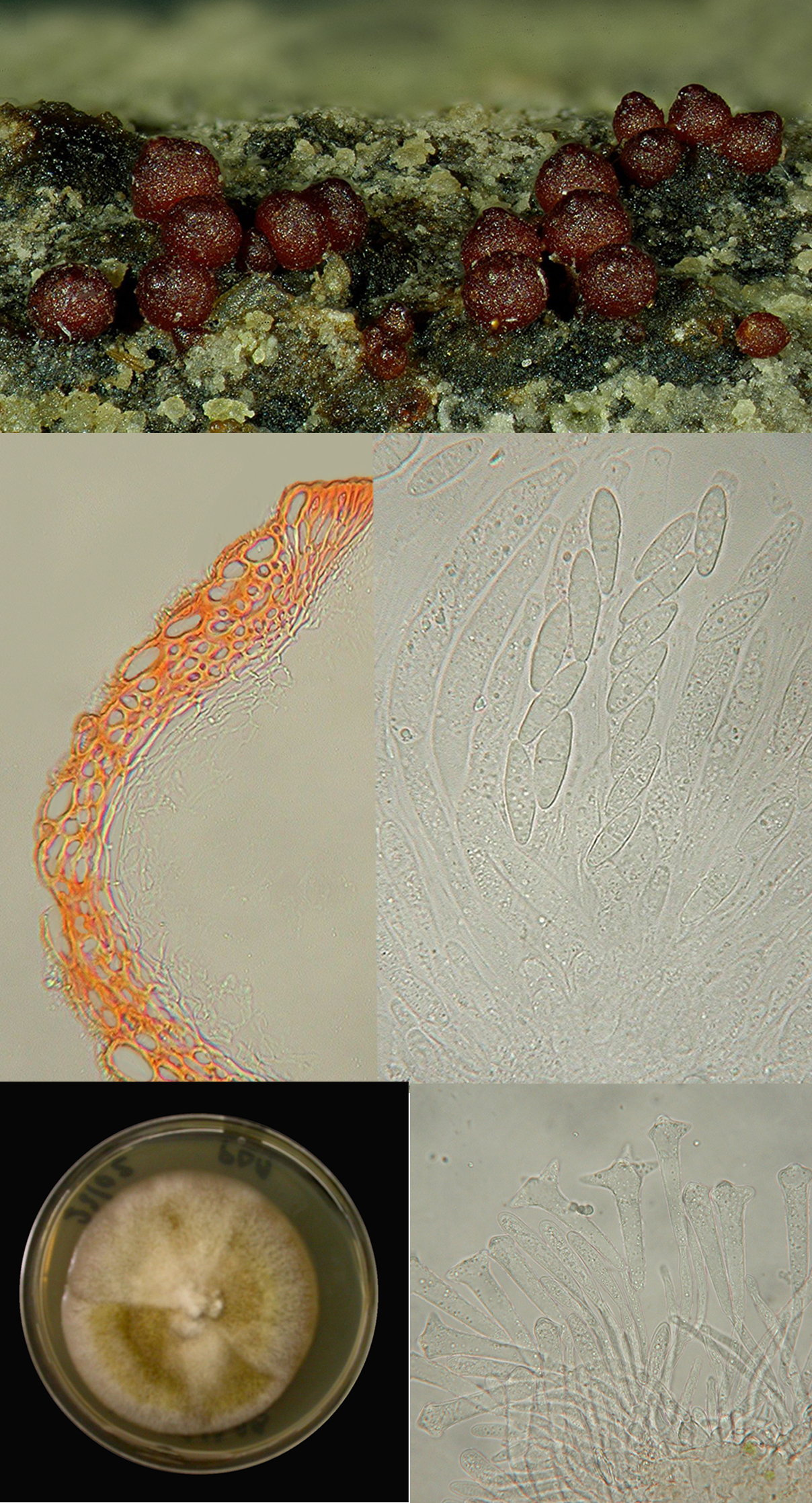 Neonectria-lugdunensis-0001.jpg
Hi Chris,
How would you tell in English '' je suis scotché par la beauté des photos'' !
SOmething like ''I am stuck ...'' may be more colloquial
Bravo AMitiés. Michel
thanks Christian to show both morphs together.
Stip