08-06-2026 10:16
 Spooren Marco
I don`t have a clou about this fungus,it is not in
09-06-2026 18:32
Camille MertensSur morceau de roseau immergé 0,5 - 0,7 mm de dia
08-06-2026 17:00
François BartholomeeusenGood day everyone, On June 5 2026, I collected de
07-06-2026 15:10
 William Slosse
Hello everyone,On 05-06-26, I found following asco
05-06-2026 11:02
Thomas Læssøehttps://svampe.databasen.org/observations/10596691
07-06-2026 12:09
 François Freléchoux
Bonjour, Voici une brève description de ce qui m
07-06-2026 12:43
Steve ClementsBojour. This was a strange find on a stick on my
12-07-2015 00:05
 Nedim Jukic
This one from the same locality as the previous on
06-06-2026 17:44
Steve ClementsBonjour, This disco was on planed wood 3 x 1.5 cm
Nectriella on Typha 1
Hans-Otto Baral,
16-07-2008 17:39
 Hi Christian & Amy and everybody
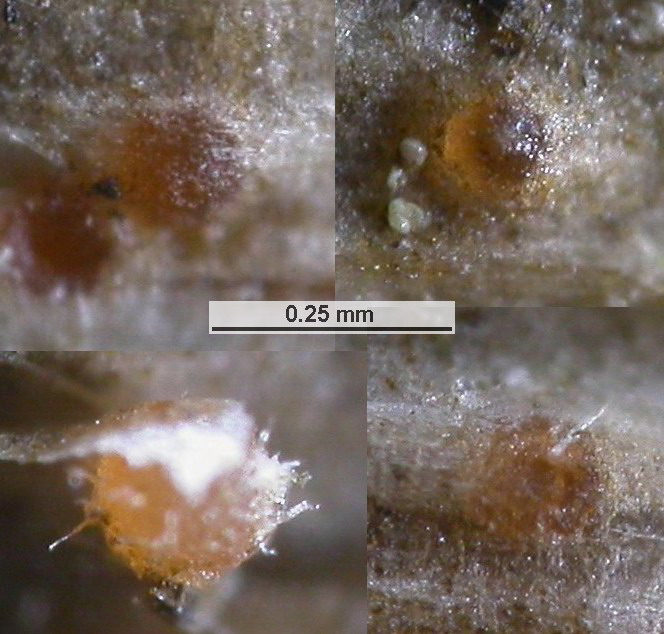
I promised Amy to collect Hypocreales, here are two on Typha. I collected in a forest pond here in Tübingen dead upright Typha latifolia shoots standing in the water, with the outer sheaths completely dry, and in about 20-40 cm above water level were minute orange dots which I first thought to be orbiliaceous. It was a further surprize that there are two species.
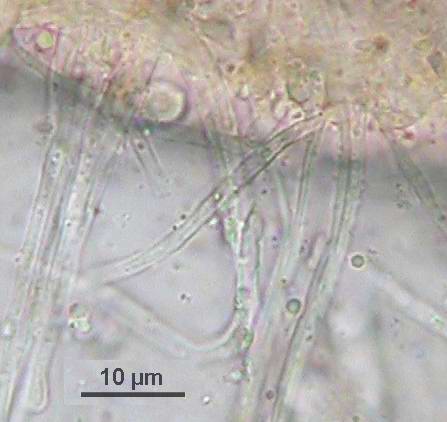
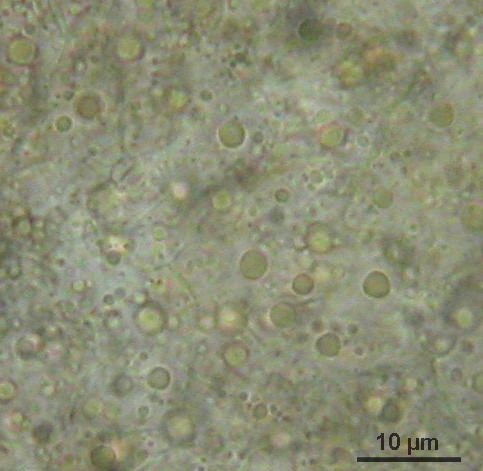
Now, I think one of them must be a Nectriella because the perithecia are permanently subepidermal. There are long thin hyphae around the perithecial wall but no true hairs. Pale yellow oil drops are seen in the wall cells. Interestingly the warts on the spores disappeared in heated KOH. I considered N. paludosa or N. curtisii, mainly because of the substrate. The size of the living spores would well match the data in Rossman & Samuels 1999, but not the size of the dead spores.
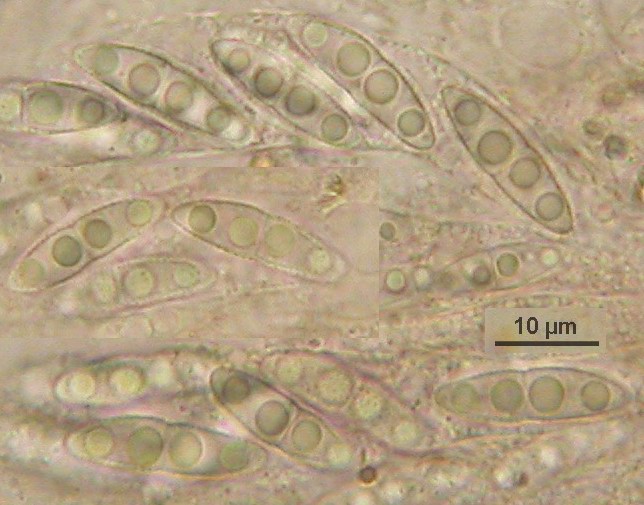
Perithecia 120-200 µm diam, subepidermal. Sp. *17-19.5(-21) x 4.3-5.5 µm, distinctly finely & densely warted-punctate, KOH heated 14-17 x (3.5-)3.8-4 µm!, smooth!
Zotto
Hans-Otto Baral,
16-07-2008 17:41
Re:Nectriella on Typha 1
Living spores (in water)
Hans-Otto Baral,
16-07-2008 17:41
Re:Nectriella on Typha 1
yellowish oil drops in cells of perithecial wall
Christian Lechat,
16-07-2008 18:08

Re:Nectriella on Typha 1
Dear friends,
Zotto, maybe it is Nectriella dacrymycella, I studied one collection of this species three years ago, collected by Bruno Coué on Iris.
Can you please send us an image (micro) of Hyphae or hairs ?
Amitiés :)
Zotto, maybe it is Nectriella dacrymycella, I studied one collection of this species three years ago, collected by Bruno Coué on Iris.
Can you please send us an image (micro) of Hyphae or hairs ?
Amitiés :)
Hans-Otto Baral,
16-07-2008 21:46
Re:Nectriella on Typha 1
Here is a photo of hyphae around perithecia