
06-05-2026 11:25
 Castillo Joseba
Me mandan el material seco de Galicia (España) re
06-05-2026 17:23
Thomas Læssøehttps://svampe.databasen.org/observations/10594257
28-04-2026 20:07
 Lothar Krieglsteiner
... on twig in the air at standing Ceratonia siliq
05-05-2026 22:40
Gernot FriebesHi,I believe this is a Plagiostoma growing on a Sa
04-05-2026 18:13
 Stephen Martin Mifsud
ID request for what seems to be a true aquatic fun
04-05-2026 16:39
Stephen Martin Mifsud
ID request: This specimen was collected in Malta o
28-07-2011 18:31
 Alex Akulov
Dear FriendsToday I made the pdf file of Velenovsk
04-05-2026 09:50
Castillo Joseba
Me mandan el material seco de Galicia,(España) re
02-05-2026 12:42
Alain BRISSARDBonjour à tousJeuidi 30 avril dernier on m'a remi
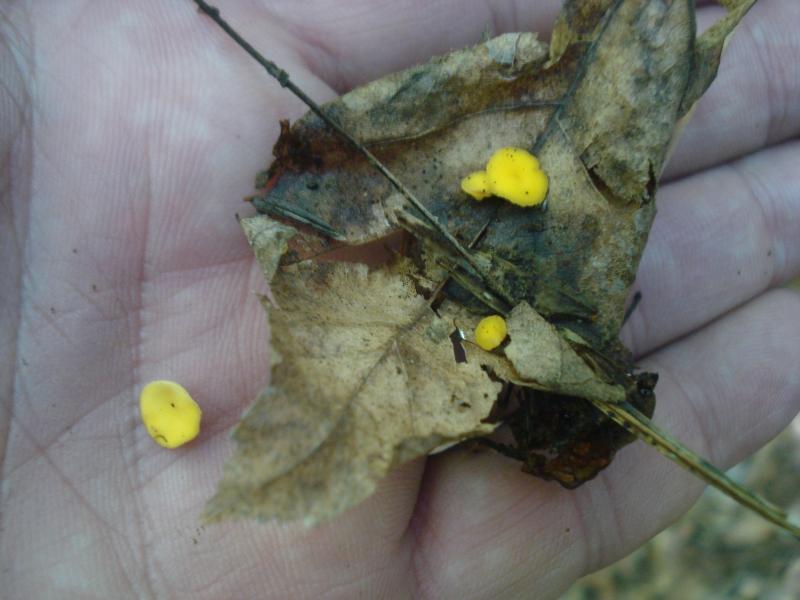
Phaeohelotium epiphyllum var. epiphyllum...?
Dave Wasilewski,
21-08-2015 07:30
Hans-Otto Baral,
21-08-2015 09:16

Re : Phaeohelotium epiphyllum var. epiphyllum...?
The substrate is rather unimportant. P. epiphyllum grows on any kind of woody plant parts. Likewise P. monticola which has a more intense yellow colour and which I would more expect in your case.
Dave Wasilewski,
21-08-2015 15:42
Re : Phaeohelotium epiphyllum var. epiphyllum...?
Thank you Hans-Otto. According to Index Fungorum, the current name for Phaeohelotium monticola is Hymenoscyphus monticola. This pointed me in the direction of genus Hymenoscyphus, which I see includes many species, some of which grow on old leaves.
Hans-Otto Baral,
21-08-2015 19:15
Re : Phaeohelotium epiphyllum var. epiphyllum...?
Yes, but genetic results show that P. monticola is rather distant from Hymenoscyphus and may well be separated at the genus level. See my paper on Phaeohelotium terrestre agg.
Baral H.O., Galán R., Platas G., Tena R. (2013). Phaeohelotium undulatum comb. nov. and Phaeoh. succineoguttulatum sp. nov., two segregates of the Discinella terrestris aggregate found under Eucalyptus in Spain: taxonomy, molecular biology, ecology and distribution. – Mycosystema 32: 386–428.
Baral H.O., Galán R., Platas G., Tena R. (2013). Phaeohelotium undulatum comb. nov. and Phaeoh. succineoguttulatum sp. nov., two segregates of the Discinella terrestris aggregate found under Eucalyptus in Spain: taxonomy, molecular biology, ecology and distribution. – Mycosystema 32: 386–428.