
09-06-2026 18:32
Camille MertensSur morceau de roseau immergé 0,5 - 0,7 mm de dia
08-06-2026 17:00
François BartholomeeusenGood day everyone, On June 5 2026, I collected de
08-06-2026 10:16
 Spooren Marco
I don`t have a clou about this fungus,it is not in
07-06-2026 15:10
 William Slosse
Hello everyone,On 05-06-26, I found following asco
05-06-2026 11:02
Thomas Læssøehttps://svampe.databasen.org/observations/10596691
07-06-2026 12:09
 François Freléchoux
Bonjour, Voici une brève description de ce qui m
07-06-2026 12:43
Steve ClementsBojour. This was a strange find on a stick on my
12-07-2015 00:05
 Nedim Jukic
This one from the same locality as the previous on
06-06-2026 17:44
Steve ClementsBonjour, This disco was on planed wood 3 x 1.5 cm
 Hi to all
Could these conidia to belong to the anamorphic state, Hendersonia carpini Sacc., of Splanchnonema carpini?
They are inside conidiomata close to the pseudothecia of the last on Carpinus betulus branches
Thanks again
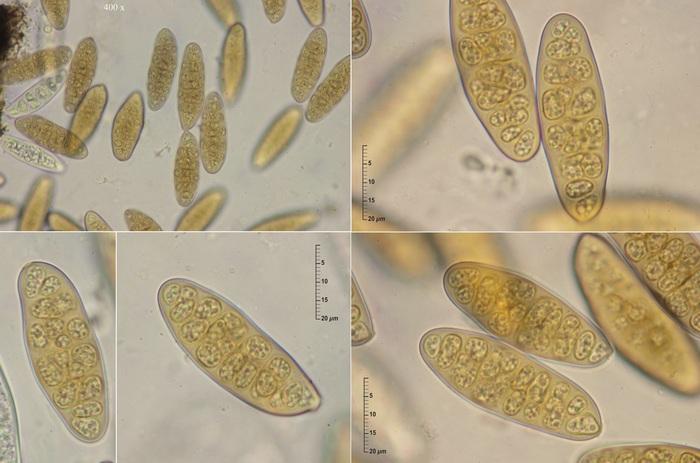

They may indeed be an anamorphic stage of the Splanchnonema, a fungus I do not know; but these are not the conidia of a Hendersonia in the traditional sense of a fungus with transverse true septa only - your fungus is distoseptate and muriform. It resembles species of Steganosporium (which are indeed anamorphic Splanchnonema).
best wishes
Chris
Thanks again

Hi Enrique,
yes, this should be Hendersonia carpini Sacc. (a younger homonym of Hendersonia carpini Otth which should represent something different). This species has recently been newly described in Persoonia as Camarographium carpini by Melnik et al. (see attachment). Published sequence data place it within Pleosporales.
Btw, Stegonsporium ("Steganosporium") is not an anamorphic Splanchnonema, but the anamorph of Prosthecium spp. on Acer (Diaporthales), see Voglmayr & Jaklitsch 2008: Prosthecium species with Stegonsporium anamorphs on Acer, Mycological Research 112: 885-905.
best wishes,
Hermann
 Camarographium-carpini-FungalPlanet100-0001.pdf
Regards
Enrique