
27-04-2026 18:48
Tony MoverleyCollected 23rd April 2026, Norfolk, EnglandSwarms
27-04-2026 17:41
 Lothar Krieglsteiner
.. Algarve, same leaf than the last post. The con
27-04-2026 18:05
Lothar Krieglsteiner
... still attached at standing tree. The green con
27-04-2026 17:16
Lothar Krieglsteiner
.. Algarve, moist lying.The conidiomata look like
27-04-2026 12:54
Steve ClementsBonjour. Ce petit champignon blanc résupiné et
27-04-2026 09:59
Pauline. PennaBonjour Can anyone advise me on these pycnidia fo

22-04-2026 20:54
 Enrique Rubio
Hi to everybody.This Pyrenopeziza grew in moist le
24-04-2026 03:16
 David Chapados
Found while looking at something else from wood in
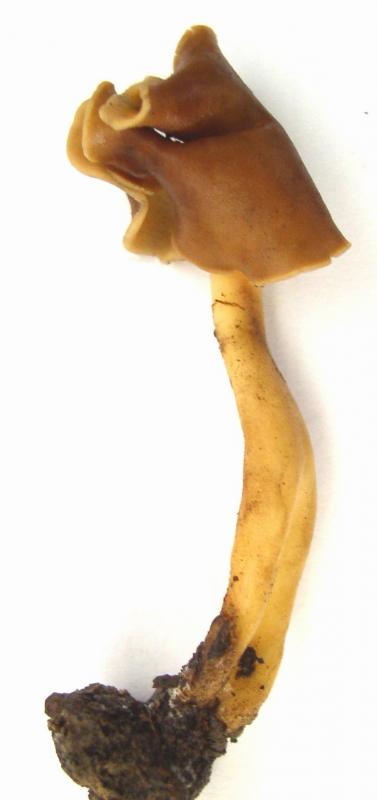
A Helvella from Iran
Reza Shaian,
24-01-2013 10:12
Cap up to 2 cm, irregularly lobed; inrolled; free from stipe, upper surface brown, undersurface cream to pale brown, pubescent,
Stipe up to 5 cm long, up to 1 cm wide, white to cream.
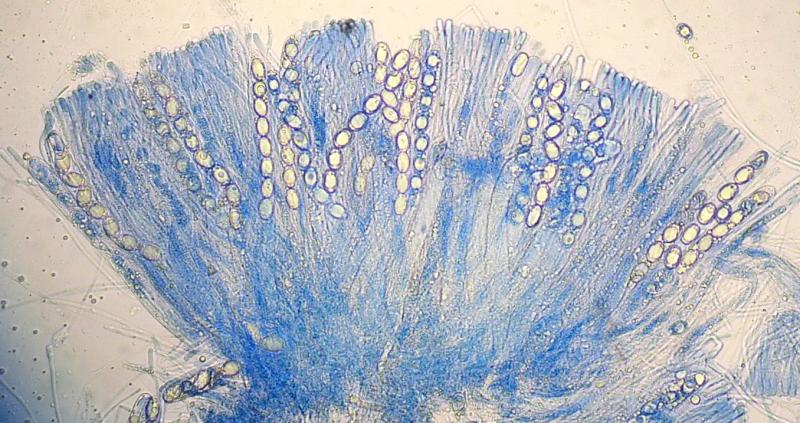
Spores 19-22 x 11.5-14.5, elliptical, smooth; with one large oil droplet.
Paraphyses with subclavate to clavate apices
?
Nicolas VAN VOOREN,
24-01-2013 10:24

Re : A Helvella from Iran
Hello.
Difficult to say something with only one specimen... Three species could be investigated: Helvella latispora, H. albella and H. elastica (although the latter is less obvious).
More data about the cells on the outer surface will be useful, and also on the ecology.
Is there a brown pigment into the paraphyses?
Difficult to say something with only one specimen... Three species could be investigated: Helvella latispora, H. albella and H. elastica (although the latter is less obvious).
More data about the cells on the outer surface will be useful, and also on the ecology.
Is there a brown pigment into the paraphyses?
Landeros Fidel,
24-01-2013 13:27
Re : A Helvella from Iran
I agree with Nicolas, we need more data to help you. I would add another species, Helvella stevensii. If it is pubescent (i.e., hyphal fascicles more than 50 micrometers), I do not think it is H. elastica, and by the apothecium colour it could not be H. albella or H. compressa (the latter endemic to the west coast of North America ). So I think it could be between H. latispora and H. stevensii ... I recommend also check if it have dextrinoid tissues...
Best,
Fidel
Best,
Fidel
Mario Filippa,
24-01-2013 22:13
Re : A Helvella from Iran
Nicolas have right, it is in Sectio Elasticae, and Fidel correctly excluded H. elastica for the pubescent undersurface. I add that the margin in some points seems slightly inrolled (this should be much more evident in the young ascomata), excluding once again H. elastica.
If we believe in the spore size given by Boudier when describing H. latispora, your collection should be H. stevensii, as far as we consider separated these last two.
Regards
Mario
If we believe in the spore size given by Boudier when describing H. latispora, your collection should be H. stevensii, as far as we consider separated these last two.
Regards
Mario