
28-04-2026 22:51
 Bernard CLESSE
Bonsoir à toutes et tous,Pourriez-vous m'aider à

28-04-2026 21:50
 Pablo Sandoval
Hola a todos,Espero se encuentren bien. Hace mucho
27-04-2026 18:05
 Lothar Krieglsteiner
... still attached at standing tree. The green con
28-04-2026 20:33
Vitus SchäfftleinHello, I found Trochila ilicina on Ilex aquifoliu
28-04-2026 20:07
Lothar Krieglsteiner
... on twig in the air at standing Ceratonia siliq
27-04-2026 20:52
Lothar Krieglsteiner
Found on hanging tiwg of Olea europaea in dried-ou
27-04-2026 18:48
Tony MoverleyCollected 23rd April 2026, Norfolk, EnglandSwarms
27-04-2026 17:41
Lothar Krieglsteiner
.. Algarve, same leaf than the last post. The con
27-04-2026 17:16
Lothar Krieglsteiner
.. Algarve, moist lying.The conidiomata look like
Discomycete from old polypore Gloeophyllum abietinum
Alex Akulov,
21-09-2010 12:46
 Dear Colleagues.
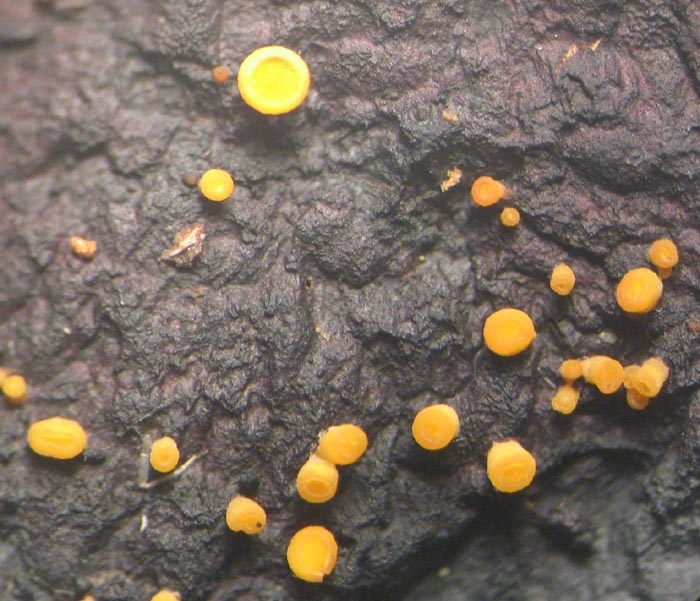
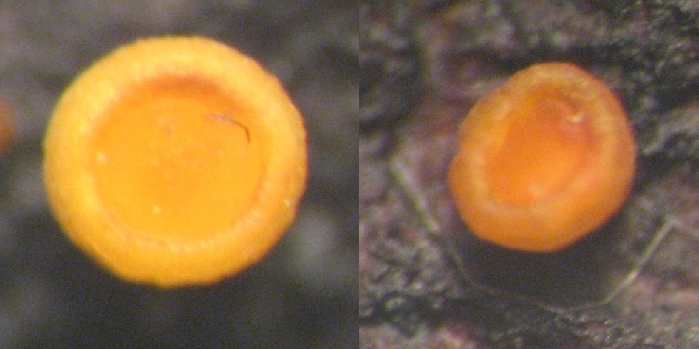
Please advise, what could be the mysterious sample of discomycete from Carpathians (Ukraine). Ascomata formed on the old fruit body of polypore Gloeophyllum abietinum on fallen Picea abies trunk. Apothecia are small, gregarious, yellowish-orange, slightly immature. Asci, lanceolate, about 100 x 6,3 microns. Paraphyses are very numerous, filiform, uniform width of about 1,5 microns, branched at the base. Ascospores are one-celled, oval or fusiform, with one large and several smaller guttules inside.
I suppose that in mature specimens the size of asci and spores may be somewhat larger.
I would be very glad for any ideas.
Waiting for answers,
Alex
Alex Akulov,
21-09-2010 12:47
Re:Discomycete from old polypore Gloeophyllum abietinum
apothecia
Hans-Otto Baral,
21-09-2010 13:08

Re:Discomycete from old polypore Gloeophyllum abietinum
any IKI reaction of the asci?
Zotto
Zotto
Alex Akulov,
21-09-2010 13:26
Re:Discomycete from old polypore Gloeophyllum abietinum
In Lugol paraphyses quickly acquire color of iodine, their tops are slightly amyloid.
Asci with amyloid apical ring.
Alex
Asci with amyloid apical ring.
Alex
Hans-Otto Baral,
21-09-2010 18:10
Re:Discomycete from old polypore Gloeophyllum abietinum
Well this needs some microphotos and a spore size. Could be a Hymenoscyphus (Phaeohelotium).
Zotto
Zotto