
28-04-2026 22:51
 Bernard CLESSE
Bonsoir à toutes et tous,Pourriez-vous m'aider à

28-04-2026 21:50
 Pablo Sandoval
Hola a todos,Espero se encuentren bien. Hace mucho
27-04-2026 18:05
 Lothar Krieglsteiner
... still attached at standing tree. The green con
28-04-2026 20:33
Vitus SchäfftleinHello, I found Trochila ilicina on Ilex aquifoliu
28-04-2026 20:07
Lothar Krieglsteiner
... on twig in the air at standing Ceratonia siliq
27-04-2026 20:52
Lothar Krieglsteiner
Found on hanging tiwg of Olea europaea in dried-ou
27-04-2026 18:48
Tony MoverleyCollected 23rd April 2026, Norfolk, EnglandSwarms
27-04-2026 17:41
Lothar Krieglsteiner
.. Algarve, same leaf than the last post. The con
27-04-2026 17:16
Lothar Krieglsteiner
.. Algarve, moist lying.The conidiomata look like
Ciboria americana?
Raúl Tena Lahoz,
16-09-2010 11:15
 Hi again!
Yesterday I found this Ciboria on a Quercus pyrenaica stromatized fruit. A stromatized area can be found at the base of the apothecia. Because Ciboria batschiana has always two nucleus?, it cannot be my species. I see that there is other species on the same host: Ciboria americana. So my question is if mine can be Ciboria americana.
Spores with one nucleus: 9-12 x 4-5 µm, nearly no oil drops, with spore sheath.
Paraphyses with one large refractive VB in the upper segment, width up to 4-5,5 µm.
Subhymenium slightly brown-pigmented, reactng light blue in IKI and enhanced in IKI after KOH.
Medulla: more or less hyaline textura intricata parallel to hymenium, also a bit reacting light blue in IKI but only noticed after KOH.
Asci: up to 95 x 9,5 µm, arising from croziers, euamyloid, Sclerotinia-type.
Ectal excipulum composed by pigmented (brown-reddish) rounded cells which protrude at margin and in outermost cells. Some bear VBs. No reaction in IKI, even after KOH.
I think there is enough data in the PDF file, but I have more photos if you need.
Thanks in advance,
Raúl.
 12878.pdf
Hans-Otto Baral,
16-09-2010 12:56

Re:Ciboria americana?
Yes, C. americana has binucleate spores in my experience, also usually rather long apo-stipes. I think it is C. americana.
The VBs coagulate when the cells die, yes, later they might get brownish by oxidation.
Your "dead" paraphyses are eprhaps only young ones without VBs. Look vacuolated.
Zotto
The VBs coagulate when the cells die, yes, later they might get brownish by oxidation.
Your "dead" paraphyses are eprhaps only young ones without VBs. Look vacuolated.
Zotto
Nicolas VAN VOOREN,
16-09-2010 13:13

Re:Ciboria americana?
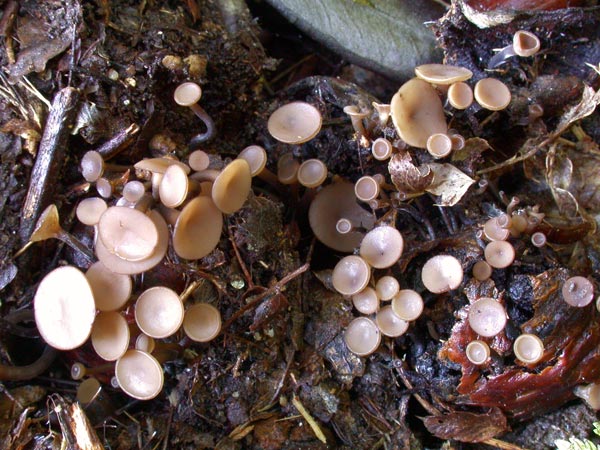
Here is a picture of Ciboria americana, collected on chesnut (Castanea sativa), in Corsica, october 2009.
Raúl Tena Lahoz,
16-09-2010 14:54
Re:Ciboria americana?
Thanks Zotto
I guess that where you say: "Yes, C. americana has binucleate spores in my experience, also usually rather long apo-stipes.", you wanted to say: "Yes, C. batschiana has binucleate spores in my experience, also usually rather long apo-stipes."
Mine are not binucleate.
Also, Ciboria americana has long stipe?
Merci Nicolas
Spores where binucleate in your collection?
Raúl
I guess that where you say: "Yes, C. americana has binucleate spores in my experience, also usually rather long apo-stipes.", you wanted to say: "Yes, C. batschiana has binucleate spores in my experience, also usually rather long apo-stipes."
Mine are not binucleate.
Also, Ciboria americana has long stipe?
Merci Nicolas
Spores where binucleate in your collection?
Raúl
Hans-Otto Baral,
16-09-2010 21:10
Re:Ciboria americana?
you are right, Raul, and I will not change that, otherwise your answer becomes weird. :-)
Obviously there are also long stipes possible. Have you a microphoto or drawing, Nicolas?
Zotto
Obviously there are also long stipes possible. Have you a microphoto or drawing, Nicolas?
Zotto