
21-04-2026 22:14
Margot en Geert VullingsThis cup fungus was found on April 10, 2026, on lo
21-04-2026 13:36
Gernot FriebesHi,I am out of ideas for this one. I collected Sal
21-04-2026 13:19
Gernot FriebesHi,this Lophodermium on Typha has ascospores measu
21-04-2026 13:05
Gernot FriebesHi,this hyphomycete feels familiar but I was not a
20-04-2026 22:00
 Malcolm Greaves
These pale yellow, hairy ascos were growing on cul
19-04-2026 21:23
Steve ClementsBonjour, I found this anamorphic fungus on old pl
19-04-2026 20:46
Steve Clements1 mm diameter approx spherical conidiophores on pl
12-04-2026 17:56
 Hardware Tony
Found on dead stems in February earlier this year
17-04-2026 19:16
 Enrique Rubio
Hi to everybodyI would appreciate any assistance r
Arachnopeziza aurelia !
Roland Labbé,
09-06-2009 17:21
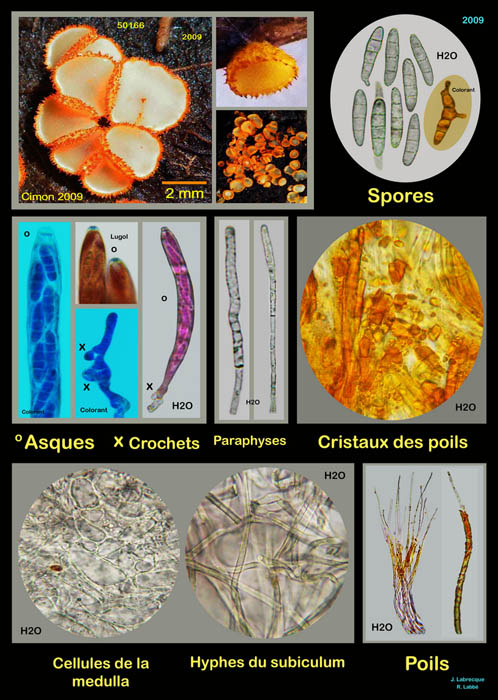
Voici un discomycète que nous croyons être Arachnopeziza aurelia.
Tous les éléments concordent en microscopie, mais la taille des apothécies semble
grande pour cette espèce, allant jusqu'à 5 mm de diam.
Que pensez-vous de cette identification ?
Merci, amitiés ! Roland
Détails :
Date de récolte: 2009/06/03
Substrat: écorce, bois nu, feuilles et ailes de fruit d'érable
Subiculum blanchâtre
Asques cylindriques, à 8 spores bisériées, avec crochet à la base et appareil apical fortement amyloïde, 90-100 x 9-10 µm
Paraphyses cylindriques, septées, contenant des globules, 105-115 x 2-3 µm, dépassant les asques de 5-10 µm
Spores ellipsoïdes-fusoïdes, à 3 septa, formant parfois des excroissances aux deux extrémités, légèrement jaunâtres en H2O, 19-25 x 4-5 µm, 21,8 x 4,3 µm en moyenne(20 spores), Q = 5,07
Medulla formé de cellules polymorphes, ellipsoïdes, globuleuses à ± cylindriques
Poils cylindriques, septés, contenus dans une gaine de cristaux jaune-roux vif, jusqu'à 300 µm x 4-5 µm
Subiculum formé d'hyphes à paroi mince, hyalines à légèrement jaunâtres, parfois finement incrustées, 3-4 µm de diam.
Richard Korf,
09-06-2009 18:17
Re:Arachnopeziza aurelia !
Hi, Roland,
Definitely A. aurelia. One of the spores you illustrate show thew gelatinous appendages on the ascospores. These usually disappoear in dried specimens and particularly if mounted in KOH. The spore size is within normal range for this species. All the substrates you mention are typical, also.
Dick Korf
Definitely A. aurelia. One of the spores you illustrate show thew gelatinous appendages on the ascospores. These usually disappoear in dried specimens and particularly if mounted in KOH. The spore size is within normal range for this species. All the substrates you mention are typical, also.
Dick Korf
Roland Labbé,
09-06-2009 18:41
Re:Arachnopeziza aurelia !
Thank you Dick.
What do you think about the apothecial size ?
We don't see that range in littérature, instead until 1 mm diam.
Roland
What do you think about the apothecial size ?
We don't see that range in littérature, instead until 1 mm diam.
Roland
Richard Korf,
09-06-2009 19:09
Re:Arachnopeziza aurelia !
Apothecial size is very often up to 3 or even 5 mm. The 1 mm maximum sounds like you are reading the size of A, aurata, not A. aurelia!
Dick
Dick
Hans-Otto Baral,
09-06-2009 20:16

Re:Arachnopeziza aurelia !
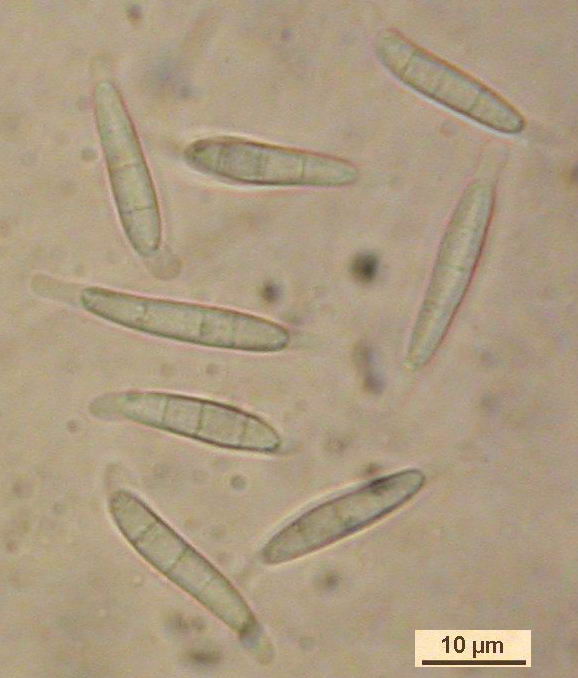
Yes, I found either 1-2 mm or 2-4 mm. All spores have these appendages when shot from the asci in water mounts, but they are easily overlooked.
here a find from W-France
Zotto
here a find from W-France
Zotto
Roland Labbé,
09-06-2009 21:57
Re:Arachnopeziza aurelia !
Merci à vous Dick et Hans.
Yours answers are quite just.
Friendly ! Roland
Yours answers are quite just.
Friendly ! Roland