
10-06-2026 13:41
 François Freléchoux
Bonjour à nouveau, Voici une trouvaille d'hier.
10-06-2026 11:53
Steve ClementsBonjour, This disco is abundant on dead stems of
10-06-2026 12:54
Steve ClementsBonjour encore, Pouvez-vous m'aider, s'il vous pl
10-06-2026 10:45
François Freléchoux
Bonjour à nouveau, Encore une détermination qui
08-06-2026 10:16
 Spooren Marco
I don`t have a clou about this fungus,it is not in
10-06-2026 09:24
François Freléchoux
Bonjour, J'imagine que cette détermination ne do
09-06-2026 18:32
Camille MertensSur morceau de roseau immergé 0,5 - 0,7 mm de dia
08-06-2026 17:00
François BartholomeeusenGood day everyone, On June 5 2026, I collected de
07-06-2026 15:10
 William Slosse
Hello everyone,On 05-06-26, I found following asco
Discomycète sp.
Roland Labbé,
21-03-2009 00:40
Voici un Disco inconnu de Québec.
Merci de vos réponses.
Amitiés ! Roland
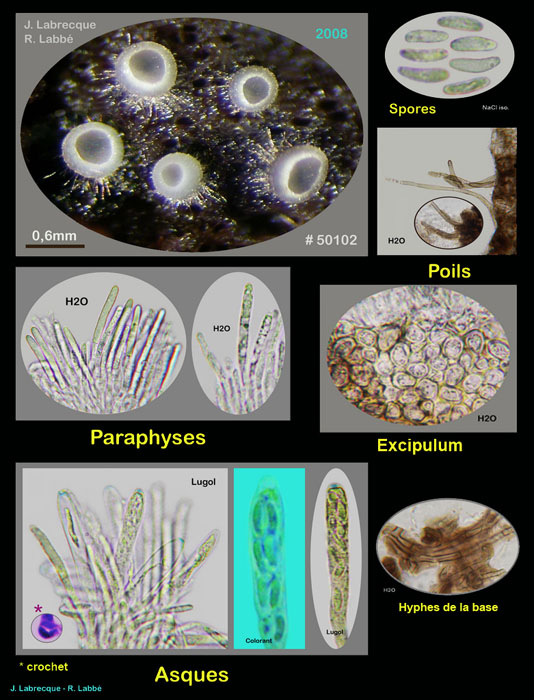
Détails :
Date de récolte: 2009 / 03 / 17
Substrat : culture intérieure sur bois de bûche d’érable rouge
Sporée non disponible
Spores cylindro-ellipsoïdes, lisses, 6,5-10 x 2-2,5µm, 7,6 x 2,2 en moyenne (10 spores), Q = 3,45
Asques à 8 spores bisériées, avec appareil apical amyloïde, 45-50 x 5 µm
Paraphyses cylindriques, parfois fourchues, à 1 septum, à contenu réfringent de 80-100%, 50-60 x 1,5-2,5µm
Excipulum en textura globulosa-angularis, formé de cellules sphériques à ellipsoïdes à paroi épaisse, brunes
Poils élargis à la base, atténués à l'apex, à paroi épaisse, bruns, > 100µm de longueur
Hyphes arrivant de la base
Guy Garcia,
21-03-2009 07:08
Re:Discomycète sp.
un mollisia
Hans-Otto Baral,
21-03-2009 12:02

Re:Discomycète sp.
Hi Roland
you may test Gminder's key: http://www.mollisia.de/start.html
Chose your language on the left. Important is to check the yellow-KOH-reaction, which is explained in Gminder's introduction
Zotto
you may test Gminder's key: http://www.mollisia.de/start.html
Chose your language on the left. Important is to check the yellow-KOH-reaction, which is explained in Gminder's introduction
Zotto
Roland Labbé,
28-03-2009 01:20
Re:Discomycète sp.
Hi Zotto !
Unfortunatly, we have no more specimens to do the test of KOH.
Those we haved have served to make the plate.
We observe again the wood if new grows wil appear.
I will give more information.
How can we try an identification of this Mollisia without this test ?
Roland
Unfortunatly, we have no more specimens to do the test of KOH.
Those we haved have served to make the plate.
We observe again the wood if new grows wil appear.
I will give more information.
How can we try an identification of this Mollisia without this test ?
Roland
Hans-Otto Baral,
28-03-2009 10:58
Re:Discomycète sp.
Dear Roland
I my opinion the identification without the KOH-test is impossible. The characters of your specimen are quite banal. In this genus species limits in many taxa are far from clear, so we need every character, and can only hope to find species concepts in the future by collecting data.
Zotto
I my opinion the identification without the KOH-test is impossible. The characters of your specimen are quite banal. In this genus species limits in many taxa are far from clear, so we need every character, and can only hope to find species concepts in the future by collecting data.
Zotto