

19-05-2026 10:27
Patrice TANCHAUDBonjour, récolte récente sur terre retournée i
04-06-2026 18:39
Gernot FriebesHi,I collected this species in two different locat
22-05-2026 13:29
Gernot FriebesHi,I am curious to hear your opinion on this mater
04-06-2026 10:50
 François Freléchoux
Bonjour, J'ai trouvé hier un petit asco observé
04-06-2026 07:02
François Freléchoux
Bonjour, Voici la description d'une espèce qui p
04-06-2026 13:34
Gernot FriebesHi,I am interested to hear your opinion on this Le
04-06-2026 11:36
Gernot FriebesHi,found on Vaccinium myrtillus.Asci: IKI –, 8-s
Black balls on Ulex
Enrique Rubio,
19-01-2022 10:25
 Hi Forum
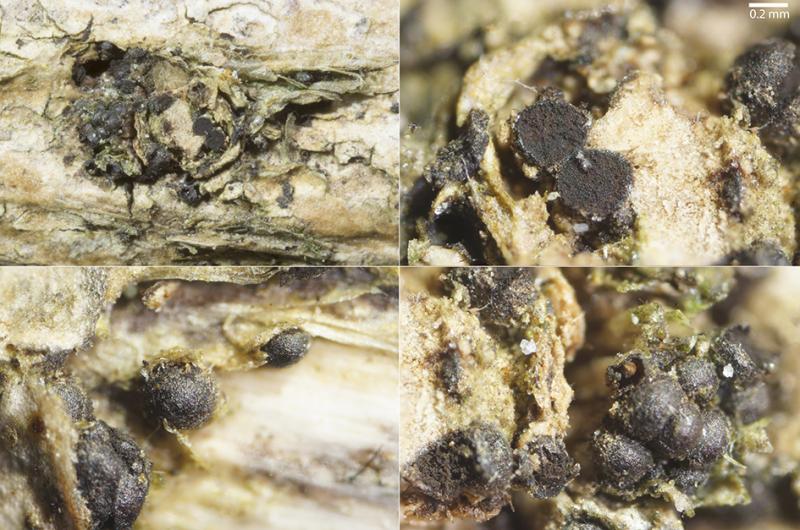
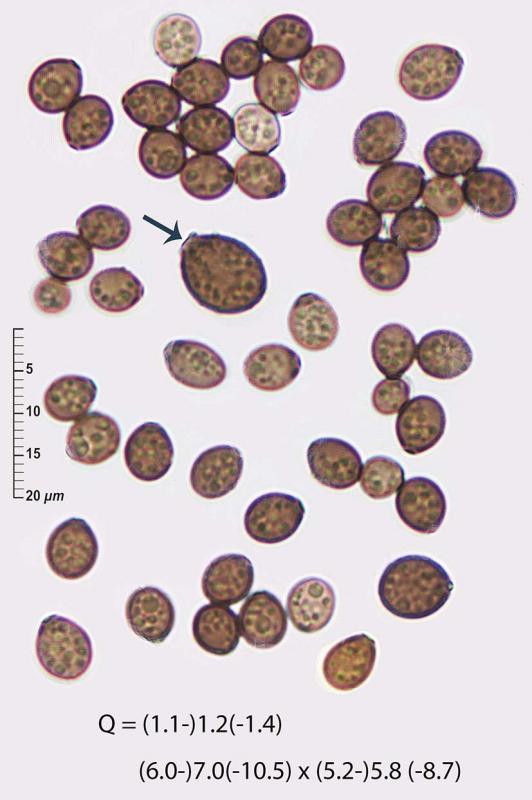
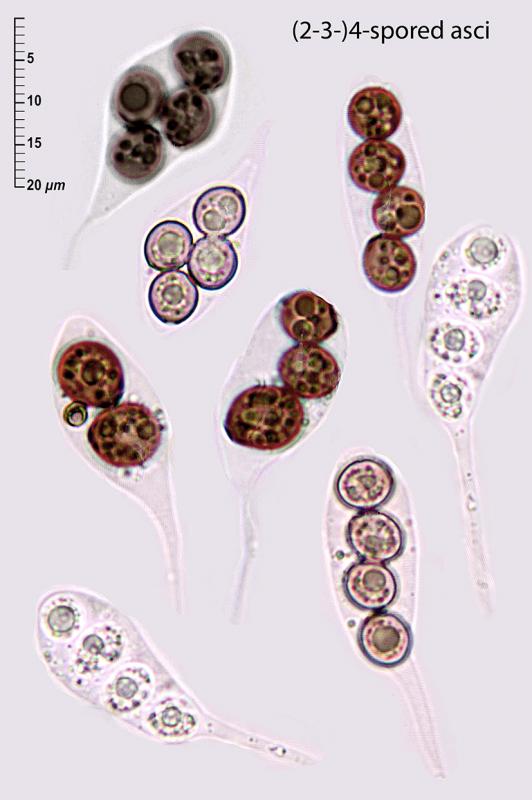
The ascomata of this fungus grew on corticated wood of Ulex europaeus, making cleistothecia (apparently non-ostiolate), blackish-brown, up to 0.5 mm in diameter, erumpent, isolated or coalescent and more or less spherical. The evanescent asci are claviform, pedicellate and contain (2-3-)4 dark brown spores with an apical pore, probably also monosporic since some excessively large spores may be seen.
At the end, the contents of the ascomata are powdery and consisting of a large cluster of spores and the asci disappear.
I wonder if this fungus could be well accommodated in the monospecific genus Boothiella, although it is different from Boothiella tetraspora, with larger cylindrical asci and larger and different spores.
Many thanks in advance for your opinions.
David Malloch,
19-01-2022 15:21

Re : Black balls on Ulex
The spores immediately remind me of Copromyces bisporus N. Lindq. However, that species has two-spored asci and grows on dung. Maybe a related species?
David Malloch,
19-01-2022 15:31
Re : Black balls on Ulex
I worked on cleistothecial fungi for my Ph.D. about 50 years ago. Here is a plate I prepared for Copromyces and similar things. http://website.nbm-mnb.ca/mycologywebpages/EssaysOnFungi/Cleistothecial_Ascomycota/Cleistothecial_Ascomycota-Plate04.html. The comments are more recent.
Enrique Rubio,
19-01-2022 16:26
Re : Black balls on Ulex
Thanks a lot, David.