
10-06-2026 12:54
Steve ClementsBonjour encore, Pouvez-vous m'aider, s'il vous pl
10-06-2026 11:53
Steve ClementsBonjour, This disco is abundant on dead stems of
10-06-2026 10:45
 François Freléchoux
Bonjour à nouveau, Encore une détermination qui
08-06-2026 10:16
 Spooren Marco
I don`t have a clou about this fungus,it is not in
10-06-2026 09:24
François Freléchoux
Bonjour, J'imagine que cette détermination ne do
09-06-2026 18:32
Camille MertensSur morceau de roseau immergé 0,5 - 0,7 mm de dia
08-06-2026 17:00
François BartholomeeusenGood day everyone, On June 5 2026, I collected de
07-06-2026 15:10
 William Slosse
Hello everyone,On 05-06-26, I found following asco
05-06-2026 11:02
Thomas Læssøehttps://svampe.databasen.org/observations/10596691
helotiaceae ?
michel hurtu,
23-02-2009 20:47
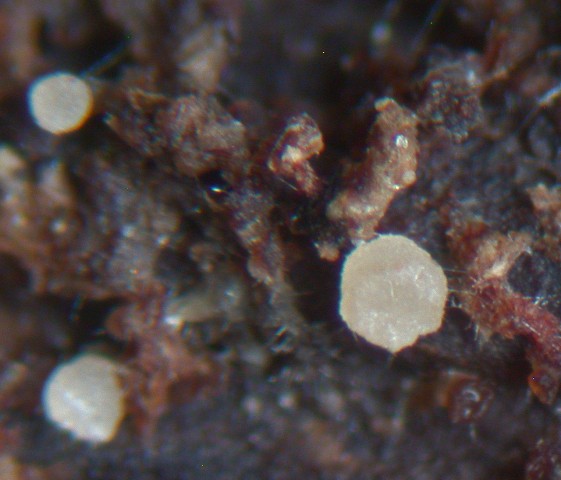
En forme de coupe ou coussinet ,sessile, 0,2 à 1 mm de diamètre,en troupe sur une petite branche de pin noir.
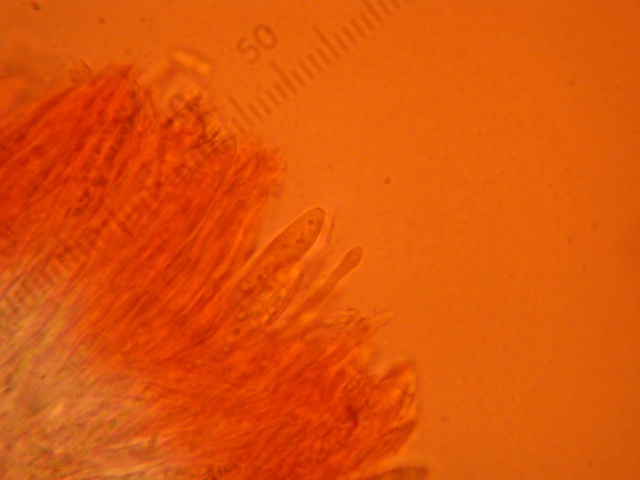
spores septées 10-12x2,5-3
asques 70x10
paraphyses septées 65x2,5 parfois légèrement enflées au sommet
I+ visible q'après passage dans KOH.
J'avais pensé à Phaeohelotium subcarneum , mais les spores ici sont septées.
merci de votre aide.
michel hurtu
michel hurtu,
23-02-2009 20:49
Re:helotiaceae ?
suite :
michel hurtu,
23-02-2009 20:50
Re:helotiaceae ?
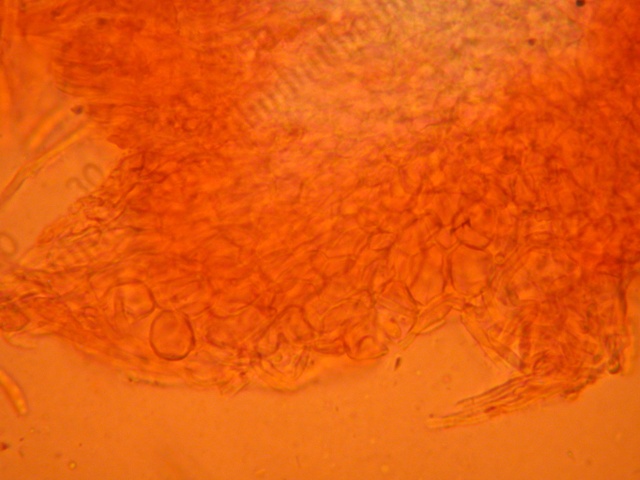
l'exipulum :
michel hurtu,
23-02-2009 20:52
Re:helotiaceae ?
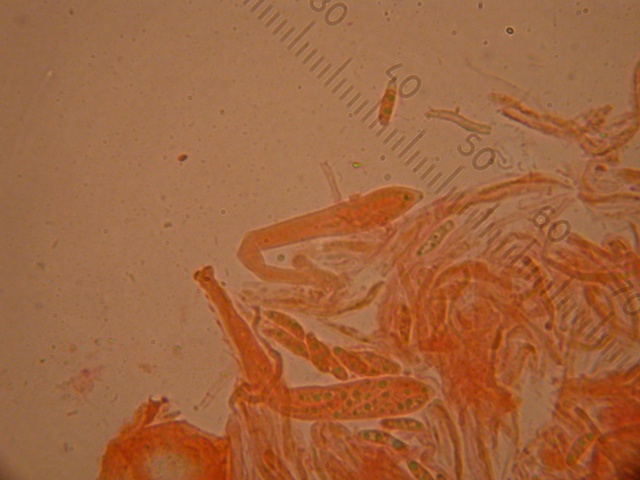
asque :
michel hurtu,
23-02-2009 20:53
Re:helotiaceae ?
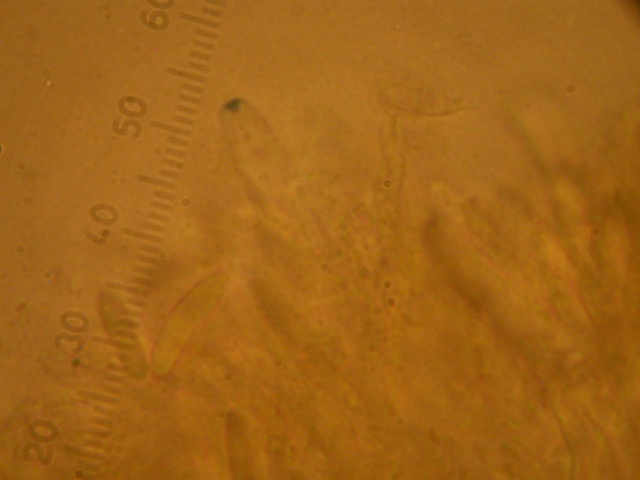
Melzer après passage dans KOH.
Hans-Otto Baral,
23-02-2009 22:40

Re:helotiaceae ?
Hi Michel
that will be very difficult to resolve. First, if you tried to identify with Breitenbach & Kränzlin, that subcarneum there is Hymenoscyphus/Phaeohelotium imberbis.
Yours has a Calycina-type of apical ring and therefore should belong in the Hyaloscyphaceae. Important are the oil drops in the spores which are quite large.
It could be a Calycina. but the only one I have with 1-septate spores on conifer: "Septopezizella" oreadum, has spores with only few small LBs.
Could you please check whether the ring is hemiamyloid (red in Lugol)? And whether the asci have croziers? Further, could you make a mount in water without pressing, in order to see the living asci and especially paraphyses and their contents? Are there any short hairs on the exterior?
Zotto
that will be very difficult to resolve. First, if you tried to identify with Breitenbach & Kränzlin, that subcarneum there is Hymenoscyphus/Phaeohelotium imberbis.
Yours has a Calycina-type of apical ring and therefore should belong in the Hyaloscyphaceae. Important are the oil drops in the spores which are quite large.
It could be a Calycina. but the only one I have with 1-septate spores on conifer: "Septopezizella" oreadum, has spores with only few small LBs.
Could you please check whether the ring is hemiamyloid (red in Lugol)? And whether the asci have croziers? Further, could you make a mount in water without pressing, in order to see the living asci and especially paraphyses and their contents? Are there any short hairs on the exterior?
Zotto
Stip Helleman,
23-02-2009 23:41

Re:helotiaceae ?
Hi Michel & Zotto,
I was thinking about pseudohelotium sordidulum but there are the spores too short, croziers are present for sure, you can tell from the CR photo with 2 CR+ attachment points.
Stip
I was thinking about pseudohelotium sordidulum but there are the spores too short, croziers are present for sure, you can tell from the CR photo with 2 CR+ attachment points.
Stip
Hans-Otto Baral,
24-02-2009 00:25
Re:helotiaceae ?
yes, Stip, Pseudohelotium is a good idea. But I also can't remember a species with such short spores. Croziers +, yes, clearly!
Zotto
Zotto
michel hurtu,
24-02-2009 15:01
Re:helotiaceae ?
Thank you Zotto and Stip for your answer.
1. I don't see any hairs with my magnifying glass.
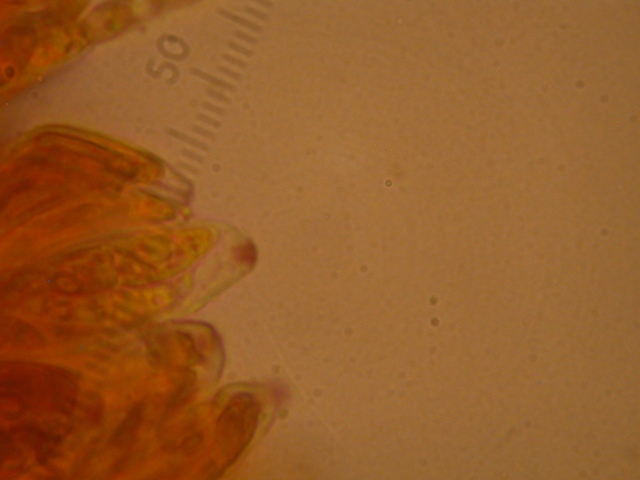
2.Here included the pictures you asked me for.
ascus with Lugol without KOH
1. I don't see any hairs with my magnifying glass.
2.Here included the pictures you asked me for.
ascus with Lugol without KOH
michel hurtu,
24-02-2009 15:07
Re:helotiaceae ?
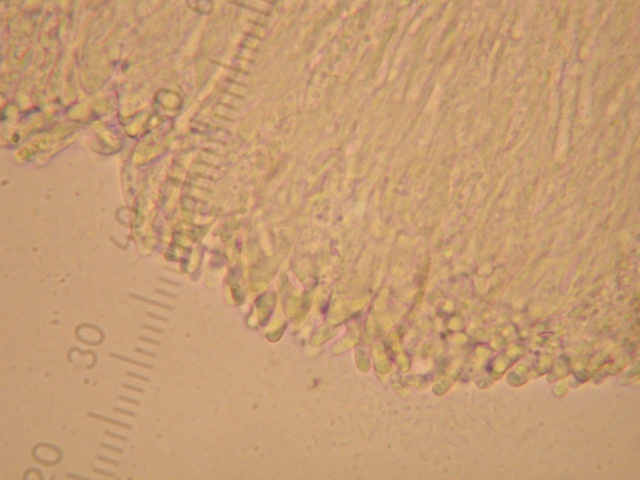
And now the mount in water without pressing.
Does the fourth picture of the ascus with croziers is enough for you because it is the only one I could see.
michel
Does the fourth picture of the ascus with croziers is enough for you because it is the only one I could see.
michel
Hans-Otto Baral,
24-02-2009 16:43
Re:helotiaceae ?
Hi Michel
fine, the asci are hemiamyloid (nicely red). The paraphyses I am not sure, look a bit like being guttulate. I am not sure that they are still alive because they lie too much over another. Perhaps you should better have slightly squashed, sorry :-(
And I have still not at all an idea about the genus, sorry. If you wish you can send it to me, but I cannot promise anything.
Zotto
fine, the asci are hemiamyloid (nicely red). The paraphyses I am not sure, look a bit like being guttulate. I am not sure that they are still alive because they lie too much over another. Perhaps you should better have slightly squashed, sorry :-(
And I have still not at all an idea about the genus, sorry. If you wish you can send it to me, but I cannot promise anything.
Zotto