
08-06-2026 10:16
 Spooren Marco
I don`t have a clou about this fungus,it is not in
10-06-2026 09:24
 François Freléchoux
Bonjour, J'imagine que cette détermination ne do
09-06-2026 18:32
Camille MertensSur morceau de roseau immergé 0,5 - 0,7 mm de dia
08-06-2026 17:00
François BartholomeeusenGood day everyone, On June 5 2026, I collected de
07-06-2026 15:10
 William Slosse
Hello everyone,On 05-06-26, I found following asco
05-06-2026 11:02
Thomas Læssøehttps://svampe.databasen.org/observations/10596691
07-06-2026 12:09
François Freléchoux
Bonjour, Voici une brève description de ce qui m
07-06-2026 12:43
Steve ClementsBojour. This was a strange find on a stick on my
12-07-2015 00:05
 Nedim Jukic
This one from the same locality as the previous on
Bisporella like
Yannick Mourgues,
30-01-2009 00:30
 Hi.
Hi.Here is a specie near B. subpallida. I need your help to know if it's right or wrong.
Macro:
ap. bright yellow, short-stalked, on rotten wood of Fagus or Fraxinus (difficult to know), diam.<0,5 mm. reddening when dammaged.
Micro:
Sp. scutuloid, 6,5-7,6x3-3,3 µm, no septate, Q=2-2,4, with 2 small guttules at each end.
Paraph. with refractive vacuoles <1 µm , Paraph. 1 septate, green inside in Lugol, l<2 µm.
Asc. IKI+ (very difficult to see..., so may be IKI-), croziers +, 70-100x4-6 µm.
What do you think about that ?
Yannick
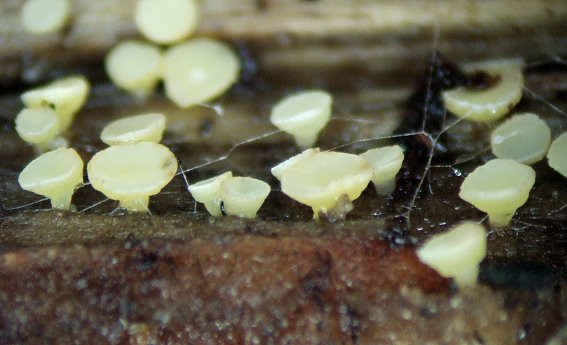
Yannick Mourgues,
30-01-2009 00:30
Re:Bisporella like
Macro...
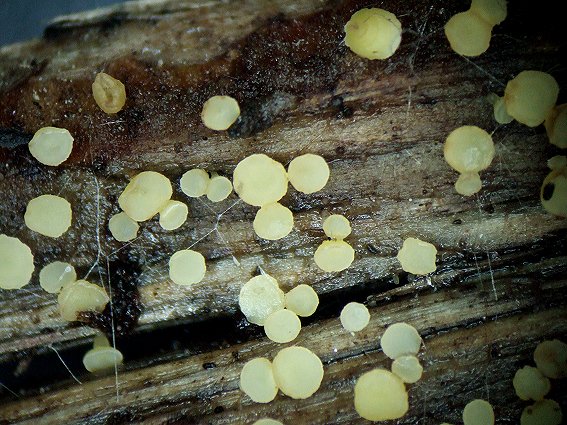
Yannick Mourgues,
30-01-2009 00:32
Re:Bisporella like
spores in H2O ...
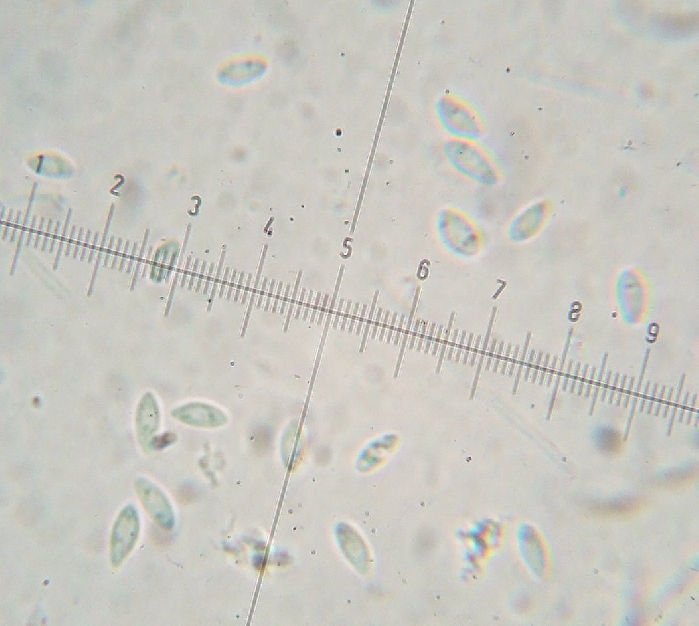
Yannick Mourgues,
30-01-2009 00:33
Re:Bisporella like
paraphyses in H2O...
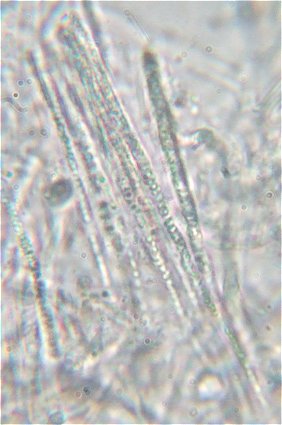
Richard Korf,
30-01-2009 00:55
Re:Bisporella like
Surely looks like a Bisporella, but that may be a MUCH larger genus than anyone has expected. We have no monograph (that I know of).
Guy Garcia,
30-01-2009 11:50
Re:Bisporella like
Faudrait vérifier si l'excipulum réagit en bleu ciel avec le lugol ou le melzer, ce qui est le cas pour Bisporella subpallida. Si la réaction est négative; voir du côté de Bisporella rubescens.
Comme Dick le signale le genre Bisporella est assez confus. De plus, de nombreux taxons publiés entre autres dans le genre Calycella pourraient trouver leur place chez les Bisporella.
Vérifie aussi la structure de l'excipulum qui est caractérsitique dans le genre Bisporella : textura oblita (gélification).
Bon courage.
Amitiés, Guy
Comme Dick le signale le genre Bisporella est assez confus. De plus, de nombreux taxons publiés entre autres dans le genre Calycella pourraient trouver leur place chez les Bisporella.
Vérifie aussi la structure de l'excipulum qui est caractérsitique dans le genre Bisporella : textura oblita (gélification).
Bon courage.
Amitiés, Guy
Hans-Otto Baral,
30-01-2009 17:56

Re:Bisporella like
Guy is right, I would also look for the blue excipulum reaction (maybe only at the apothecial base) and believe that this is B. subpallida. I think, however, that Bisporella is heterogeneous. I only recognize two species in Bisporella s.str., B. subpallida and the type, B. pallescsens. Both have multiguttulate paraphyses and a Hymenoscyphus-type of ascus apex (quite faintly reacting, very different from the Calycina-type in "Bisporella" citrina and others which are surely closer to or even conspecific with Calycina. I remember that molecular data have proven this view.
I attach some images of a recent find (on Salix wood, Chemnitz).
Zotto
I attach some images of a recent find (on Salix wood, Chemnitz).
Zotto
Hans-Otto Baral,
30-01-2009 17:56
Re:Bisporella like
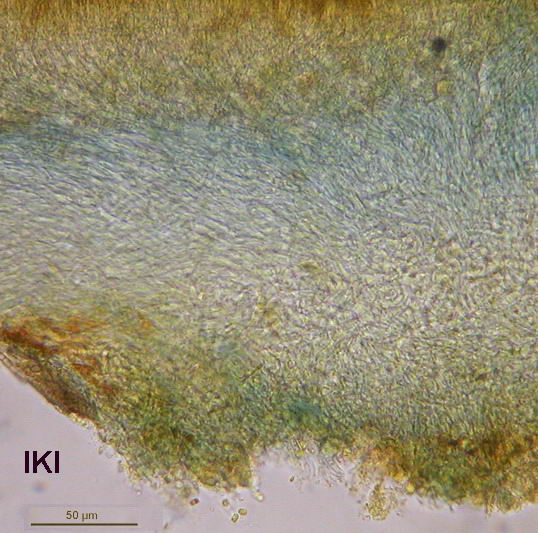
section of lower flanks, with gelatinized hyphae and guttulate cortical cells (live)
Hans-Otto Baral,
30-01-2009 17:57
Re:Bisporella like
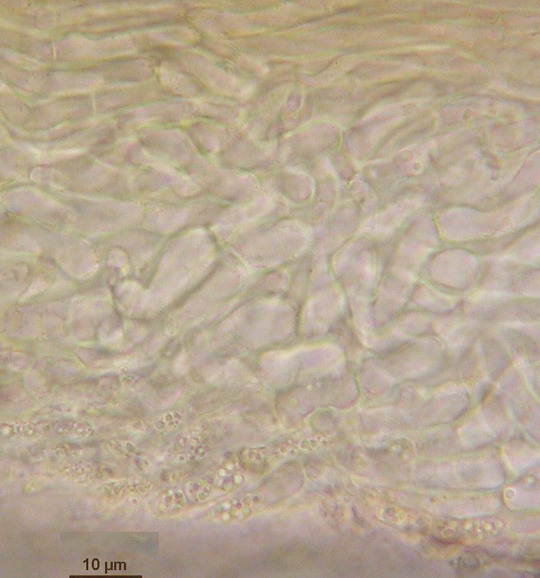
spores
Hans-Otto Baral,
30-01-2009 17:58
Re:Bisporella like
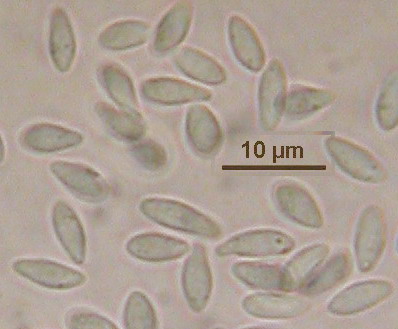
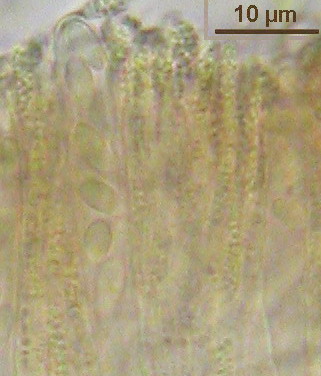
ascus and guttulate paraphyses (live)
Yannick Mourgues,
30-01-2009 21:29
Re:Bisporella like
Bonsoir et merci à tous les deux.
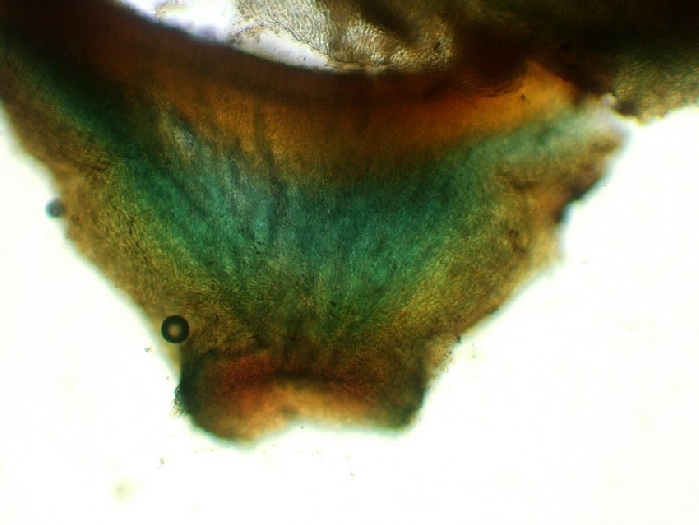
Je viens de vérifier la réaction d'une coupe dans le Lugol, et l'excipulum réagit bien en bleu.
La textura est bien oblita comme vous l'avez dit.
Je peux donc conclure pour Bisporella subpallida ?
I have just checked the blue excipulum reaction and it's positive.
Textura is oblita.
So can I conclude for Bisporella subpallida ?
Avez-vous déjà constaté que :
1. les apothécies deviennent rouges à la blessure ?
2. le contenu des paraphyse devient vert dans le Lugol ?
Have you ever noted that :
1. apo. are reddening when dammaged ?
2. paraph. becomes green inside with Lugol ?
Thank's a lot.
Yannick
Je viens de vérifier la réaction d'une coupe dans le Lugol, et l'excipulum réagit bien en bleu.
La textura est bien oblita comme vous l'avez dit.
Je peux donc conclure pour Bisporella subpallida ?
I have just checked the blue excipulum reaction and it's positive.
Textura is oblita.
So can I conclude for Bisporella subpallida ?
Avez-vous déjà constaté que :
1. les apothécies deviennent rouges à la blessure ?
2. le contenu des paraphyse devient vert dans le Lugol ?
Have you ever noted that :
1. apo. are reddening when dammaged ?
2. paraph. becomes green inside with Lugol ?
Thank's a lot.
Yannick
Guy Garcia,
30-01-2009 22:44
Re:Bisporella like
Personnellement je n'ai étudié que 2 récoltes de Bisporella subpallida (dont une de Gérard Trichies) et je n'ai pas souvenir ni noté un verdissement du contenu des paraphyses dans le lugol ? Mais, il me semble, à la vue de ta photo, que ton récatif doit être très concentré !
Quant au rougissement voir la fiche de récolte HB 6069E (sur DVD de Zotto).
Quant au rougissement voir la fiche de récolte HB 6069E (sur DVD de Zotto).
Yannick Mourgues,
30-01-2009 22:52
Re:Bisporella like
Ok, merci pour ces précisions.
Amitiés.
Yannick
Amitiés.
Yannick
Hans-Otto Baral,
30-01-2009 23:33
Re:Bisporella like
Oh yes, Guy, that 6069 is a third apparently true Bisporella, though it resembles also Hymenoscyphus kathiae, were not the strong oblita. Yes, this reddening is due to an oxidation process of the VBs (paraphysis vacuolar guttules).
No, I also cannot remember to have seen a greenish reaction in IKI. Usually one gets a yellowish to red-brown reaction of VBs in IKI.
Zotto
No, I also cannot remember to have seen a greenish reaction in IKI. Usually one gets a yellowish to red-brown reaction of VBs in IKI.
Zotto
Yannick Mourgues,
30-01-2009 23:35
Re:Bisporella like
Thank's Zotto !
Yannick
Yannick