

30-05-2026 21:12
Philippe PELLICIERSur branche de mélèze (Larix) près de la neige,
31-05-2026 10:35
Hulda Caroline HolteHello,I collected this species growing on a rather
25-05-2026 16:35
 Bernard CLESSE
Bonjour à toutes et tous,J'ai trouvé récemment,
29-05-2026 15:35
daniel FERREBonjour à tous,Je voudrais votre aide pour cette
28-05-2026 16:15
James MitchellHello,Does anyone have the original publication of
28-05-2026 11:06
Thomas Læssøehttps://svampe.databasen.org/observations/10596750
23-05-2026 11:44
 Charles Grapinet
Hello, I am having trouble identifying this copro
25-05-2026 16:44
François BartholomeeusenHi forum members,During an excursion organised by
26-05-2026 21:25
Dirk GerstnerHello everyone, I'm completely stumped by this li
Saccobolus eleutherosporus
Chris Yeates,
22-01-2020 14:17

Bonjour tous
This post also links to http://www.ascofrance.com/search_forum/4310 and http://www.ascofrance.com/search_forum/5182
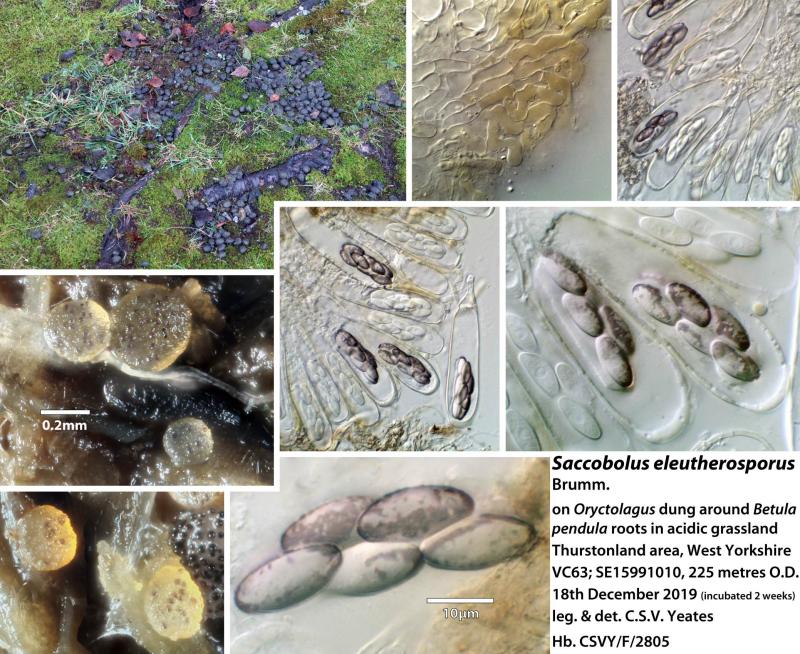
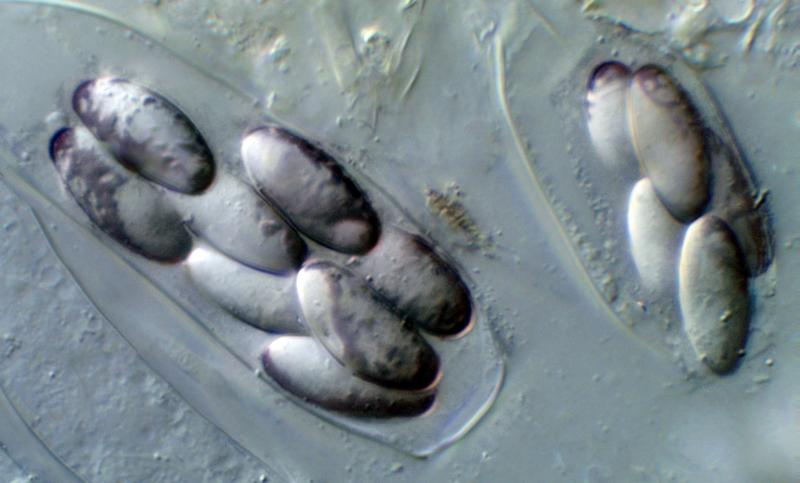
This rarely-reported Saccobolus has turned up in England - first found by Nick Aplin in October 2017 in East Sussex. I have recently collected it in West Yorkshire, 300 kilometres to the NW.
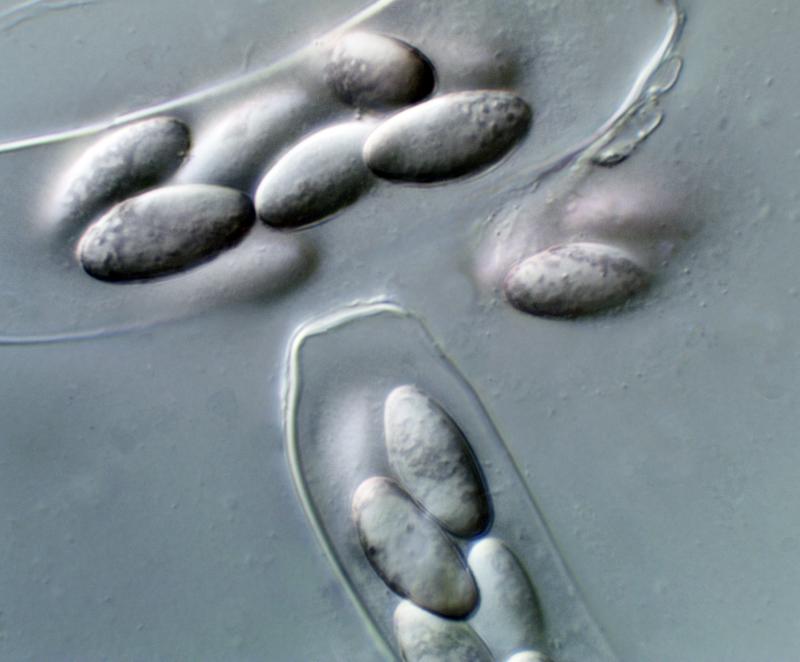
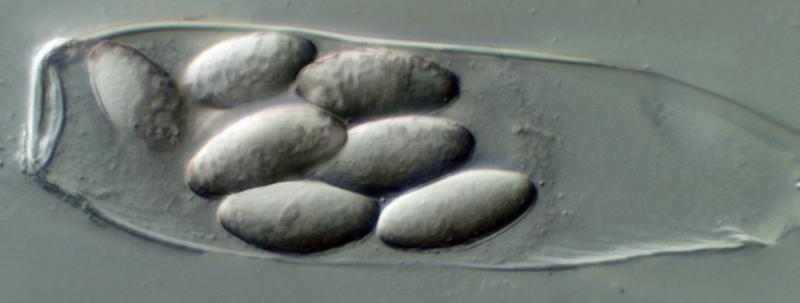
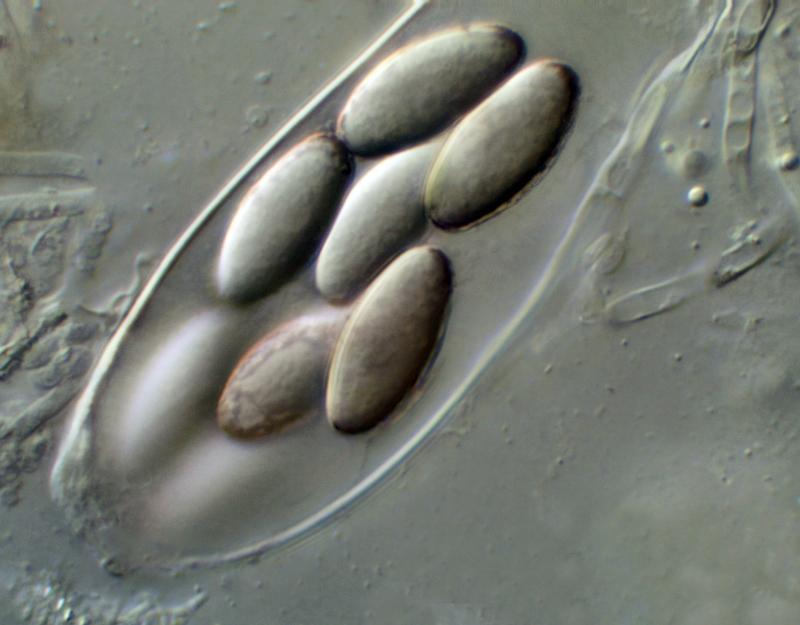
As can be seen from the composite image the spores have scattered ornamentation, pale for Saccobolus. In the first collection the spores barely became "free" - an important character in S. eleutherosporus. So a week ago I collected more from the same site (last four images). In what is clearly the same fungus the spores had paler pigmentation than the previous collection and showed all stages from spores "in formation" to totally dissociated ones (the latter very obvious when discharged from the ascus). Indeed it seemed as though the heavier and darker the pigmentation the stronger the attachment of the spore-cluster. In all apothecia I examined there was yellow pigmentation in the paraphyses and often in the ectal excipulum - see image.
See also http://fungi.myspecies.info/all-fungi/saccobolus-eleutherosporus for the UK finds.
I do not think that either Nicolas' or Enrique's collections are S. eleutherosporus. I am puzzled by the apparent rarity of this fungus - there seem to be fewer than 10 authentic collections. Perhaps other AF members know of more than the ones already mentioned (something like 2 each from France, Belgium, Austria & UK).
Cordialement
Chris
Michel Delpont,
22-01-2020 18:08

Re : Saccobolus eleutherosporus
Good evening Chris.
The presence of what appears to be yellow pigment effectively raises a question; but perhaps it is a question of parasites external to the fungus. On the other hand, I have already found certain species of Saccobolus, such as Saccobolus depauperatus, with the presence of pigment in places. The age of apothecia at may also be of importance. Is this pigment present on all copies?
I think it is still despite everything Saccobolus eleutherosporus, which is not a very common fungus and often difficult to identify with certainty.
Amitiés.
Michel.
Peter Püwert,
22-01-2020 18:49

Re : Saccobolus eleutherosporus
Hello,
here is a link to a discussion in a forum, but unfortunately only in German.
Peter.
Chris Yeates,
22-01-2020 20:59
Re : Saccobolus eleutherosporus
Thank for the link Peter
I have no doubt that the collection is the same species as mine and Nick's. I may have missed it, where was the collection made? Presumably Germany, or perhaps Austria? In answer to Michel's question, there was almost always some yellow present, giving the apothecia that "sparkling wine" colour mentioned in the Pilzforum post.
I shall now think of myself as a Dungpilzfreund ;-) . . .
Chris