
09-06-2026 18:32
Camille MertensSur morceau de roseau immergé 0,5 - 0,7 mm de dia
08-06-2026 10:16
 Spooren Marco
I don`t have a clou about this fungus,it is not in
08-06-2026 17:00
François BartholomeeusenGood day everyone, On June 5 2026, I collected de
07-06-2026 15:10
 William Slosse
Hello everyone,On 05-06-26, I found following asco
05-06-2026 11:02
Thomas Læssøehttps://svampe.databasen.org/observations/10596691
07-06-2026 12:09
 François Freléchoux
Bonjour, Voici une brève description de ce qui m
07-06-2026 12:43
Steve ClementsBojour. This was a strange find on a stick on my
12-07-2015 00:05
 Nedim Jukic
This one from the same locality as the previous on
06-06-2026 17:44
Steve ClementsBonjour, This disco was on planed wood 3 x 1.5 cm
Mollisina flava?
Raúl Tena Lahoz,
20-11-2008 17:39
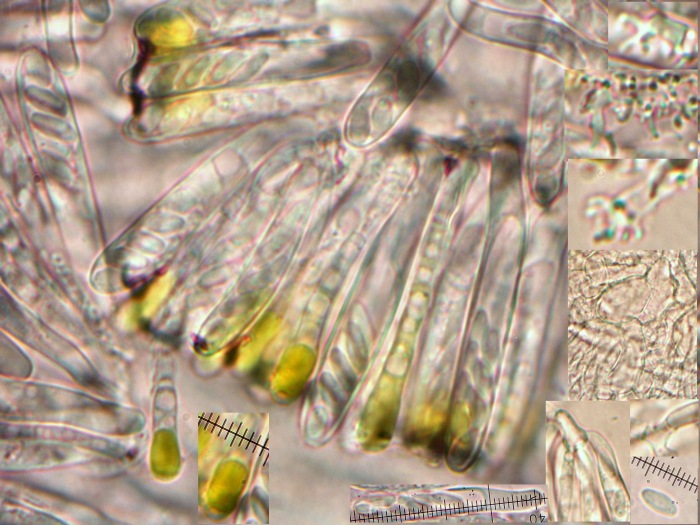
 It fits well with Raitviir´s description, except for the width of the paraphyses and because he says nothing about contents. Also asci seems to be longer. Spores hardly discharge. Upper right, finger-shaped projections. Middle right, ectal excipulum at base. On Populus sp. fallen leaves.
Thanks a lot!
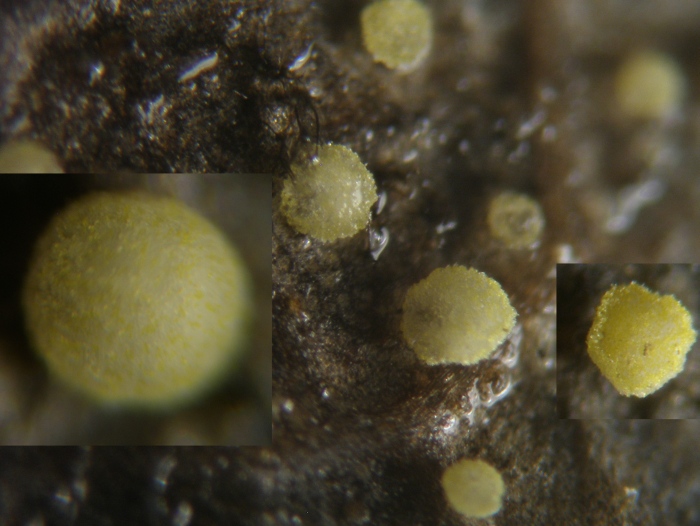
Raúl Tena Lahoz,
20-11-2008 17:39
Re:Mollisina flava?
Micro.
Stip Helleman,
20-11-2008 18:51

Re:Mollisina flava?
Hello Raúl,
Thanks for sharing this rare species, it seems to fit perfect also with Arendholz original description
but both give smaller paraphyses width. which is natural because you have living material with full cell turgor. have you tested the asci, should be Lug. red or MLZ- (MLZ + after KOH)
Can you show us also a picture from dead material? i am curious about the behavior of the VBs in the paraphyses on die-ing(in some Calycellina spec. they become persistent)
Stip
Thanks for sharing this rare species, it seems to fit perfect also with Arendholz original description
but both give smaller paraphyses width. which is natural because you have living material with full cell turgor. have you tested the asci, should be Lug. red or MLZ- (MLZ + after KOH)
Can you show us also a picture from dead material? i am curious about the behavior of the VBs in the paraphyses on die-ing(in some Calycellina spec. they become persistent)
Stip
Hans-Otto Baral,
20-11-2008 22:48

Re:Mollisina flava?
Hi Raúl
yes, raitviir neglected all these contents because he very rarely studied living specimens. I have seen this species 5 times, always on Populus leaves, and quite long ago. Surely the yellow VBs disappear when the apothecia are dried, or usually only yellow remnants of them can inconsistelnty be seen.
And yes, the minute apical ring should react red or blue at lower concentration, red at higher.
Zotto
yes, raitviir neglected all these contents because he very rarely studied living specimens. I have seen this species 5 times, always on Populus leaves, and quite long ago. Surely the yellow VBs disappear when the apothecia are dried, or usually only yellow remnants of them can inconsistelnty be seen.
And yes, the minute apical ring should react red or blue at lower concentration, red at higher.
Zotto
Raúl Tena Lahoz,
26-11-2008 14:01
Re:Mollisina flava?
Thanks Stip and Zotto, and sorry for the late response. I still do not have photos of dead material. I will try to make them next weekend. It was MLZ-.
Raúl.
Raúl.
Raúl Tena Lahoz,
29-11-2008 17:05
Re:Mollisina flava?
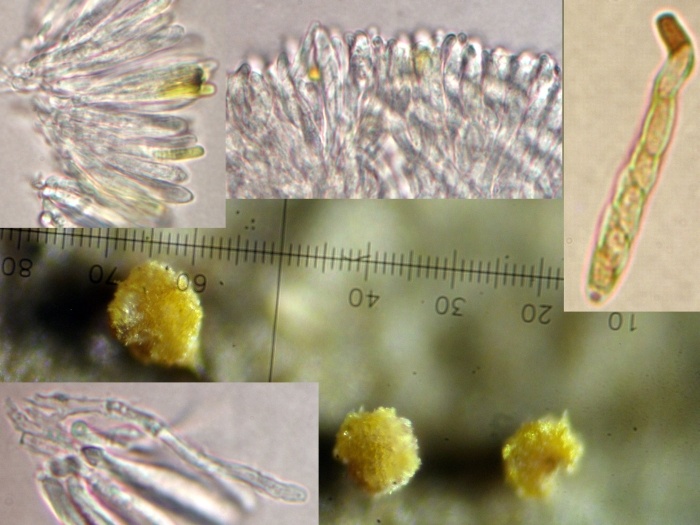
Hi Stip. New photos of rehidrated material. As Zotto indicates yellow VBs have dissapeared in most of the paraphyses. They still remain only in a few. Apos dried ten days ago. Also turgor has gone. Apical ring red in IKI.
Raúl.
Raúl.
Hans-Otto Baral,
29-11-2008 17:18
Re:Mollisina flava?
The two yellow paraphyses look like being still alive. A certain xerotolerance for some days or weeks is well possible in this species. Are the apothecia dry or rewetted?
Zotto
Zotto
Raúl Tena Lahoz,
29-11-2008 23:38
Re:Mollisina flava?
Sorry, when I said "New photos of rehidrated material" I was refering to the micro photos. The macro below is of dry apothecia, aprox. 0, 12 mm.
Thanks Zotto,
Raúl.
Thanks Zotto,
Raúl.
Stip Helleman,
29-11-2008 23:41
Re:Mollisina flava?
Hi Raúl,
I was wandering if the Vbs in this species wer of the same chemical substance as some Calycellina species, but it appears not so, thanks for the fotos.
Stip
I was wandering if the Vbs in this species wer of the same chemical substance as some Calycellina species, but it appears not so, thanks for the fotos.
Stip
Hans-Otto Baral,
30-11-2008 12:47
Re:Mollisina flava?
Hi Stip
why do you think that the VBs of Mollisina differ from Calycellina? I don't see any reason to believe so. There exist yellow and hyaline VBs in both genera, and whether or not there can remains of the Vbs be seen in some paraphyses of older herbarium material is more a matter of the drying process, the senescence of the apos during drying etc.
Zotto
why do you think that the VBs of Mollisina differ from Calycellina? I don't see any reason to believe so. There exist yellow and hyaline VBs in both genera, and whether or not there can remains of the Vbs be seen in some paraphyses of older herbarium material is more a matter of the drying process, the senescence of the apos during drying etc.
Zotto
Stip Helleman,
02-12-2008 21:38
Re:Mollisina flava?
Hoi Zotto,
I think also there is no generic difference between the VBs of Mollisina and Calycellina, but i observed the behavior of VBs in dieing Fruitbodies where they become persistant and this looks like a chemical reaction. So far i only observed it in Calycellina (sensu You) species.
Stip
I think also there is no generic difference between the VBs of Mollisina and Calycellina, but i observed the behavior of VBs in dieing Fruitbodies where they become persistant and this looks like a chemical reaction. So far i only observed it in Calycellina (sensu You) species.
Stip
Hans-Otto Baral,
02-12-2008 22:13
Re:Mollisina flava?
Hoi Sip
o.k., that should be followed. This was the reason why Seppo wrote "yellow pigment" in his genus Phialina (= calycellina ss. meo). Otherwise he would not have been able to observe it.
But VBs are also partly persistent in Durella, I remember, and who knows where else.
Zotto
o.k., that should be followed. This was the reason why Seppo wrote "yellow pigment" in his genus Phialina (= calycellina ss. meo). Otherwise he would not have been able to observe it.
But VBs are also partly persistent in Durella, I remember, and who knows where else.
Zotto