
21-04-2026 13:36
Gernot FriebesHi,I am out of ideas for this one. I collected Sal
21-04-2026 13:19
Gernot FriebesHi,this Lophodermium on Typha has ascospores measu
21-04-2026 13:05
Gernot FriebesHi,this hyphomycete feels familiar but I was not a
20-04-2026 22:00
 Malcolm Greaves
These pale yellow, hairy ascos were growing on cul
19-04-2026 21:23
Steve ClementsBonjour, I found this anamorphic fungus on old pl
19-04-2026 20:46
Steve Clements1 mm diameter approx spherical conidiophores on pl
12-04-2026 17:56
 Hardware Tony
Found on dead stems in February earlier this year
17-04-2026 19:16
 Enrique Rubio
Hi to everybodyI would appreciate any assistance r
14-04-2026 05:32
Ethan CrensonHi all, A few weeks back a friend pointed out som
17-04-2026 15:14
 Bruno Coué
Bonjour.Récoltes du 16/04/2026, sur feuilles mort
Stictis friabilis ?
Patrice TANCHAUD,
18-02-2019 19:45
Bonjour
récolte sur épicéa, spores 62-83 x 3-3,6 µm.
Me semble conforme à Stictis friabilis.
Merci d'avance pour vos avis éventuels.
Patrice
Merci d'avance pour vos avis éventuels.
Patrice
 Doc1-0052.pdf
Hans-Otto Baral,
18-02-2019 22:23

Re : Stictis friabilis ?
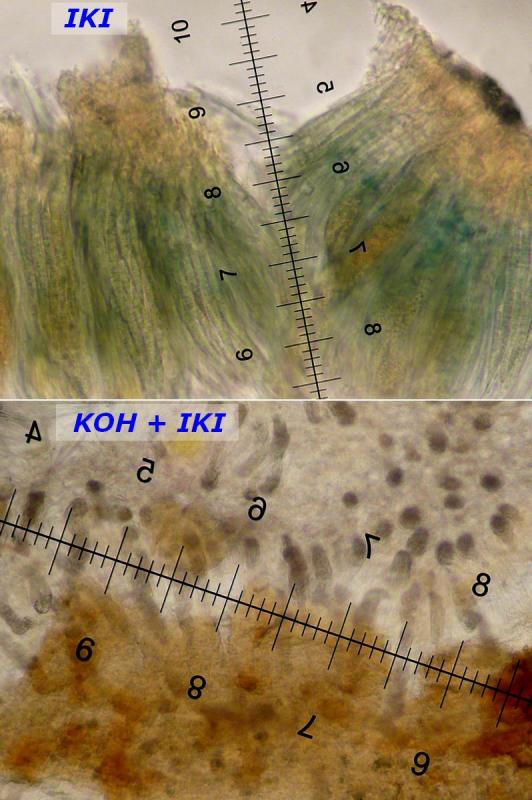
Yes, this could be. Did you test IKI and KOH+IKI, the hymenium/asci must be entirely inamyloid.
Patrice TANCHAUD,
19-02-2019 09:14
Re : Stictis friabilis ?
Thanks Zotto. Here is a photo.
Hans-Otto Baral,
19-02-2019 10:10
Re : Stictis friabilis ?
Oh this speaks against friabilis. But it cannot be that a positive reaction in IKI turns negative after KOH. It looks as if you did not wash enough with water (KOH neutralizes iodine by forming KI).
Another possibility could be Karstenia idaei. I think this possible confusion could be ruled out by a section of the margin.
Another possibility could be Karstenia idaei. I think this possible confusion could be ruled out by a section of the margin.
Patrice TANCHAUD,
19-02-2019 10:49
Hans-Otto Baral,
19-02-2019 11:39
Re : Stictis friabilis ?
So it is clearly amyloid! The margin needs to be a section, otherwise I am lost. But Stictis usually has crystals, Karstenia not.
Patrice TANCHAUD,
19-02-2019 12:12
Re : Stictis friabilis ?
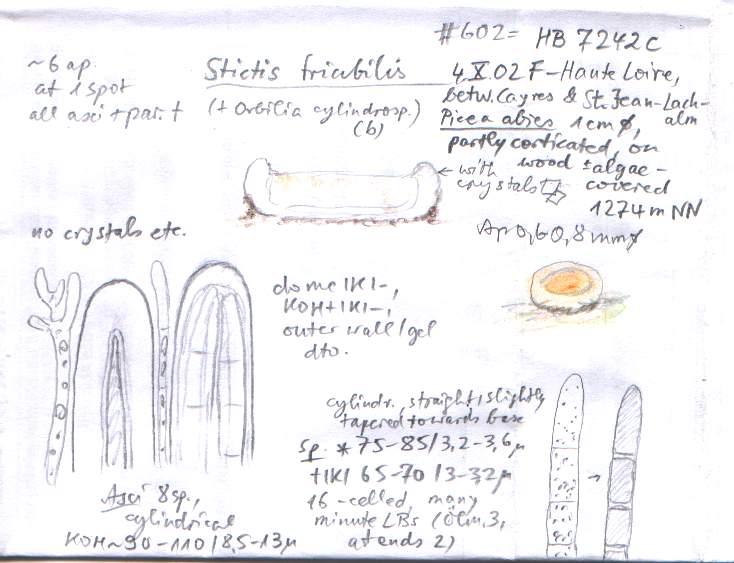
Here, in your DVD, you note "no crystals".
Hans-Otto Baral,
19-02-2019 12:16
Re : Stictis friabilis ?
Yes, this may be so. But I found S. friabilis completely inamyloid, with or without KOH.
Patrice TANCHAUD,
19-02-2019 12:46
Re : Stictis friabilis ?
Here, good KOH and very good IKI, and a good preparer ...

Patrice TANCHAUD,
20-02-2019 08:55
Re : Stictis friabilis ?
I see Karstenia idaei here : https://mushroomobserver.org/image/show_image/400197?obs=157228
The blue color is probably due to IKI or melzer and looks like what I got.
It's not easy to find the differences for an amateur between S. friabilis et K. idaei ...
Hans-Otto Baral,
20-02-2019 09:21
Re : Stictis friabilis ?
Perhaps a closeup macro would help? I was thinking that there is some macroscopical difference between the two genera.
Karstenia is now in Odontotremataceae and Stictis in Stictidaceae (when you look in my folders).
I would perhaps see clear with a median section of the margin, I know it is not easy but possible (with a razor blade).
Karstenia is now in Odontotremataceae and Stictis in Stictidaceae (when you look in my folders).
I would perhaps see clear with a median section of the margin, I know it is not easy but possible (with a razor blade).
Patrice TANCHAUD,
20-02-2019 11:14
Hans-Otto Baral,
20-02-2019 11:16
Re : Stictis friabilis ?
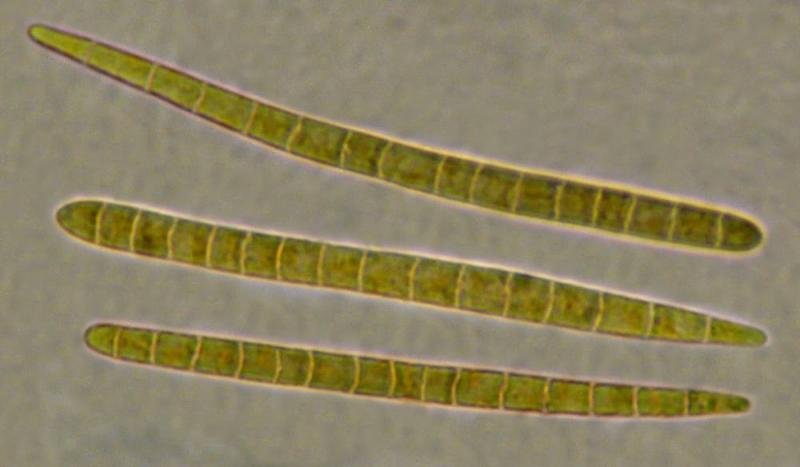
Yes, I think this looks more like a Karstenia. K. idaei has finally up to 15 septa as I remember.
Patrice TANCHAUD,
20-02-2019 12:01
Re : Stictis friabilis ?
Spores in melzer.
Hans-Otto Baral,
20-02-2019 12:42
Re : Stictis friabilis ?
C'est si bon :-)
We come to an end I feel. Sherwood does not mention the number of speta, but figures 8-12. She says J- for the paraphyses and nothing for the asci. Since she used MLZ and does not state whether she applied KOH, her data are uncertain. But given that my HB 7242c is correctly identified, I conclude that K. idaei is the much better solution.
Zotto
We come to an end I feel. Sherwood does not mention the number of speta, but figures 8-12. She says J- for the paraphyses and nothing for the asci. Since she used MLZ and does not state whether she applied KOH, her data are uncertain. But given that my HB 7242c is correctly identified, I conclude that K. idaei is the much better solution.
Zotto
Patrice TANCHAUD,
20-02-2019 13:03
Re : Stictis friabilis ?
Thank you Zotto for all your explanations. I had not noticed the existence of K. idaei with similar spores and distinguishing them is not easy.
Patrice TANCHAUD,
01-04-2019 15:30
Re : Stictis friabilis ?
Bonjour,
je reviens sur cette discussion car je vois également l'existence de K. gregaria (absent du DVD de Zotto) et je ne vois pas où sont les différences avec K. idaei.
Merci d'avance à toutes personnes informées.
I come back to this discussion because I also see the existence of K. gregaria (missing from Zotto's DVD) and I do not see where are the differences with K. idaei.
Thank you in advance to all informed people.
Thank you in advance to all informed people.
Patrice
Hans-Otto Baral,
01-04-2019 16:08
Re : Stictis friabilis ?
Bonjour Patrice
you are right, this is an alternative. But maybe it is only a synonym, Graddon seems to have neglected K. idaei as he did not mention it. The spores are longer than in most of the data in my folder, but one by Enrique Rubio (V.2015) has up to 75.
Zotto
you are right, this is an alternative. But maybe it is only a synonym, Graddon seems to have neglected K. idaei as he did not mention it. The spores are longer than in most of the data in my folder, but one by Enrique Rubio (V.2015) has up to 75.
Zotto
Patrice TANCHAUD,
01-04-2019 20:16
Re : Stictis friabilis ?
We are OK Zotto, thanks again.