
27-04-2026 20:52
 Lothar Krieglsteiner
Found on hanging tiwg of Olea europaea in dried-ou
28-04-2026 22:51
 Bernard CLESSE
Bonsoir à toutes et tous,Pourriez-vous m'aider à
29-04-2026 08:01
Lothar Krieglsteiner
... on twig attached to small tree of Citrus auran
29-04-2026 10:44
Lothar Krieglsteiner
growing at moist, drying-out soil at the side of a
28-04-2026 20:33
Vitus SchäfftleinHello, I found Trochila ilicina on Ilex aquifoliu

28-04-2026 21:50
 Pablo Sandoval
Hola a todos,Espero se encuentren bien. Hace mucho
27-04-2026 18:05
Lothar Krieglsteiner
... still attached at standing tree. The green con
28-04-2026 20:07
Lothar Krieglsteiner
... on twig in the air at standing Ceratonia siliq
27-04-2026 18:48
Tony MoverleyCollected 23rd April 2026, Norfolk, EnglandSwarms

Hi forum
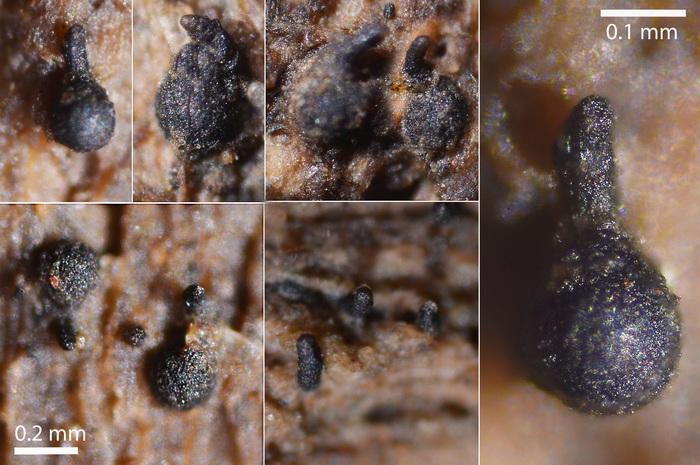
These scattered, more or less inmersed, black, ostiolate, glabrous, lageniform perithecia, 0.3-0.5 mm long, with elongated cylindrical necks 100-200 microns long, were growing on indeterminate semirotten wood together with pseudothecia of Capronia cf. pilosella.
The asci are shortly stipitate, with a conspicuous refractive, IKI negative, apical apparatus, 170-194 x 10-12 microns, with 8 obliquely 1-seriate, hyaline, 4-celled ascospores. Paraphyses often collapsing.
I think this fungus should be near the genus Ceratosphaeria but any species seems to fit well with my collection.
Have yo some idea for me?
Thanks again
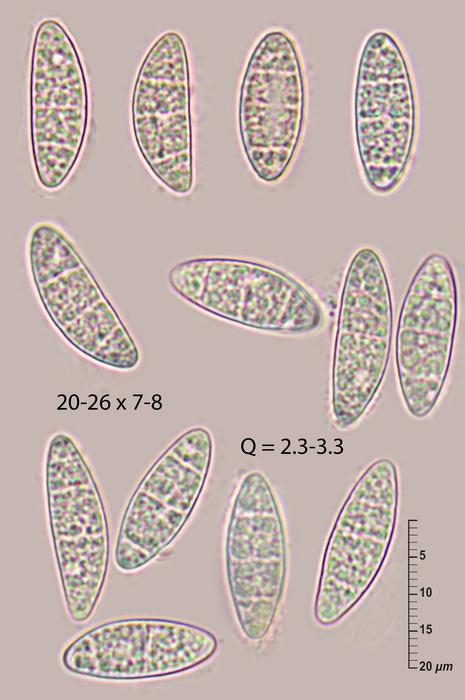
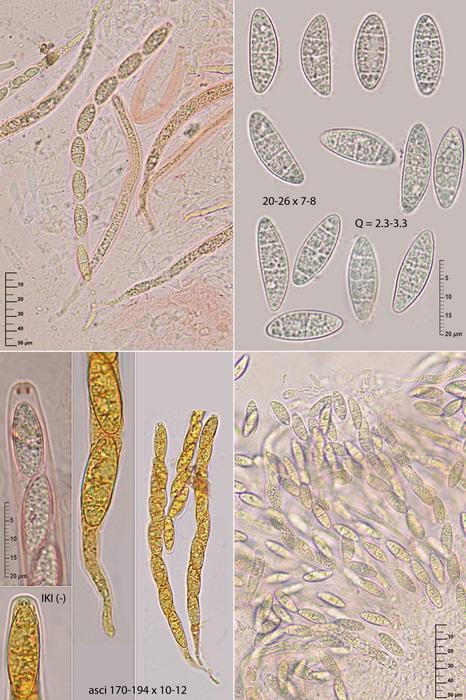
Your collection seems to be referrable to Ceratosphaeria, characterised by the elongated beak, spores having several cross walls, often more than three..By definition the genus Zignoella has at most a papillate ostiole, and spore cross walls at most three.
Suggested taxa for your collection are Ceratosphaeria crinigena or possibly C. rhenana
Kind regards,
Peter

since the great work done by Martina Réblova it became unfortunately challenging to assign one of these beaked fungi to a genus without the asexual morph and molecular data.
There is a good overview of these fungi with a key to genera in Réblova 2013, Mycologia 105: 462-475. Your fungus might have affinities with Ceratolenta caudata but has significantly larger ascospores.
Enrique, you should make an effort to find fungi that exist!
Saludos,
Jacques

Zotto
You are right, Zotto! Your memory is surprising...http://www.ascofrance.fr/search_forum/38103 But for this collection on Rubus, also out and far of the water, i could not to observe the inmersed ascomata. But I think Annulusmagnus has greater ascospores and a more conspicuous, very congophilous, apical apparatus.
Who knows!