
12-03-2026 15:45
Åge OterhalsDear forum,I found this small discomycete on a ver
11-03-2026 16:48
 Bruno Coué
Bonjour, je serais heureux d'avoir votre avis sur
11-03-2026 17:36
 Michel Hairaud
Bonjour, Je cherche des indices pour cette réc
08-03-2026 14:05
 Thierry Blondelle
Bonjour à tous,Sur 3 récoltes supposées de H. l
11-03-2026 14:14
Gernot FriebesHi,I would like to share a collection of Scopinell

10-03-2026 18:08
 Marc Detollenaere
Dear Forum,On stems of Arctium, I found some downy

Hi to averybody
Maybe you know this pyreno that makes very inconspicuous uniperitheciate inmersed perithecia on Rubus canes. Perhaps it has so peculiar microscopical data that make easy the identification?
Asci IKI and Melzer negative
Thanks in advance
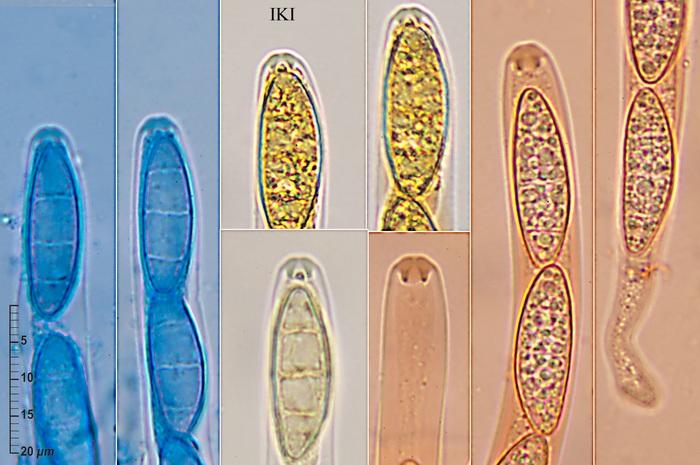
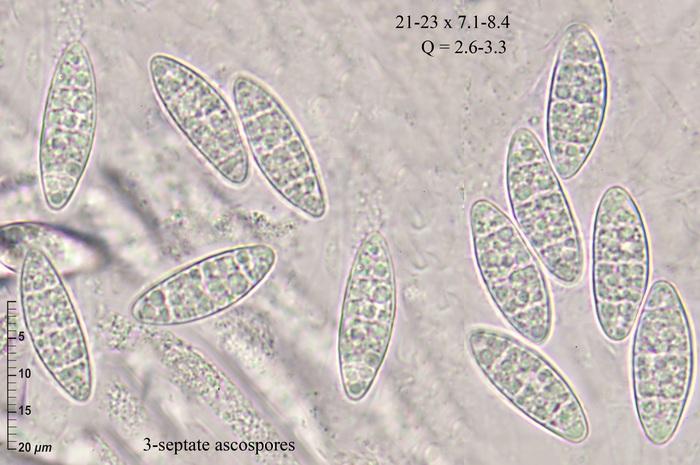
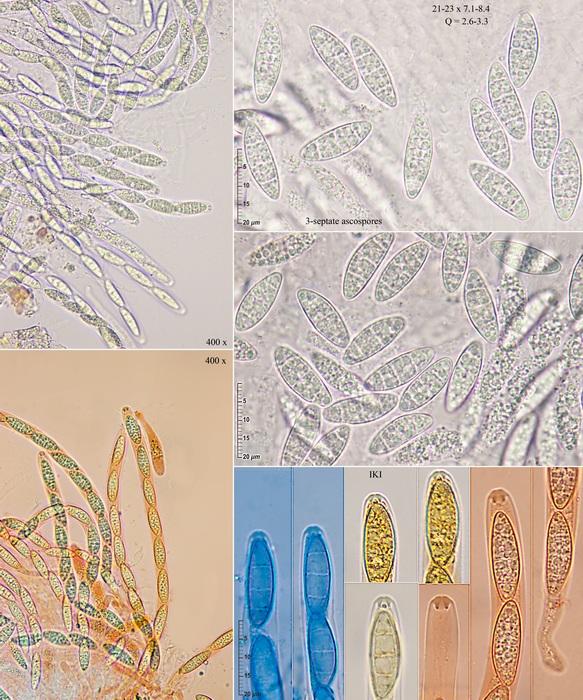

I have a plate of yours named Annulusmagnus (Annulatascus) triseptatus, 10.V.2009.
maybe something like this?
Zotto

I had the same idea, but the apical aparatus in congo was not conspicuous enough to me. In Annulusmagnus it is very congophilous.
Was it in moist or aquatic environment, Enrique?
Regards
Martin
Hi to both
It's sound strange because the cane is not in aquatic environnment and the ascospores seem to be smaller (16–37 x 5–10 (Campbell & Shearer, 2004), and 24-32 x 8-10 for my own collections). But nevertheless they are similar enough...and the apical apparatus too.
The fungus was collected far from the water.
Thanks!
Maybe Alain or Jacques can cmment on this sample. Do the perithecia have an elongate ostiolum?
My own collections have a spore size range of 26-34x7-9 µm and 31-37x9-12 µm. So there is variation.
Regards
Martin

Hi friends,
Zotto has well recognized microscopical features of A. triseptatus. And Martin is right with ascospores size. But terrestrial habit is very strange for a such species.
Have you more informations about this fungus ? I would like to see a vertical section of perithecia.
Alain
Hi Alain
Sorry but I don't have more information about this fungus. The perithecia were found by chance inmersed on a Rubus cane together with these other http://www.ascofrance.fr/search_forum/35062, but I did not keep this material.

I missed your post.
Most likely a member of Annulatascaceae, indeed, microscopically fitting well this family, the short twisted stipe is typical of Annulusmagnus and Annulatascus. Based on your information the ascomata are deviating in gross morphology from what we know from aquatic habitats.
I see no reason why terrestrial counterparts of Annulusmagnus would not exist.
This fungus would be worth being re-collected and sequenced. If someone is interested...
Cheers,
Jacques
HI Jacques
I'll try it!
Thanks a lot to all