
28-04-2026 22:51
 Bernard CLESSE
Bonsoir à toutes et tous,Pourriez-vous m'aider à

28-04-2026 21:50
 Pablo Sandoval
Hola a todos,Espero se encuentren bien. Hace mucho
27-04-2026 18:05
 Lothar Krieglsteiner
... still attached at standing tree. The green con
28-04-2026 20:33
Vitus SchäfftleinHello, I found Trochila ilicina on Ilex aquifoliu
28-04-2026 20:07
Lothar Krieglsteiner
... on twig in the air at standing Ceratonia siliq
27-04-2026 20:52
Lothar Krieglsteiner
Found on hanging tiwg of Olea europaea in dried-ou
27-04-2026 18:48
Tony MoverleyCollected 23rd April 2026, Norfolk, EnglandSwarms
27-04-2026 17:41
Lothar Krieglsteiner
.. Algarve, same leaf than the last post. The con
27-04-2026 17:16
Lothar Krieglsteiner
.. Algarve, moist lying.The conidiomata look like
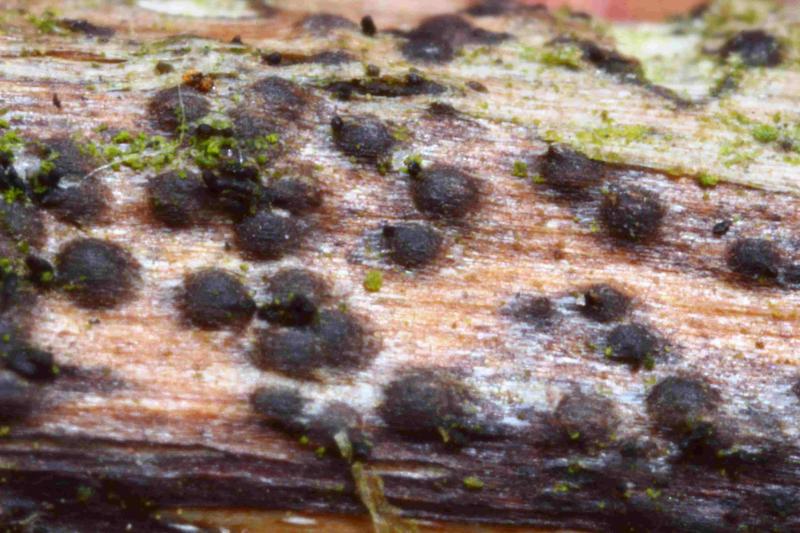
I have found fruit bodies growing on a stem of Epilobium hirsutum, which display characteristics of the genus Plagiostoma. The attached photo shows the densely grouped fruit bodies, with ostioles offset to the edge of the perithecia.
The spores, which are faintly 1-septate, have a very short bristle at each end, as shown in the attached sketch.
I have referred to the Systematic Account of the Genus Plagiostoma, which was published in March 2011 and see that there are no species included on the substrate Epilobium. Using the key instead, my sample does not key out, based on the microscopic and macroscopic characteristics either.
I wonder if during the four years since the systematic account was published, species of Plagiostoma have been found and identified on other hosts.
I do have a lot of fruit bodies, if anyone is interested for sequencing etc.
Thank you,
With Best Wishes,
Peter.


Hi Peter,
See Gnomonia riparia.
Alain

useful description (under Cryptoderis) here:
http://www.librifungorum.org/Image.asp?ItemID=8&ImageFileName=SyllogeFungorum2-230.jpg
regards
Chris
 SnapShot-0001.jpg
Thank you both for the useful references.
Gnomonia riparia does look good. I had not considered the genus Gnomonia, because of the distinctly offset position of the ostiole.
I do notice that both of the descriptions mention 4-spored asci, whereas I noted 8-spored. I will have another look at my sample to see whether there are any 4-spored.
With Best Wishes,
Peter.
Yes Peter, I note 8 ascospores in each ascus too. It looks like 4-spored (see my photo) but is indeed 8-spored.
Monod has worked on the material of Niessl, Graz 1874, as and he has seen a few asci. Perhaps he has not seen enough good material. And perhaps that G. misella on Hypericum is an other fungus. Molecular data would be necessary.
We can call our fungus "Gnomonia riparia" in the meantime.
Alain
Yes, I thought that I could see a fifth spore in your ascus photo.
I did notice in the descriptions that there were very few asci available.
My sample certainly has 8-spored asci, which are presumably dead, because the spores are spread throughout instead of being grouped at the tip.
I will record it as Gnomonia riparia.
With Best Wishes,
Peter.