
28-04-2026 20:33
Vitus SchäfftleinHello, I found Trochila ilicina on Ilex aquifoliu

30-04-2026 10:28
Rot BojanHello, by appearance I would say that I am dealing
27-04-2026 18:48
Tony MoverleyCollected 23rd April 2026, Norfolk, EnglandSwarms
14-04-2026 05:32
Ethan CrensonHi all, A few weeks back a friend pointed out som
27-04-2026 20:52
 Lothar Krieglsteiner
Found on hanging tiwg of Olea europaea in dried-ou
28-04-2026 22:51
 Bernard CLESSE
Bonsoir à toutes et tous,Pourriez-vous m'aider à
29-04-2026 08:01
Lothar Krieglsteiner
... on twig attached to small tree of Citrus auran
29-04-2026 10:44
Lothar Krieglsteiner
growing at moist, drying-out soil at the side of a

Psilachnum dans les pieds de Helleborus viridis
Enrique Rubio,
08-06-2007 20:36
 Je vous prie, nouvellement, une opinion sur cet Psilachnum (?) que croit sur les pieds morts de Helleborus viridis a 1500 m.
Il est minuscule, urceolée puis cupulée, marge blanc et fimbriée, sessile; blanc, puis jaune et finallement rouge. Les vapeurs de NH4OH le changent avec violence au rouge.
Spores 6-10 x 1.7-2.4. Asques avec crochets, IKI bb. Poils septées (1-3), apex obtuse, hyalines. Ectal excipulum angularis. Le IKI provoque l'aparition d'un couleur bleuatre (amyloide) sur les poils et la base des memes. Ps. rubrotinctum Graddon, une spece que je ne connais pas des Filipendula et Cirsium, a les spores (selon la Literatture) plus petites.
Avez vous une idée sur cet champignon?
Merci beaucoup a tous par votre aide.

Enrique Rubio,
08-06-2007 20:37
Re:Psilachnum dans les pieds de Helleborus viridis
Autre image
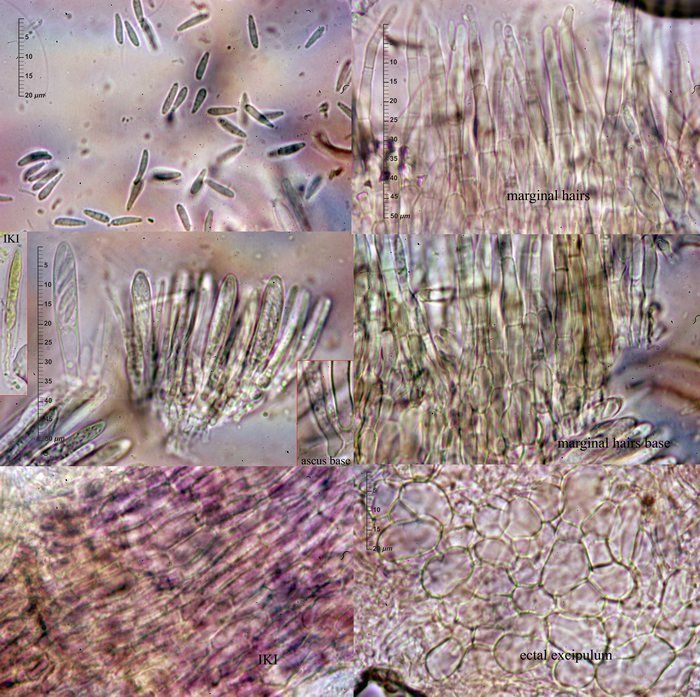
Enrique Rubio,
08-06-2007 20:37
Re:Psilachnum dans les pieds de Helleborus viridis
Une autre
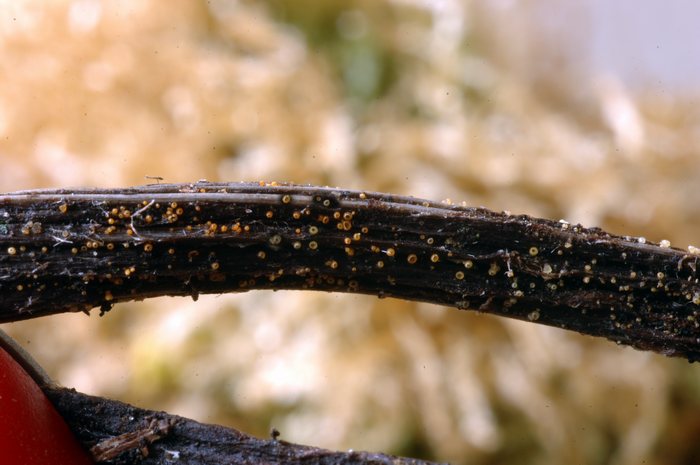
Jacques Trimbach,
08-06-2007 21:40
Re:Psilachnum dans les pieds de Helleborus viridis
Je trouve un Hyaloscypha hellebori Vel. dans la Monogr.Disco.Bohem. qu'il dit "melinus" (couleur de coing), qui a des poils et spores un peu rapprochants (un bout pointu et l'autre arrondi) et qui pousse sur débris de hellebore. Mais Huhtinen dit qu'il n'y a pas de type et ne donne ni déscription, ni avis.
Hans-Otto Baral,
08-06-2007 23:55

Re:Psilachnum dans les pieds de Helleborus viridis
You are probably right with the genus Psilachnum. The species should be "Orbilia" rubicunda = "O." rozei, known from leaves of Helleborus, although the spores are a bit wider in the types and a fresh collection I have seen. See on the DVD, perhaps in dir. Psilachnum, for HB 7794 and 7268. But I am unaware of an amyloid (violet) reaction of the hairs. It is possible that the VBs inside the hairs cause a violet reaction with IKI, and that perhaps only as long as they are alive. "Orbilia" rubicunda grows on the petioles as well as on the upper parts of the leaves.