
19-04-2026 21:23
Steve ClementsBonjour, I found this anamorphic fungus on old pl
19-04-2026 20:46
Steve Clements1 mm diameter approx spherical conidiophores on pl
12-04-2026 17:56
 Hardware Tony
Found on dead stems in February earlier this year
17-04-2026 19:16
 Enrique Rubio
Hi to everybodyI would appreciate any assistance r
14-04-2026 05:32
Ethan CrensonHi all, A few weeks back a friend pointed out som
17-04-2026 15:14
 Bruno Coué
Bonjour.Récoltes du 16/04/2026, sur feuilles mort
12-04-2026 15:52
Gernot FriebesHi,I'm looking for help with this anamorph collect
14-04-2026 21:52
Gernot FriebesHi,found on dead leaves of Carex elata. Conidia: 4
16-04-2026 22:09
Buckwheat PeteHello, I'd like to ask about this older specimen:
15-04-2026 19:33
Fátima Durán ManzanequeHi!! I need help, I found this Ascomycete but I d
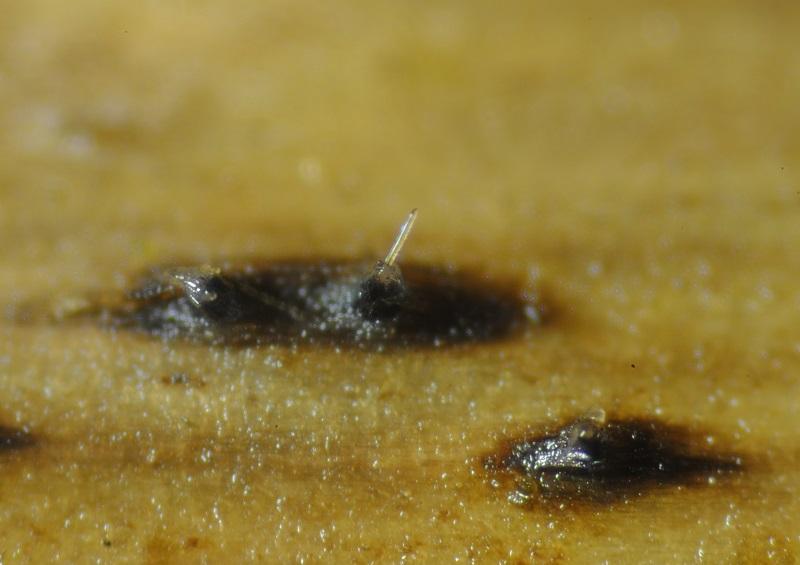
I have found a pyrenomycete on Phalaris/Phragmites (?) on a riverbank in the South of England that I cannot identify. It grows on the same stem as Massarina arundinacea.
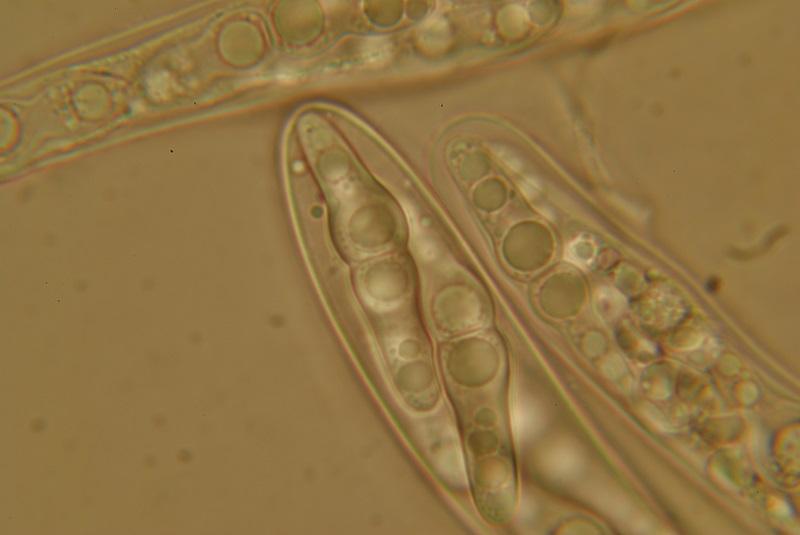
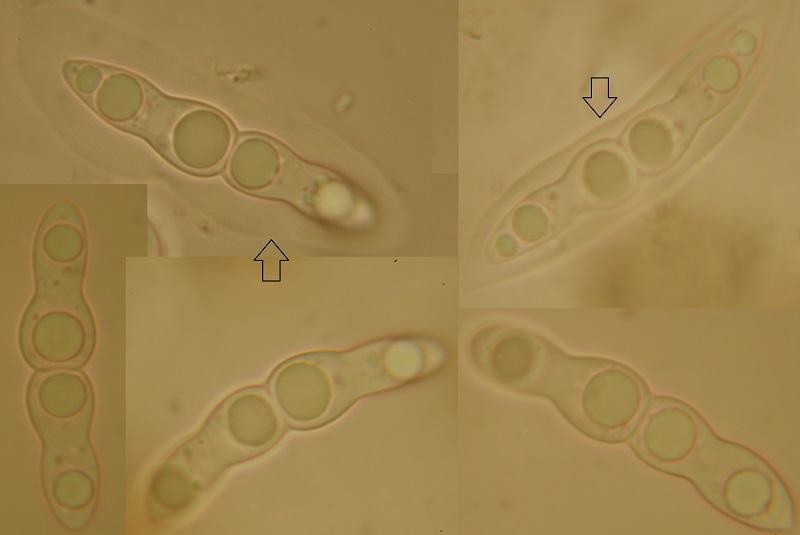
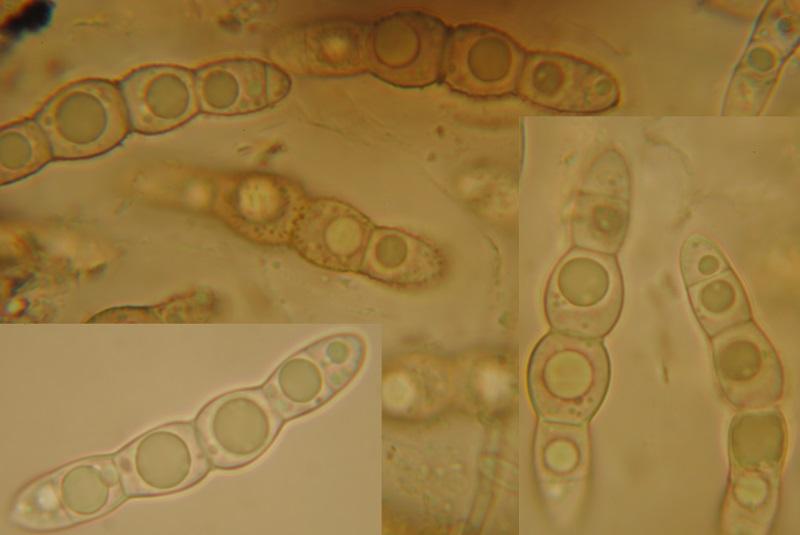
Ascospores (37.1 - 41 x 7.7 - 8.7µm) have a distinct but fugacious mucilaginous sheath. They are hyaline and (almost?) always 1-septate when discharged, but become light brown, roughened and 3-5 septate when senescent.
Asci have no visible aparatus.
Ostioles appear not to be laterally compressed.
I have a feeling it may be another species around Massarina, but I have no access to 'A World Revision of Massarina' Aptroot. I wonder if someone out there could help me (either with the identification or with the article...)
Merci pour votre aide,
Nick

 1998-v66-p89-0001.pdf
Apparemment il s'agit en effet de: Massarina arundinacea (Sow.: Fr.) Leuchtman, Sydowia,
37: 179, 1984 (1985)
Spécimen fréquent sur Phragmite et probablement aussi sur Phalaris.
Cordialement
Paul
Salut à tous,
Cheers Chris - I'm not sure it's helped me much, though :) - These Massarina are tough...
Thanks for your help, Paul - These ascospores seem strange for M.arundinacea. They are larger than I have come to expect, have different guttules and are slightly differently shaped.
Can the two types of spores below plausibly come from the same species or do they both represent extremes of M.arundinacea? They are from two diffferent perithecia on the same stem (the photos are to the same scale).
Cordialement,
Nick
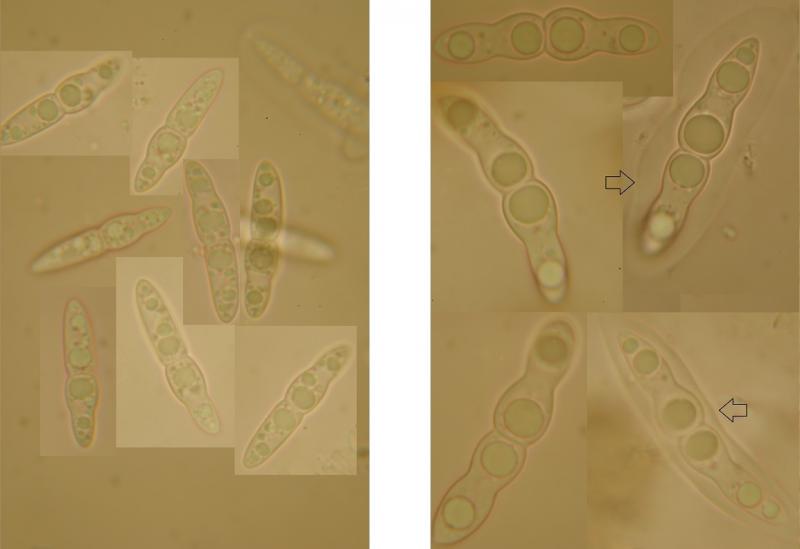

I think this is not M. arundinacea (Lentithecium arundinaceum). I had this species 2 weeks ago in Austria.
regards,
björn
Yes, after further study it's clear to me this is not M.arundinacea.
There are clearly no exact matches in 'A World Revision of Massarina' Aptroot.
I suppose I could dry the specimen in order to compare spore size and shapes with Aptroot's illustrations (as they were drawn from herbarium material). I don't have much hope though....
Cordialement,
Nick

I agree, it's not M. arundinacea ( even if there is some similar features).
Tanaka & Harada have decribed, in Pleosporales in Japan vol. 3, species found on similar substrates with almost similar ascospores but these last ones are generally smaller.
the closest one is perhaps Massarina peerallyi (given by T&H with ascopores measuring 31-43 x 7-10,5 µm ; perhaps different from the peerallyi of Hyde & Aptroot, I think). It could be a new species.
It's surely a question for a specialist.
Alain
Thanks for pointing me towards Tanaka & Harada - An interesting article - My fungus does seem very close indeed to several of those species!
Tomorrow I will send the specimen to René Schumacher for culture/sequencing, so I haven't yet given up hope...
Cordialement,
Nick