
19-05-2026 10:27
Patrice TANCHAUDBonjour, récolte récente sur terre retournée i
04-06-2026 10:50
 François Freléchoux
Bonjour, J'ai trouvé hier un petit asco observé
04-06-2026 07:02
François Freléchoux
Bonjour, Voici la description d'une espèce qui p
04-06-2026 13:34
Gernot FriebesHi,I am interested to hear your opinion on this Le
04-06-2026 11:36
Gernot FriebesHi,found on Vaccinium myrtillus.Asci: IKI –, 8-s
22-05-2026 13:29
Gernot FriebesHi,I am curious to hear your opinion on this mater
18-10-2022 00:12
Valencia Lopez Francisco JavierHola amigos/asRecientemente encontré esta colecci
Microthyrium on Bark of Hedrea helix
Peter Thompson,
01-05-2013 13:47
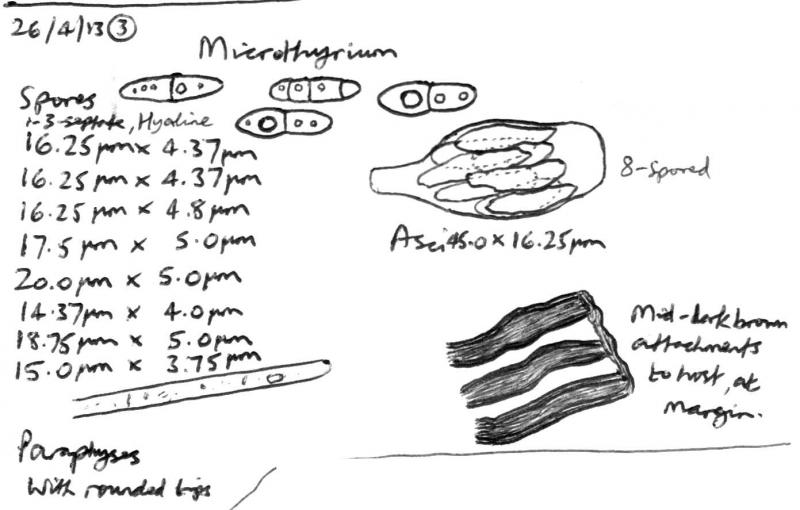
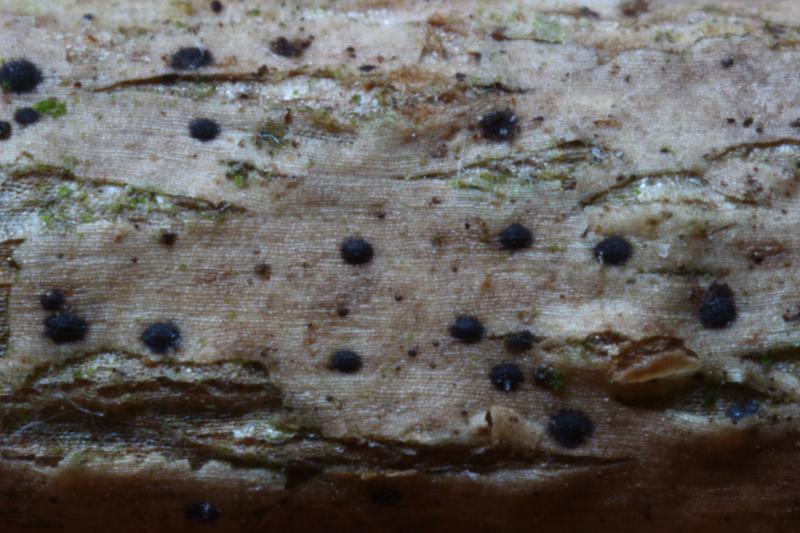
I recently found a Microthyrium species with evenly coloured thyriothecia growing on the bark of ivy (Hedera helix). It is quite clearly not Microthyrium ciliatum var. hederae, usually found on leaves, because the spores are significantly larger.
I have attached an image of the fruit bodies and the microscopy.
I wonder if anyone has an idea as to which species it will be.
Thank you,
Best wishes,
Peter.
Chris Yeates,
01-05-2013 15:40

Re : Microthyrium on Bark of Hedrea helix
Hello Peter
that doesn't look right for a Microthyrium to me . . .
cheers
Chris
that doesn't look right for a Microthyrium to me . . .
cheers
Chris
Peter Thompson,
01-05-2013 16:38
Re : Microthyrium on Bark of Hedrea helix
Hello Chris,
The fruit bodies are flat and can be lifted intact off the surface of the host. They are surely thyriothecia of Microthyrium or a similar genus.
Best wishes,
Peter.
The fruit bodies are flat and can be lifted intact off the surface of the host. They are surely thyriothecia of Microthyrium or a similar genus.
Best wishes,
Peter.
Chris Yeates,
01-05-2013 19:01
Re : Microthyrium on Bark of Hedrea helix
Hello Peter
I wouldn't argue with "similar genus" and it may be that the photo is somewhat deceptive, but is the upper surface really only one cell thick?
Chris
I wouldn't argue with "similar genus" and it may be that the photo is somewhat deceptive, but is the upper surface really only one cell thick?
Chris
Alain GARDIENNET,
01-05-2013 20:48

Re : Microthyrium on Bark of Hedrea helix
Hi,
Yes perhaps another Microthyriaceae, like Phragmothyrium flageoletii (just an idea to check).
It woulb be useful to see a vertical cut, and the structure of peridium.
Alain
Yes perhaps another Microthyriaceae, like Phragmothyrium flageoletii (just an idea to check).
It woulb be useful to see a vertical cut, and the structure of peridium.
Alain
Peter Thompson,
26-05-2013 19:02
Re : Microthyrium on Bark of Hedrea helix
Hello Alain,
Thank you for your suggestion of Phragmothyrium flageoletii and my apologies for taking so long to respond.
I have found a document of Illinois Biological Monographs. Using the key to genera, I arrive at Phragmothyrium as the genus. From the species listed and described, only two are known to grow on Hedera. P. flageoletii is certainly the closest from the sizes of spores and asci, but I also see paraphyses, whereas the Illinois Biological Monographs describe the species as not having paraphyses.
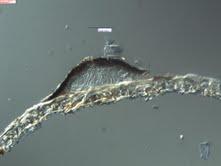
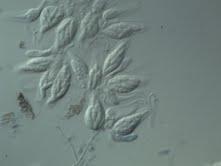
I have attached the cross section, which you requested (with thanks to Peter Wilberforce, who is also interested in this sample). Also attached is the image of the asci.
We wonder what you think?
Thank you,
Best Wishes,
Peter.
Thank you for your suggestion of Phragmothyrium flageoletii and my apologies for taking so long to respond.
I have found a document of Illinois Biological Monographs. Using the key to genera, I arrive at Phragmothyrium as the genus. From the species listed and described, only two are known to grow on Hedera. P. flageoletii is certainly the closest from the sizes of spores and asci, but I also see paraphyses, whereas the Illinois Biological Monographs describe the species as not having paraphyses.
I have attached the cross section, which you requested (with thanks to Peter Wilberforce, who is also interested in this sample). Also attached is the image of the asci.
We wonder what you think?
Thank you,
Best Wishes,
Peter.
 PhragmothyriumSpecies-0001.doc