
02-06-2026 14:33
 Nicolas VAN VOOREN
Hello.I'm searching for a PDF copy of the followin
02-06-2026 17:58
Louis DENYBonjour forum, Sur feuille de Populus tremula, en

28-07-2011 18:31
 Alex Akulov
Dear FriendsToday I made the pdf file of Velenovsk
11-09-2025 16:57
 Jason Karakehian
Our revision of Marthamycetales (Leotiomycetes) is
12-11-2019 10:32
 Miguel Ángel Ribes
Hi againExactly at the same place than my previous
25-12-2019 17:54
Valencia Lopez Francisco JavierHola a todos/asEstas supuestas pezizas estaban en
12-07-2015 00:05
 Nedim Jukic
This one from the same locality as the previous on

30-05-2026 21:12
Philippe PELLICIERSur branche de mélèze (Larix) près de la neige,
Peziza lobulata versus Peziza moseri
Bartusek Martin,
27-02-2013 15:01
 Hello, I have a question about the relationship between taxa Peziza lobulata and Peziza moseri. In the literature, that is available to me, I found only one characteristic - the presence or the absence of fat droplets in spores. Because I have some experiences in microscopy, I think that observability or invisibility of these drops is caused by the medium in which the specimen is prepared. Please, let me know, whether my conclusion is right or not. Regards Martin.
Hans-Otto Baral,
27-02-2013 15:04

Re : Peziza lobulata versus Peziza moseri
Hi Martin
you are fully right! However, the other possibility is that the two species actually differ in their lipid content (study in the living state recommended). Regrettably I do not know these species, but like to follow the discussion here. :-)
Zotto
you are fully right! However, the other possibility is that the two species actually differ in their lipid content (study in the living state recommended). Regrettably I do not know these species, but like to follow the discussion here. :-)
Zotto
Mario Filippa,
28-02-2013 01:57
Re : Peziza lobulata versus Peziza moseri
Hi,
I have found both and even if I don't have a full description, I recall them rather well and macroscopically they are not so similar (but my experience is based only on a few apothecia).
In general, the oil drops may be a useful feature in making a key, but I'm sure that in a full description of all details, including pigmentation, ascus base, layers of the excipulum, shape and size of the cells and so on, it will become possible to found many other differences.
It is true that the oil drops can become invisible in many mounting media, but I think it's mandatory to observe everything in water, at first.
There are a lot of things that you can observe only in certains media: amiloidity in iodine, carminophily in acetocarmine and iron, nuclei with Giemsa stain, and so on... And they may be very, very important!
Regards
Mario
I have found both and even if I don't have a full description, I recall them rather well and macroscopically they are not so similar (but my experience is based only on a few apothecia).
In general, the oil drops may be a useful feature in making a key, but I'm sure that in a full description of all details, including pigmentation, ascus base, layers of the excipulum, shape and size of the cells and so on, it will become possible to found many other differences.
It is true that the oil drops can become invisible in many mounting media, but I think it's mandatory to observe everything in water, at first.
There are a lot of things that you can observe only in certains media: amiloidity in iodine, carminophily in acetocarmine and iron, nuclei with Giemsa stain, and so on... And they may be very, very important!
Regards
Mario
Martin Bemmann,
28-02-2013 20:12

Re : Peziza lobulata versus Peziza moseri
Dear Martin,
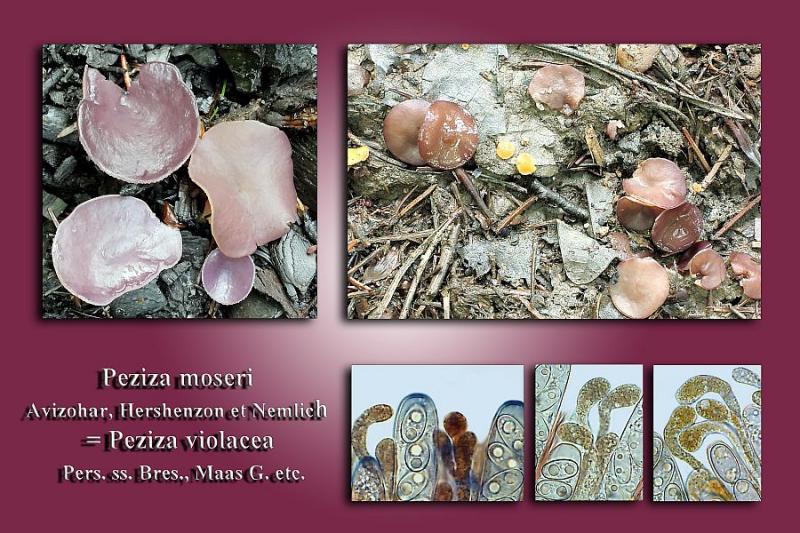
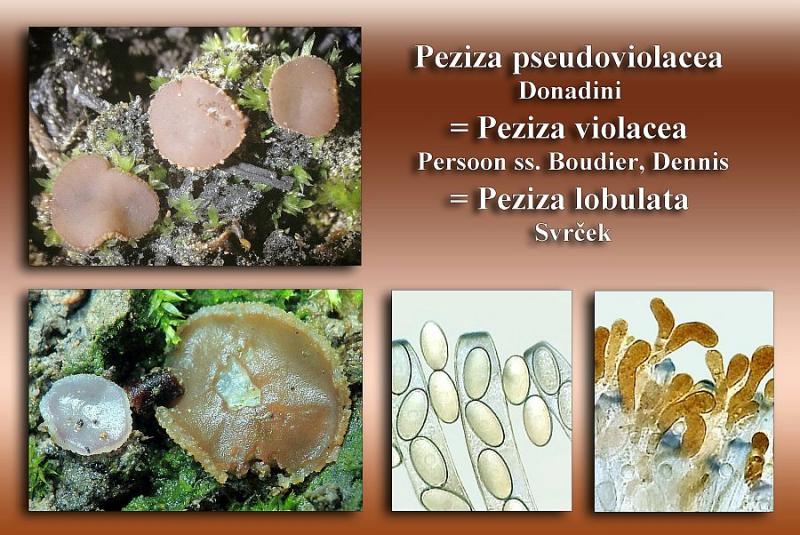
a German asco-enthusiast, Peter Püwert, who is reading the forum only, asked me to upload two plates of P. moseri and P. pseudoviolacea/lobulata.
He comments that the synonymy is confusing him as well, multiple collections may lead to further enlightenment.
Regards
Martin
a German asco-enthusiast, Peter Püwert, who is reading the forum only, asked me to upload two plates of P. moseri and P. pseudoviolacea/lobulata.
He comments that the synonymy is confusing him as well, multiple collections may lead to further enlightenment.
Regards
Martin
Bartusek Martin,
28-02-2013 21:15
Re : Peziza lobulata versus Peziza moseri
Yes, there is it visible well, the slide was prepared obviously in Melzer´s reagent, but I still want to ask whether it was a dry or a fresh material. Honestly, it is a bad habit not to add the method of the preparation of the slides to the key. It should be the essential part of the proper key.
Thank you all.
Thank you all.