
29-04-2026 08:01
 Lothar Krieglsteiner
... on twig attached to small tree of Citrus auran
28-04-2026 20:33
Vitus SchäfftleinHello, I found Trochila ilicina on Ilex aquifoliu
28-04-2026 22:51
 Bernard CLESSE
Bonsoir à toutes et tous,Pourriez-vous m'aider à

28-04-2026 21:50
 Pablo Sandoval
Hola a todos,Espero se encuentren bien. Hace mucho
27-04-2026 18:05
Lothar Krieglsteiner
... still attached at standing tree. The green con
28-04-2026 20:07
Lothar Krieglsteiner
... on twig in the air at standing Ceratonia siliq
27-04-2026 20:52
Lothar Krieglsteiner
Found on hanging tiwg of Olea europaea in dried-ou
27-04-2026 18:48
Tony MoverleyCollected 23rd April 2026, Norfolk, EnglandSwarms
27-04-2026 17:41
Lothar Krieglsteiner
.. Algarve, same leaf than the last post. The con
Bombardia sp. from Fraxinus wood
Alex Akulov,
01-01-2011 12:12
 Dear Friends
Happy New year to all!
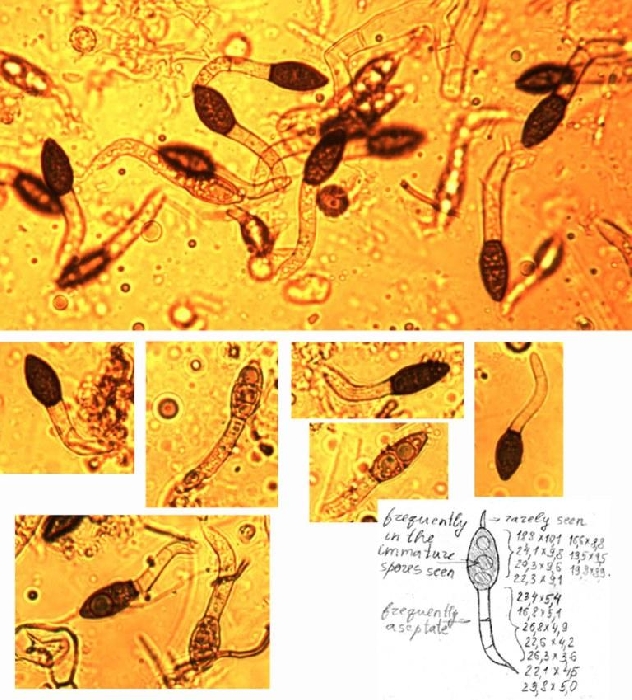
Today I found an interesting sample of Bombardia (similar with B. fasciculata, = B. bombarda). Unfortunately, the spores dimensions referred to this species in Ellis and Ellis book does not fit my sample. The other literature on this genus, I have not. Maybe someone knows the species with such parameters?
The sample was collected on the heavily rotten trunk of Fraxinus excelsior together with Tommentella sp. in December 2 in Ukraine.
Grateful before,
Alex.
Alex Akulov,
01-01-2011 12:13
Re:Bombardia sp. from Fraxinus wood
Photoes
Christian Lechat,
01-01-2011 12:24

Re:Bombardia sp. from Fraxinus wood
Hi Alex,
maybe Cercophora caudata? it would be necessary to see perithecia.
Christian
maybe Cercophora caudata? it would be necessary to see perithecia.
Christian
Alex Akulov,
01-01-2011 13:22
Re:Bombardia sp. from Fraxinus wood
Dear Christian
Yes, my sample really is similar with Cercophora caudata well. To test this I will need detailed literature on Cercophora, which is stored at my workplace at the university. Unfortunately, I do not have the article of Hilber & Hilber (Zeitschrift fur Mykologie 45 (2) :209-233. 1979). Have you got this paper?
Perithecia on my sample are old with a partially collapsed walls. In addition, they are almost completely submerged in the subiculum of Tommentella. There are black, with dark protuberant necks, but I see not setae.
Thank you for help!
Alex
Yes, my sample really is similar with Cercophora caudata well. To test this I will need detailed literature on Cercophora, which is stored at my workplace at the university. Unfortunately, I do not have the article of Hilber & Hilber (Zeitschrift fur Mykologie 45 (2) :209-233. 1979). Have you got this paper?
Perithecia on my sample are old with a partially collapsed walls. In addition, they are almost completely submerged in the subiculum of Tommentella. There are black, with dark protuberant necks, but I see not setae.
Thank you for help!
Alex