
09-04-2026 15:25
Jac GelderblomOn bare soil between mosses Ifound an asco I deter
09-04-2026 13:55
Thomas Læssøehttps://svampe.databasen.org/observations/10589176
09-04-2026 10:12
Thomas Læssøehttps://svampe.databasen.org/observations/10587061
08-04-2026 20:33
 Vasileios Kaounas
Found 07-04-26, in Abies cephalonica. Diameter 1,
08-04-2026 10:39
FRANCIS FOUCHIERBonjour , je recherche en pdf cet article: KORF R

06-04-2026 21:36
 Viktorie Halasu
Hello, could anyone please send me the article wi
06-04-2026 19:40
 David Gibbs
Help with this one much appreciated, on rotting Fa
Peziza spec.
Björn Wergen,
13-10-2010 12:38
 Salut,
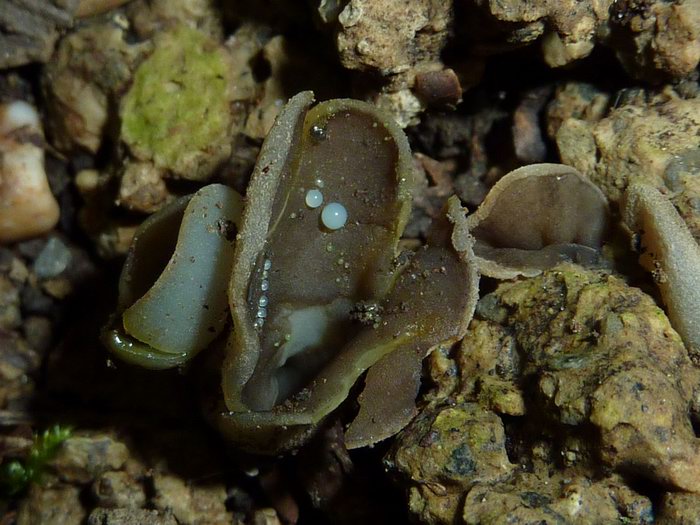
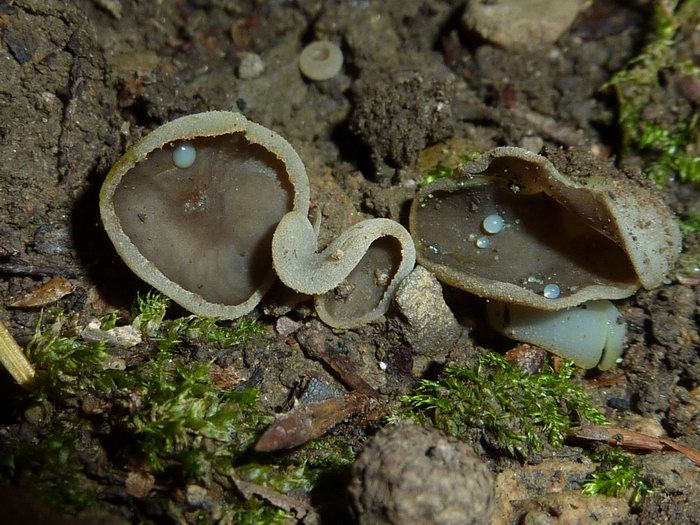
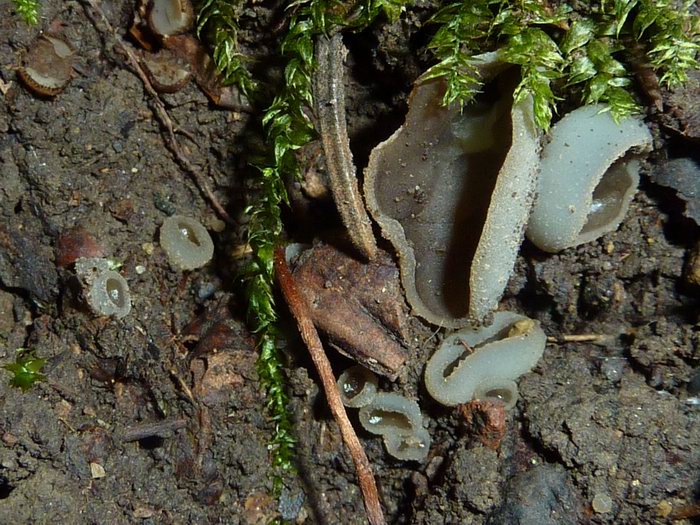
during on one of my last expeditions I have found some Pezizas, Peziza succosa and another one, still undetermined. Microscopical data let me decide to call it Peziza succosella, but the form of the spores are not that ellipsoid like P. succosella has it...well let me give you a description of it:
Fruitbody 20-30 mm, cup-like, with violaceous to brown-violaceous hymenium and a pale violett to greyviolett, rough outside, gives a opalescent "latex" after breaking it.
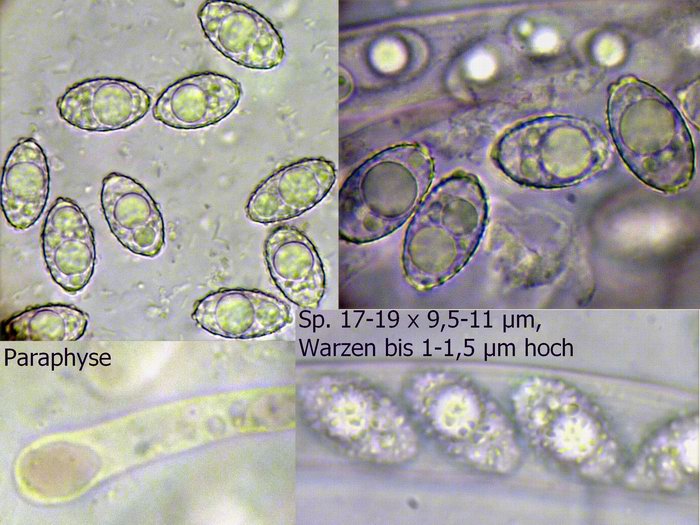
Spores ellipsoid to distinct fusiform, with distinct warts 1-1,5 µm high, even more conspicuously (broader, not higher) at the poles (see photos), with only one vakuole, sometimes with one big and some smaller ones, 17-19 x 9,5 -11 µm.
Paraphyses cylindrical, with swollen apex, septate, in the apex filled with brown-orange material, 3,6 µm, apex up to 5 µm broad.
Found on soil, between moss in a Fagus-forest.
Björn Wergen,
13-10-2010 12:41
Peziza spec.
photo
Björn Wergen,
13-10-2010 12:41
Re:Peziza spec.
photo
Björn Wergen,
13-10-2010 12:41
Re:Peziza spec.
Mikro
Nicolas VAN VOOREN,
13-10-2010 21:13

Re:Peziza spec.
This is Peziza succosa.
Björn Wergen,
13-10-2010 23:03
Re:Peziza spec.
sure? The "two" species grew together and were definitely distinguishable from each other by different colous and fruitbody-size...I had lots of succosa collections this year to see the difference to this species here, especially the exceptional formed spores (nearly fusiform) and the broader warts at the poles...
cheers, kazuya
cheers, kazuya
Nicolas VAN VOOREN,
15-10-2010 07:57
Re:Peziza spec.
P. succosa offers a great variabilty in its macrsocopic aspects. Your first photograph is typical: white latex, becoming yellowish when drying, colour of hymenium, colour of the external surface. The microscopic features are also in accordande with this species.
Is it possible to see the spores in CRB?
Is it possible to see the spores in CRB?
Björn Wergen,
18-10-2010 14:02
Re:Peziza spec.
Hi Nicolas,
its not possible for me to see spores in CRB, I do not have any chemicals to proof it...
cheers,
Kazuya
its not possible for me to see spores in CRB, I do not have any chemicals to proof it...
cheers,
Kazuya