28-04-2026 20:07
 Lothar Krieglsteiner
... on twig in the air at standing Ceratonia siliq
14-04-2026 05:32
Ethan CrensonHi all, A few weeks back a friend pointed out som
28-04-2026 20:33
Vitus SchäfftleinHello, I found Trochila ilicina on Ilex aquifoliu

30-04-2026 10:28
Rot BojanHello, by appearance I would say that I am dealing
27-04-2026 18:48
Tony MoverleyCollected 23rd April 2026, Norfolk, EnglandSwarms
27-04-2026 20:52
Lothar Krieglsteiner
Found on hanging tiwg of Olea europaea in dried-ou
28-04-2026 22:51
 Bernard CLESSE
Bonsoir à toutes et tous,Pourriez-vous m'aider à
29-04-2026 08:01
Lothar Krieglsteiner
... on twig attached to small tree of Citrus auran
29-04-2026 10:44
Lothar Krieglsteiner
growing at moist, drying-out soil at the side of a
Trichopezizella sur Sambucus ebulus
Gilbert MOYNE,
13-06-2010 18:59
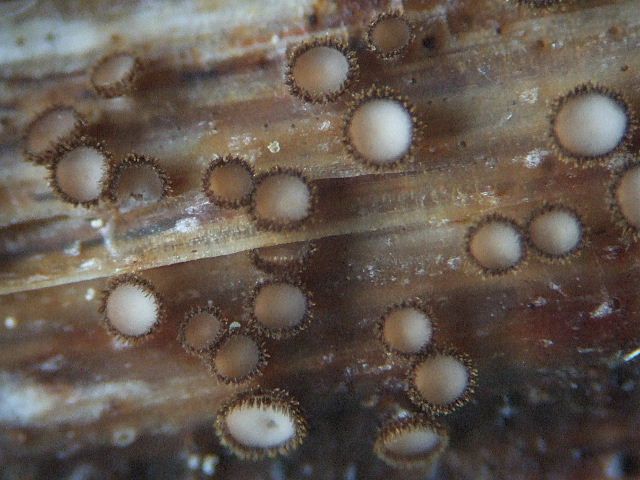
En fouinant cette fois dans un massif de yèble (Sambucus ebulus) j'ai trouvé des tiges couvertes de ce Trichopezizella (enfin je crois) , souvent en compagnie de Trichopeziza leucophaea et mollissima (parfois les trois sur la même tige).
Apothécies 0,8-1,5 mm de diamètre, largement étalées sur le support, à hyménium souvent convexe, blanc, bordé d'une marge aux nombreux poils.
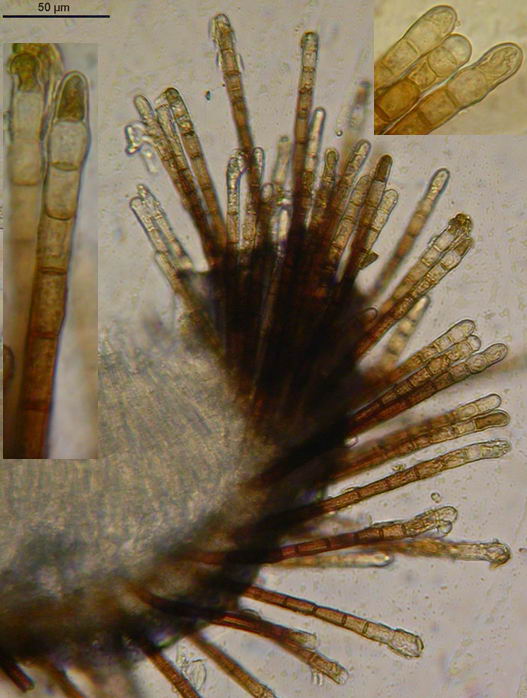
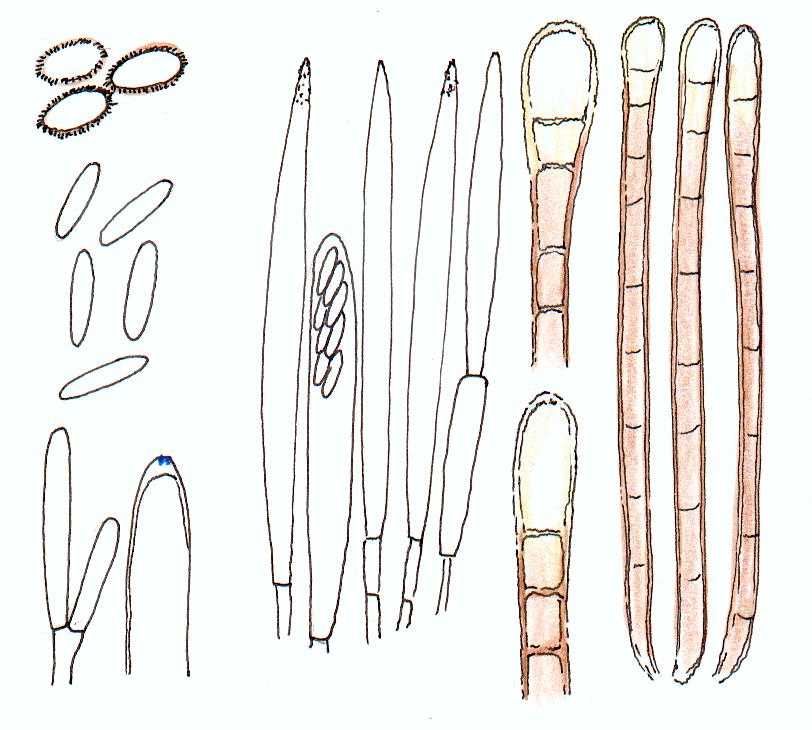
Poils 150-200 x 6 µm, à paroi assez épaisse, 8-9 cloisons plus resserrées vers le haut qui est parfois renflé, brun sauf à l'extrême base et vers le haut.
Asques 50-55 x 6-7, pas vu de crochets malgré une longue recherche, J+, 8 spores bisériées.
Paraphyses lancéolées, sans gouttes, parfois une impression de légèrement granuleuses au sommet, dépassant largement les asques.
Spores étroitement elliptiques, lisses, hyalines, sans goutte, 7-10 x 1-1,5.
J'arrive du côté de Trichopezizella nidula mais l'habitat me gène.
J'ai récolté T. nidula sur Polygonum de nombreuses fois cette année et j'ai l'impression que c'est autre chose.
Si vous pouvez éclairer ma lanterne...
Merci
Gilbert
 11911.jpg
Hans-Otto Baral,
13-06-2010 20:49

Re:Trichopezizella sur Sambucus ebulus
certainly Trichopezizella, although I wonder about the warted tips of paraphyses. Hair length of up to 200 µm sounds also strange, usual is max. 150. I have never seen T. nidulus without croziers when on substrates other than Polygonatum, so I presume yours has croziers. But that to know for sure would be valuable. I use to look for croziers on a section. if you try a section you will also see that the hair bases are distinctly rooting, like in Scutellinia.
Zotto
Zotto
Hans-Otto Baral,
16-06-2010 20:31
Re:Trichopezizella sur Sambucus ebulus
Asci are with croziers and I found the haurs only 100-130 µm long. So it is "Dasyscyphus" rubroguttatus Svrcek, with the only hesitation that Svrcek did not care for croziers.
Hairs are nicely rooting.
Zotto
Hairs are nicely rooting.
Zotto