28-04-2026 20:07
 Lothar Krieglsteiner
... on twig in the air at standing Ceratonia siliq
14-04-2026 05:32
Ethan CrensonHi all, A few weeks back a friend pointed out som
28-04-2026 20:33
Vitus SchäfftleinHello, I found Trochila ilicina on Ilex aquifoliu

30-04-2026 10:28
Rot BojanHello, by appearance I would say that I am dealing
27-04-2026 18:48
Tony MoverleyCollected 23rd April 2026, Norfolk, EnglandSwarms
27-04-2026 20:52
Lothar Krieglsteiner
Found on hanging tiwg of Olea europaea in dried-ou
28-04-2026 22:51
 Bernard CLESSE
Bonsoir à toutes et tous,Pourriez-vous m'aider à
29-04-2026 08:01
Lothar Krieglsteiner
... on twig attached to small tree of Citrus auran
29-04-2026 10:44
Lothar Krieglsteiner
growing at moist, drying-out soil at the side of a
Pyreno on Artemisia
Martin Bemmann,
28-05-2010 03:55
 Hello,
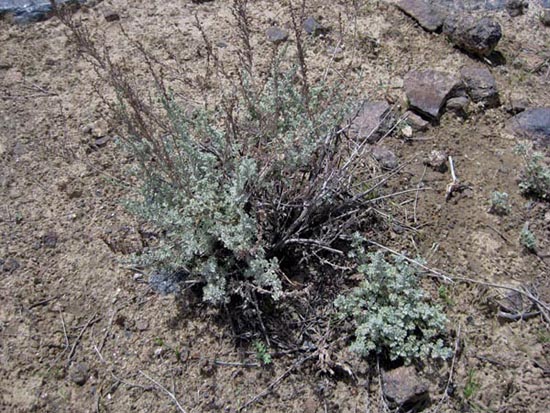
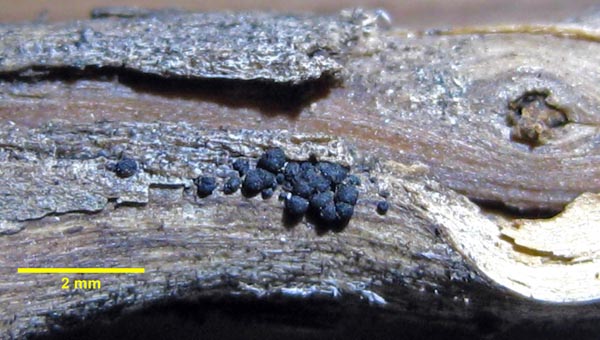
this Pyreno I found some days ago on a dead stem of Artemisia brevifolia in northern Pakistan at ca. 1,400 m above sealevel.
Perithecia are sphaerical, sessile, gregarious, ostioles not observed, c. 0.3mm dm.
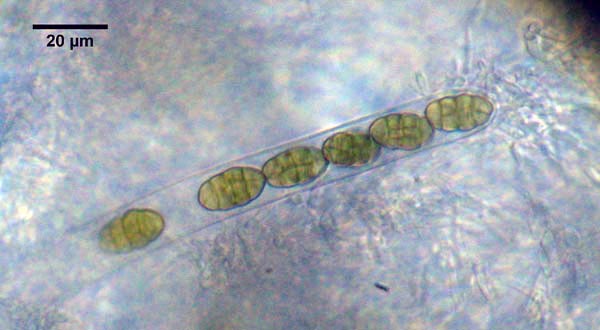
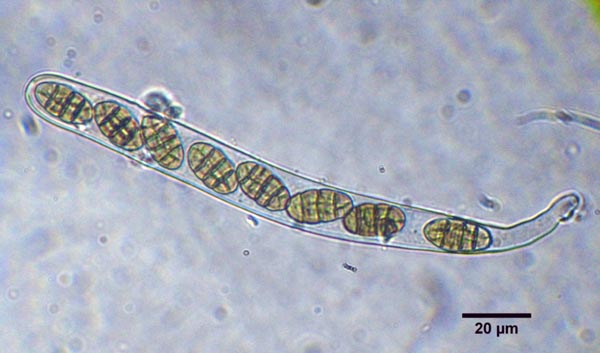
Asci are IKI-, 8-spored, uniseriate, cylindric with a short stipe, the only one completely visible measured 162x14.7 µm.
Paraphyses are abundant, hyaline and filiforme.
Spores are oval with rounded tips, light olivebrown, muriforme septated with 3 horizontal septa and 1 mostly incomplete vertical septum, 16.5-20x7.7-10.4 µm (no "free" spores observed).
Would Teichospora be an option?
Best regards,
Martin
Martin Bemmann,
28-05-2010 03:57
Re:Pyreno on Artemisia
Spores within an ascus:
Martin Bemmann,
28-05-2010 03:58
Re:Pyreno on Artemisia
another ascus
Milanka Tanaskovic,
29-05-2010 00:56
Re:Pyreno on Artemisia
Peut-être du côté des Cucurbitariaceae? Une petite ressemblance avec Cucurbitaria berberidis que j’ai récolté récemment sur les branches morte de Berberis hort.
Mila
Mila
Alain GARDIENNET,
29-05-2010 09:14

Re:Pyreno on Artemisia
Hi Martin,
I suppose that this pyreno starts under the bark. Isn't it ?
Did you observe other characters (setae, clypeus, ...), did you observe a gel coating around spore ?
I will research around the genus Pleospora. The host is more an host for Pleosporaceae than Cucurbitariaceae, I think, but I can be wrong.
Alain
I suppose that this pyreno starts under the bark. Isn't it ?
Did you observe other characters (setae, clypeus, ...), did you observe a gel coating around spore ?
I will research around the genus Pleospora. The host is more an host for Pleosporaceae than Cucurbitariaceae, I think, but I can be wrong.
Alain
Alain GARDIENNET,
29-05-2010 09:28
Re:Pyreno on Artemisia
My opinion is that your recolt should be Pleospora pellita var. bardanae . A species seen in all the world (E, nA, sA, Asia) on various herbaceous stems. You should work in this direction.
But it's only my opinion.
Alain
But it's only my opinion.
Alain
Martin Bemmann,
29-05-2010 19:23
Re:Pyreno on Artemisia
Thank you Milanka and Alain,
I am afraid this has to wait until I'm back in Germany. I have few literature with me and the wwweb is very slow via mobile here, but I learned that Pleospora und Teichospora were discussed as beeing close genera, the first growing preferebly on herbaceous material and the latter on wood (Wehmeyer 1961, Arx&Müller 1975 etc.). And Cucurbitaria comes close as well but with a stromatic growth. Did I understand the summary given by D. Sierra Lopez 2006, pp. 237ff right?
By the way, the ascospores of Teichospora quercina she shows on pl. 7 are fitting well to my collection by shape and size. The lenght of asci she gives (100-115x 11-13 µm) appears to short to me since they should contain 8 up to 20µm long spores uniseriatelly.
These dead stems of Artemisia brevifolia (I gave a wrong species name above by mistake - now edited) can be considered as beeing wood (see photograph attached). In fact it is collected as local fuel.
@Alain: I could not observe any of the features you are asking for, maybe due to my basic equipment here, eg. no Stereoloupe at hands.. It might be that the perithecia were developed under the bark, but most of it is fallen off. But on the left side of my first picture you can see a single ascoma clearly sitting upon the bark.
Crivelli 1986, p. 99 follows Shoemaker 1968 that Pl. pellita var. bardanae belongs to Nodulosphaeria and therefore gives no description or figures in his thesis on Pl. So I can't follow your guess right now. It seems to be (IF) synonyme to Pl. bardanae depicted in Berlese's vol2, pl. VI. That one has far to acute sporetips to match with my collection.
I wonder I can find out more at home...
Thanks again,
Martin
I am afraid this has to wait until I'm back in Germany. I have few literature with me and the wwweb is very slow via mobile here, but I learned that Pleospora und Teichospora were discussed as beeing close genera, the first growing preferebly on herbaceous material and the latter on wood (Wehmeyer 1961, Arx&Müller 1975 etc.). And Cucurbitaria comes close as well but with a stromatic growth. Did I understand the summary given by D. Sierra Lopez 2006, pp. 237ff right?
By the way, the ascospores of Teichospora quercina she shows on pl. 7 are fitting well to my collection by shape and size. The lenght of asci she gives (100-115x 11-13 µm) appears to short to me since they should contain 8 up to 20µm long spores uniseriatelly.
These dead stems of Artemisia brevifolia (I gave a wrong species name above by mistake - now edited) can be considered as beeing wood (see photograph attached). In fact it is collected as local fuel.
@Alain: I could not observe any of the features you are asking for, maybe due to my basic equipment here, eg. no Stereoloupe at hands.. It might be that the perithecia were developed under the bark, but most of it is fallen off. But on the left side of my first picture you can see a single ascoma clearly sitting upon the bark.
Crivelli 1986, p. 99 follows Shoemaker 1968 that Pl. pellita var. bardanae belongs to Nodulosphaeria and therefore gives no description or figures in his thesis on Pl. So I can't follow your guess right now. It seems to be (IF) synonyme to Pl. bardanae depicted in Berlese's vol2, pl. VI. That one has far to acute sporetips to match with my collection.
I wonder I can find out more at home...
Thanks again,
Martin