
30-05-2026 21:12
Philippe PELLICIERSur branche de mélèze (Larix) près de la neige,
31-05-2026 10:35
Hulda Caroline HolteHello,I collected this species growing on a rather
25-05-2026 16:35
 Bernard CLESSE
Bonjour à toutes et tous,J'ai trouvé récemment,
29-05-2026 15:35
daniel FERREBonjour à tous,Je voudrais votre aide pour cette
28-05-2026 16:15
James MitchellHello,Does anyone have the original publication of
28-05-2026 11:06
Thomas Læssøehttps://svampe.databasen.org/observations/10596750
23-05-2026 11:44
 Charles Grapinet
Hello, I am having trouble identifying this copro
25-05-2026 16:44
François BartholomeeusenHi forum members,During an excursion organised by
26-05-2026 21:25
Dirk GerstnerHello everyone, I'm completely stumped by this li
26-05-2026 22:44
Ethan CrensonHi all, I think I have Incrucipulum capitatum her
Pyrenopeziza on monocot.
Enrique Rubio,
22-04-2026 20:54
 Hi to everybody.
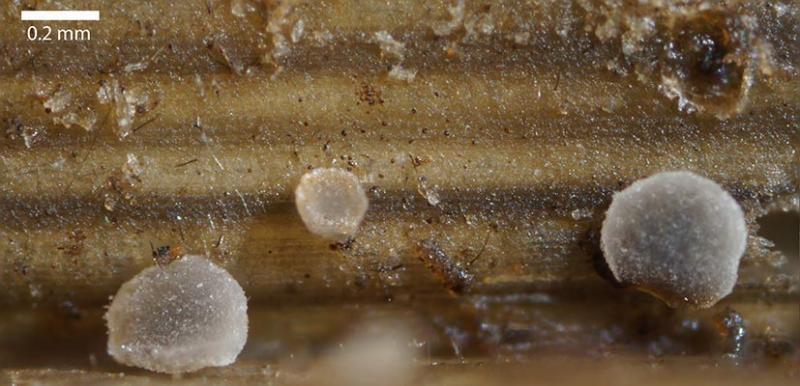
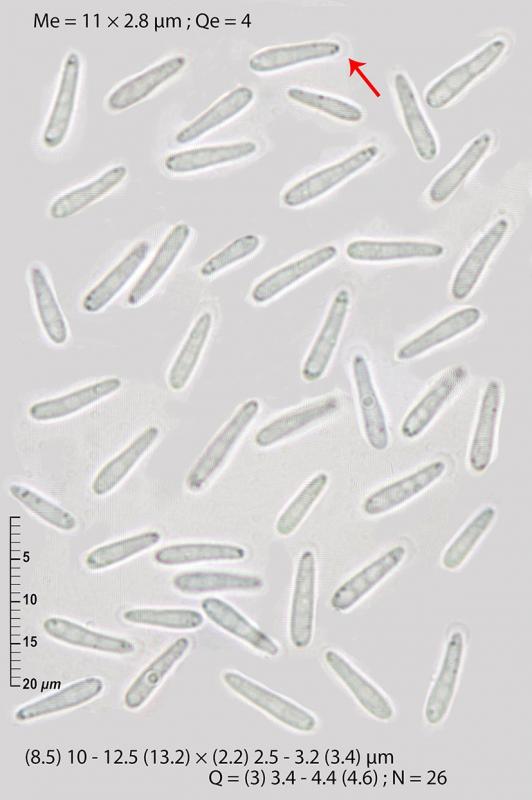
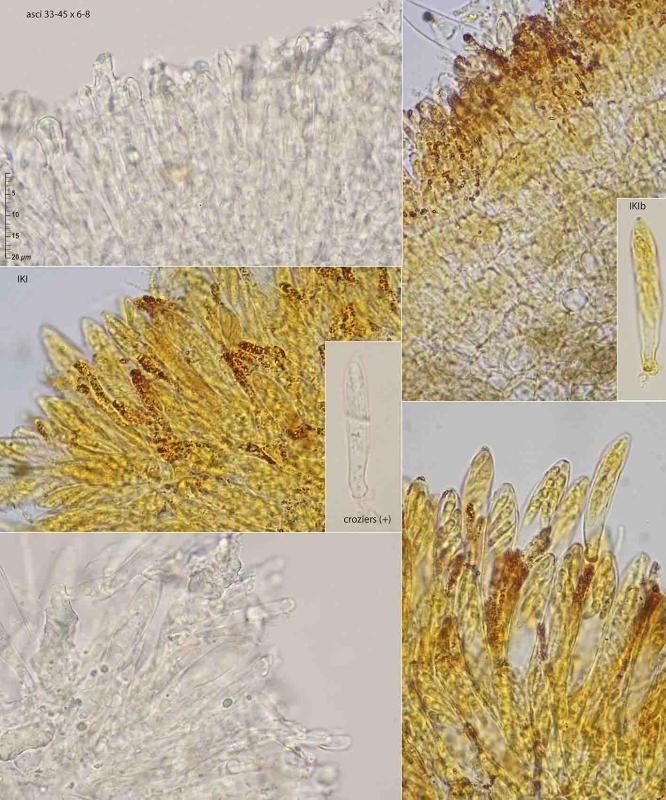
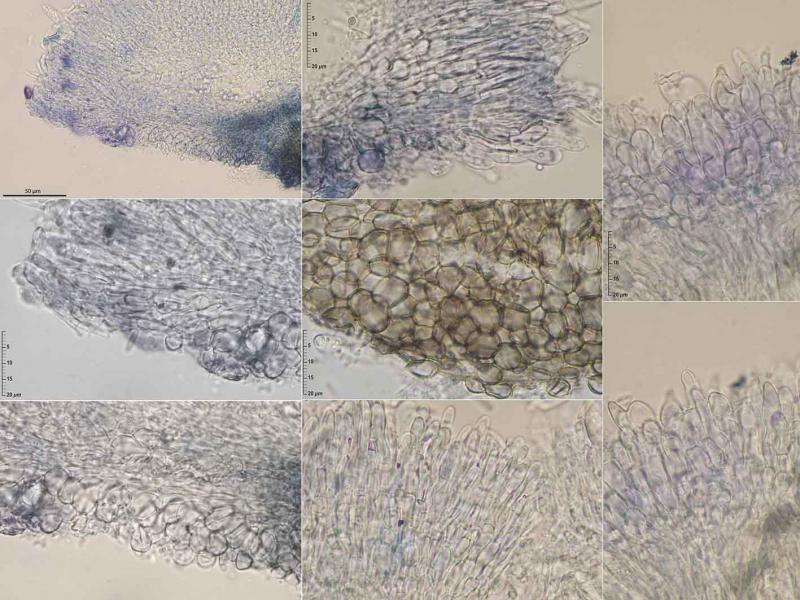
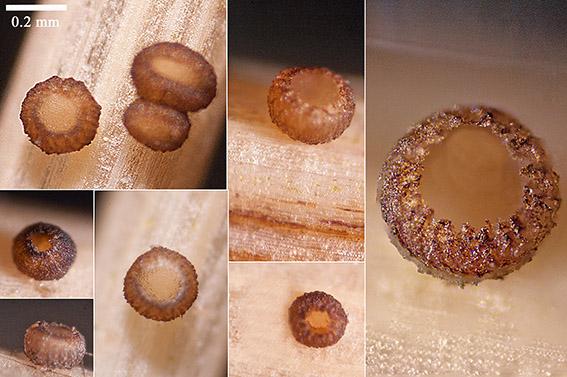
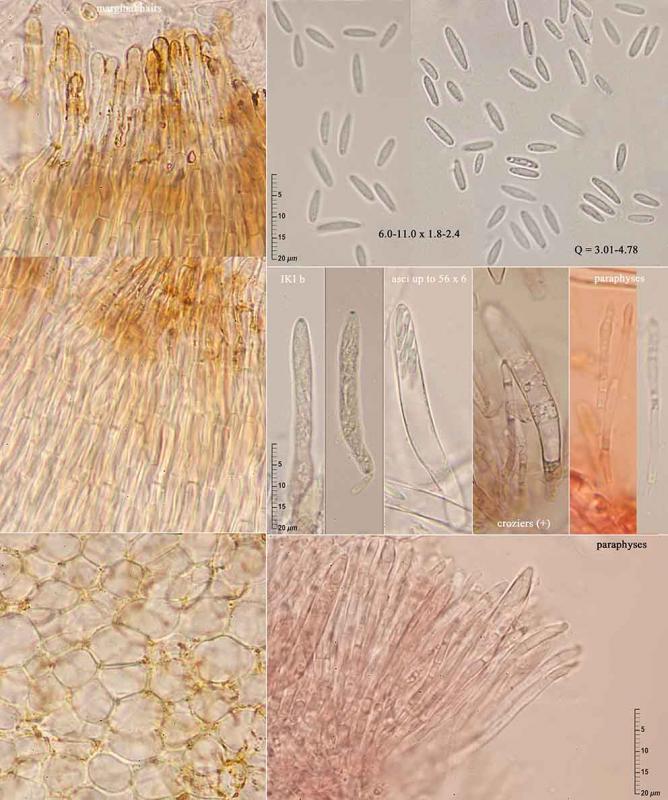
This Pyrenopeziza grew in moist leaves of monocot. (Carex?) in a coastal lagoon in northern Spain. The apothecial margin is very briefly pubescent with short chains of cells with a clavate or broad bullet-shaped terminal element. Asci IKIb asci arising from croziers. Ascospores clavate with a broad obtuse base and a narrower, pointed apex. The lipid content is low or very low, consisting of only a few fine droplets near the poles (OCI=0-1) and remnants of a small apical gelatinous sheath that soon disappears (red arrowed). The paraphyses appear to have very little content and their apices possess an amorphous, almost hyaline or yellowish substance that reacts reddish in IKI. Excipulum textura globuloso-angularis texture of greyish cells.
There are some similarities with Peziza inapiculata Declercq, but I'd like to hear your thoughts.
Many thanks again
Hans-Otto Baral,
24-04-2026 09:26
Re : Pyrenopeziza on monocot.
Pyrenopeziza karstenii is a quite variable species or species aggregate, I think this fits to some of the sampes in my folder.
Michel Hairaud,
24-04-2026 11:45

Re : Pyrenopeziza on monocot.
Ah ! good idea !
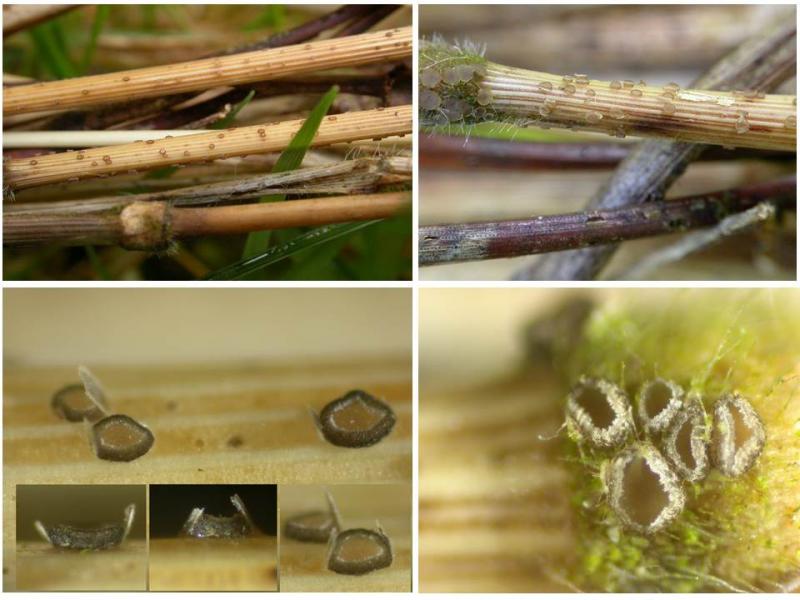
In my collections of what I called P. karstenii , the apothecia appeared with rather brown hairs and under the stem epiderm ''cut'' in an opercule .
AmitiésMichel
In my collections of what I called P. karstenii , the apothecia appeared with rather brown hairs and under the stem epiderm ''cut'' in an opercule .
AmitiésMichel
Hans-Otto Baral,
24-04-2026 11:51
Re : Pyrenopeziza on monocot.
Yes, this variation occurs. I think the species is little understood.
Enrique Rubio,
24-04-2026 12:03
Re : Pyrenopeziza on monocot.
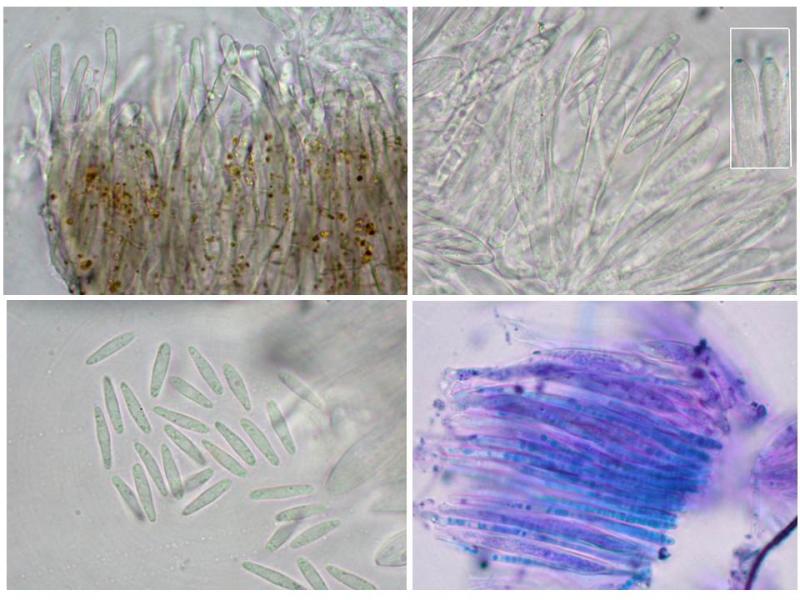
Yes, I think Michel is right. In this collection lacks the typical reddish-brown granular
exudate of P. karstenii, a characteristic that I have always observed in all my collections, despite its variability.
exudate of P. karstenii, a characteristic that I have always observed in all my collections, despite its variability.
Michel Hairaud,
24-04-2026 12:08
Re : Pyrenopeziza on monocot.
Here are some pics
Hans-Otto Baral,
24-04-2026 12:11
Re : Pyrenopeziza on monocot.
Such pigments may vary, we do not know. For instance, Durella suecica I remember dakr brown and whitish.
Enrique Rubio,
24-04-2026 12:28
Re : Pyrenopeziza on monocot.
And the marginal hairs, which are longer and narrower and always pigmented, just like the walls of the excipular cells.
Enrique Rubio,
24-04-2026 12:30
Re : Pyrenopeziza on monocot.
Thank you both very much. It definitely doesn't remind me of Pyrenopeziza karstenii.
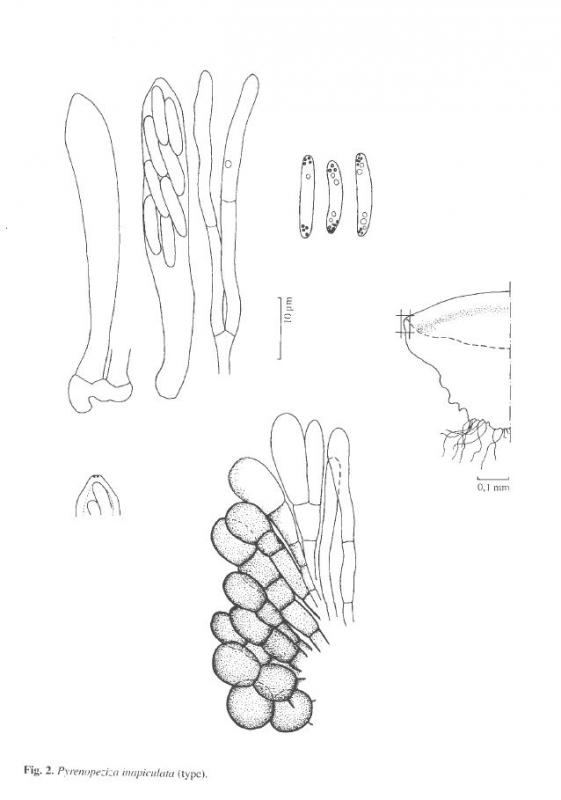
I think it is more similar to *inapiculata*, although the spores are more clavate and less fusiform than those described by Declercq in his protologue.
I think it is more similar to *inapiculata*, although the spores are more clavate and less fusiform than those described by Declercq in his protologue.
Hans-Otto Baral,
25-04-2026 09:29
Re : Pyrenopeziza on monocot.
P. inapiculata isn't a bad idea, but as far as I see the asci there are much longer, though under a similar width. Did you measure your asci? I get *33 x 7.5 µm, inapiculata is around 40-60 x 6.5-7.5 µm.
I saw again how heterogeneous P. karstenii is in my folder. I tried a bit to sort, but it is impossible. So it is important to collect the data. Could you please give me hints on your three samples of this thread? Date and location, of course substrate?
Michel Hairaud,
25-04-2026 11:21
Re : Pyrenopeziza on monocot.
Ok, that would help to get a better idea of the taxon. We may have different interpretations of it.
I will give the data once back home.
Interesting thread anyway !
Michel
I will give the data once back home.
Interesting thread anyway !
Michel
Enrique Rubio,
25-04-2026 12:12
Re : Pyrenopeziza on monocot.
The measurementes of the asci are in my plate: 33-45 x 6-8.
My three collections were made allways on Poaceae. I'll send you those references later.
My three collections were made allways on Poaceae. I'll send you those references later.
Enrique Rubio,
25-04-2026 12:14
Re : Pyrenopeziza on monocot.
Declercq's illustrations of inapiculata spores are less clvate than mine.
Hans-Otto Baral,
25-04-2026 15:07
Re : Pyrenopeziza on monocot.
Yes, and I see in your second plate the asci are much longer and the spores less clavate.
Hans-Otto Baral,
26-04-2026 07:58
Re : Pyrenopeziza on monocot.
I saw that we have a sequence of one of the samples of P. inapiculata collected by Torsten Richter and documented by Ingo Wagner. The phylotree is in my folder under the name
Pyrenopeziza-inapiculata-(Typha)-180708-TR-IW027-TU134278-Baum
I have one sequence of a "typical" P. karstenii: HB 9956 TUF-104726 and one under the name
"Mollisia" poaeoides (as Pyrenopeziza cf. karstenii) IW158
which are all quite different.
So any further sequences would be interesting to compare.
Michel Hairaud,
20-05-2026 11:00
Re : Pyrenopeziza on monocot.
Hi together,
I found again what I called P. karstenii on stems of Melica uniflora on calacreaous forestry ground.
My previuos collections were on a similar substrate
Michel
I found again what I called P. karstenii on stems of Melica uniflora on calacreaous forestry ground.
My previuos collections were on a similar substrate
Michel