
12-04-2026 17:56
 Hardware Tony
Found on dead stems in February earlier this year
12-04-2026 15:52
Gernot FriebesHi,I'm looking for help with this anamorph collect
12-04-2026 12:22
 William Slosse
In a dune grassland in Oostduinkerke (Belgium), on
11-04-2026 15:45
 Zuzana Sochorová (Egertová)
Please, could anyone send me this paper?Moyne G.,
11-04-2026 13:34
Artem PtukhaHello, I am seeking assistance with the identific

11-04-2026 10:19
 Michel Hairaud
Chers amis d'Ascofrance , voici une très bonne no
11-04-2026 10:10
Michel Hairaud
Dear Ascofrance members, here is some very good ne
10-04-2026 23:22
Gernot FriebesHi,ascospores are 1- to 3-septate, approximately
10-04-2026 15:51
William Slosse
Hello everyone, On 08/04/26, I found a growth sit
Help for Genus and Species ID
Michel Hairaud,
11-03-2026 17:36
Bonjour, Je cherche des indices pour cette récolte sur bois mort (Plus probablement Acer sp.) au sol Apos 0,10-0,15 mm, hyalines à blanchâtres , un peu granuleuses d'aspect, très fragiles
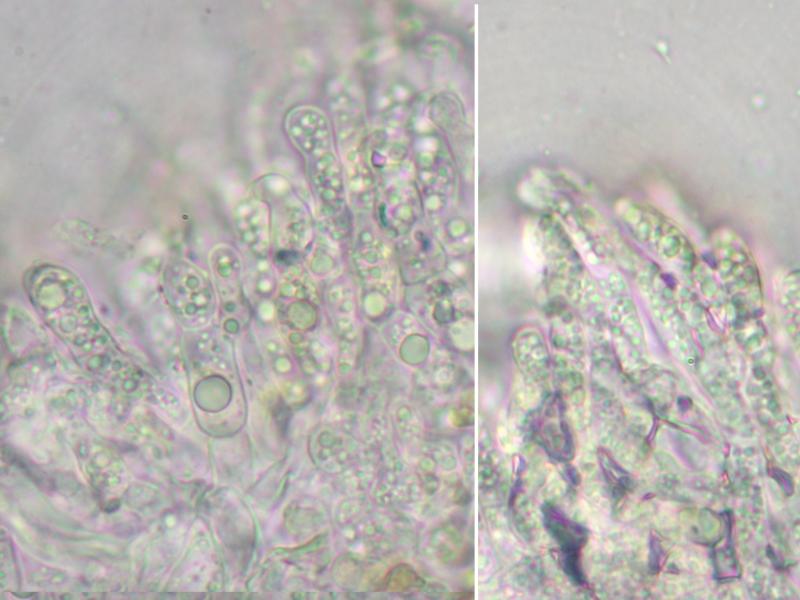
Asques avec crochets, , IKI négatif , en moyenne 60 x 16 µm, Spores 10-12 x 5-6 µm.
Paraphyses remarquablement larges, avec VBs (CRB +) Ectal prismatica avec VBs
Merci pour tout indice,
Amitiés. Michel


Hans-Otto Baral,
11-03-2026 19:50

Re : Help for Genus and Species ID
Hard to tell. Seems there is an inamyloid apical dome in dead asci.
The VBs speak for a Pezizellaceae. Mo idea. Perhaps the excipulum could narrow the relationship?
Michel Hairaud,
11-03-2026 23:30
Re : Help for Genus and Species ID
Thanks, Zotto,
I did search in the Pezizellaceae after observation of the prismatica type ectal , full of VBs ...
but found no match
Michel
I did search in the Pezizellaceae after observation of the prismatica type ectal , full of VBs ...
but found no match
Michel
Nicolas VAN VOOREN,
12-03-2026 07:37

Re : Help for Genus and Species ID
Peut-être une idée stupide, mais pourquoi pas un champignon lichénisé ? Il me semble apercevoir sur les photos macros ce qui pourrait être un thalle...
Hans-Otto Baral,
12-03-2026 09:14
Re : Help for Genus and Species ID
Asci and spores indeed resemble some lichens, maybe Agyrium, but inamyloid hymenia in lichens I think are very rare. It would be the first case of VBs occurring in lichens.
I am not sure if the apothecia survive drought. What is the substrate and how was the situation when you found it, Michel?
Your pics show the cortical layer of the excipulum, but how is it more inside? I fear the fungus is too small to obtain a section.
Lothar Krieglsteiner,
12-03-2026 18:06

Re : Help for Genus and Species ID
perhaps what I suggest is ridiculous, but this fungus reminds me to some extent of Mniaecia, e.g. M. gloeocapsae s.l. - but I know those usually grow on soil. But perhaps the algae are more important?
Hans-Otto Baral,
12-03-2026 20:51
Re : Help for Genus and Species ID
Mniaecia so far never had VBs. it would surprize me.
Michel Hairaud,
13-03-2026 10:26
Re : Help for Genus and Species ID
Merci pour vos efforts, Nicolas, Zotto et Lothar.
My first idea was also Mniaecia because of spore shape, but the other caracters do not fit, (VBs and négative IKI ) I also searched in other groups unsuccessfully. I also considered a lichen with no result but I know too little about lichens.
This collection was on a small piece of wood (most probably acer ) semi burried on calacareous soil. No thallus actually visible under lthe dissecting microscope and a croos section of tha apo is indeed difficult with a razor blade .
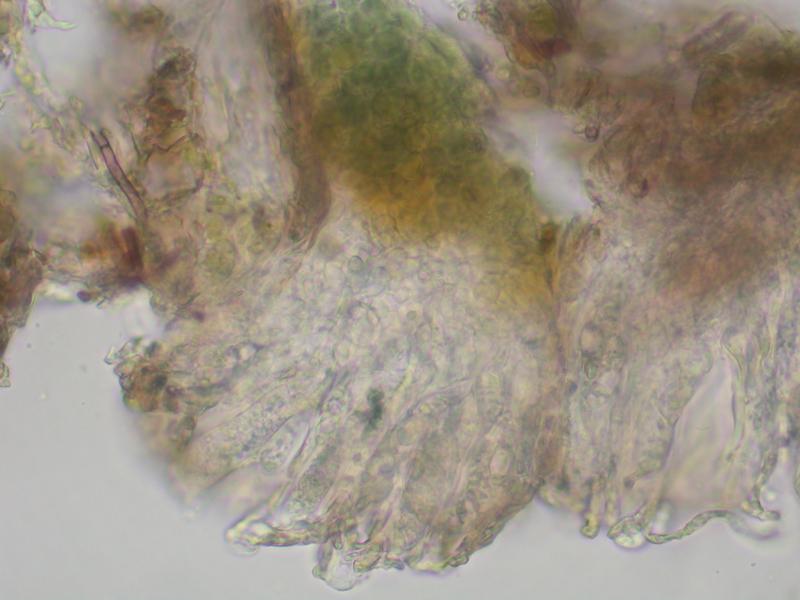
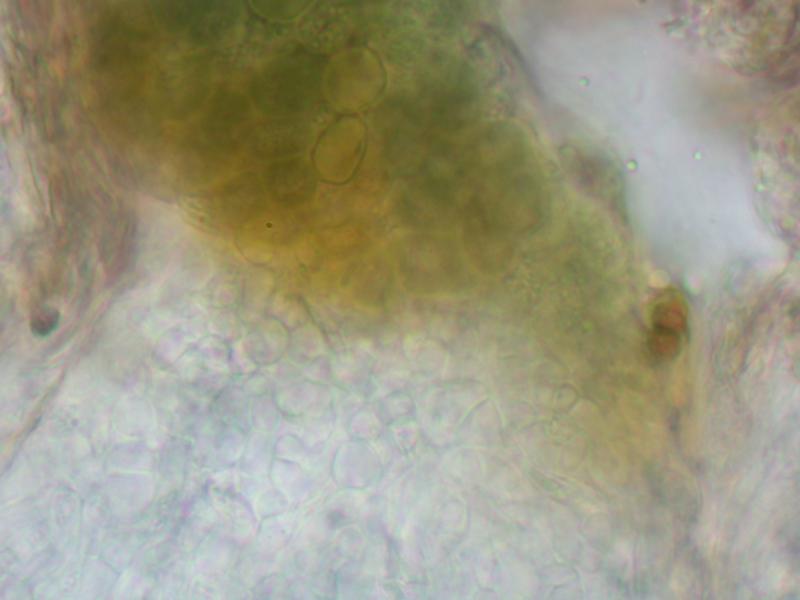
I tried again anyway and one can guess the hyalin medulla (prismatica-angularis) and also some algae under the apo . These algae might be linked to the apos , I'm not sure, but I could not find such algae at the wood surface around the apos .
See the (unfortunately poor quality) pics .
Michel
My first idea was also Mniaecia because of spore shape, but the other caracters do not fit, (VBs and négative IKI ) I also searched in other groups unsuccessfully. I also considered a lichen with no result but I know too little about lichens.
This collection was on a small piece of wood (most probably acer ) semi burried on calacareous soil. No thallus actually visible under lthe dissecting microscope and a croos section of tha apo is indeed difficult with a razor blade .
I tried again anyway and one can guess the hyalin medulla (prismatica-angularis) and also some algae under the apo . These algae might be linked to the apos , I'm not sure, but I could not find such algae at the wood surface around the apos .
See the (unfortunately poor quality) pics .
Michel
Hans-Otto Baral,
13-03-2026 11:27
Re : Help for Genus and Species ID
Yes I see, isodiametric cells similar as in ectal, but there brownish. remains a mystery for me.
Zdenek Palice,
16-03-2026 10:11

Re : Help for Genus and Species ID
A beautiful species!. ? might be something close to Trizodia, a dinosaurus among Lichinomycetes sensu latissimo, a kind of semilichen. Based on the colour and cell arrangement of the tentative photobiont it reminds me a nostoccalean cyanobacterium. Recently, a kind of similar stuff was described from Japan as Trizodia sylvestris (the 2-nd species of the genus), which is definitely something else, but not completely dissimilar, see Moryiama et al. (2025), Symbiosis 96:53–66
https://doi.org/10.1007/s13199-025-01059-w
https://doi.org/10.1007/s13199-025-01059-w
Michel Hairaud,
18-03-2026 10:27
Re : Help for Genus and Species ID
Merci Zdenek.
I could not get the paper you cited but had a look at Trizodia , which can be macroscopically and microscopilly compared but for the substrate and the iodine reaction.
I can send to you the exsic on the small piece of wood I collected if you wish. (need your mail adress , then)
Amitiés. Michel
I could not get the paper you cited but had a look at Trizodia , which can be macroscopically and microscopilly compared but for the substrate and the iodine reaction.
I can send to you the exsic on the small piece of wood I collected if you wish. (need your mail adress , then)
Amitiés. Michel