

30-04-2026 10:28
Rot BojanHello, by appearance I would say that I am dealing
27-04-2026 18:48
Tony MoverleyCollected 23rd April 2026, Norfolk, EnglandSwarms
14-04-2026 05:32
Ethan CrensonHi all, A few weeks back a friend pointed out som
27-04-2026 20:52
 Lothar Krieglsteiner
Found on hanging tiwg of Olea europaea in dried-ou
28-04-2026 22:51
 Bernard CLESSE
Bonsoir à toutes et tous,Pourriez-vous m'aider à
29-04-2026 08:01
Lothar Krieglsteiner
... on twig attached to small tree of Citrus auran
29-04-2026 10:44
Lothar Krieglsteiner
growing at moist, drying-out soil at the side of a
28-04-2026 20:33
Vitus SchäfftleinHello, I found Trochila ilicina on Ilex aquifoliu

Enigmatic pyrenomycete
Enrique Rubio,
01-01-2025 13:45
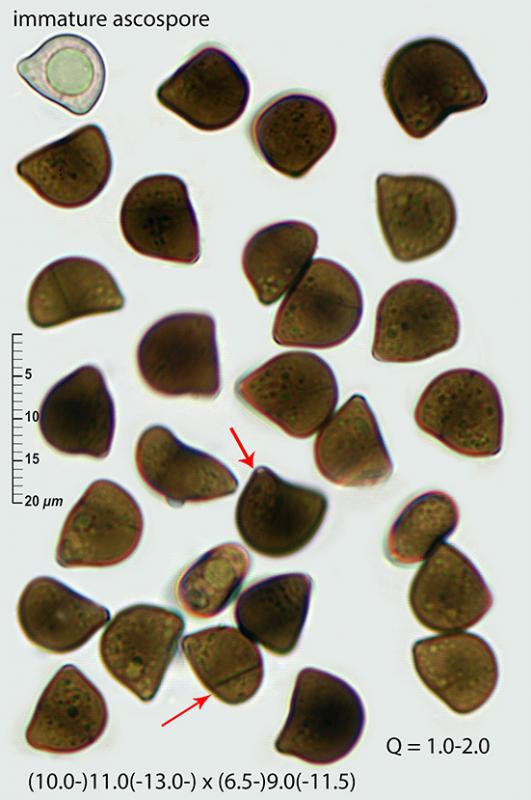
 THESE BLACKISH ASCOMATA WERE SEMI-IMMERSED IN A HARDWOOD BRANCH (PROBABLY QUERCUS) PARTIALLY BURIED IN THE GROUND, NEXT TO STROMATA OF XYLARIA HYPOXYLON. THE ASCOMATA, UP TO 700 MICRONS LONG, HAVE A BLACKISH PERITHECIAL VENTER IMMERSED UNDER THE WOOD AND A LONG NECK WITH A FIMBRIATED OSTIOLE THAT AGGLUTINATES SPORE BALLS OF DISCHARGED ASCOSPORES.
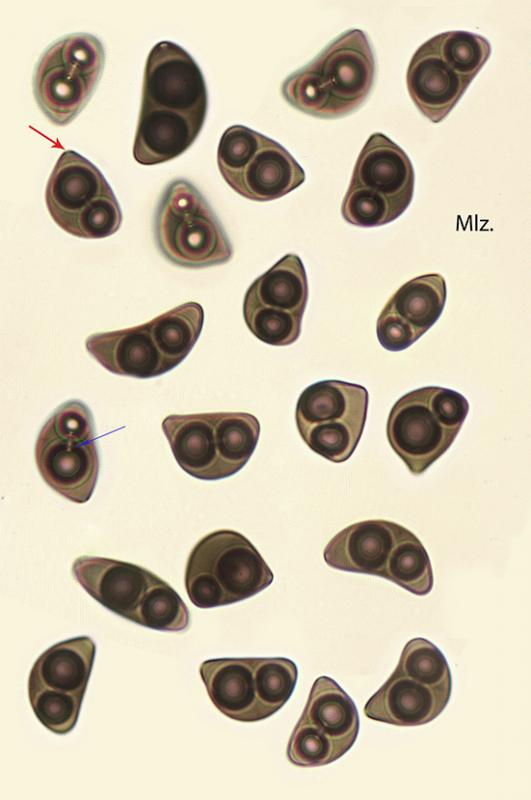
THE ASCI ARE CYLINDRICAL, WITH A DOUBTFUL OR INCONSPICUOUS APICAL APPARATUS MLZ. NEGATIVE AND THEY HAVE EIGHT OBLIQUELY UNISERIATE ASCOSPORES. THE PARAPHYSES ARE ABUNDANT, IN SOME CASES WITH MONILIFORM SEGMENTS AND THEY EXCEED THE LEVEL OF THE ASCI.
THE MATURE ASCOSPORES ARE BLACISH BROWN, THEY HAVE AT LEAST ONE GERM PORE (RED ARROW), SOMETIMES TRANSVERSE SEPTA, A COMPLEX SYMMETRIY AND PERHAPS A SHORT GERM-SLIT ONLY WELL VISIBLE IN MELZER'S REAGENT (BLUE ARROW).
I CANNOT FIND AN APPROPRIATE GENUS FOR THIS FUNGUS, NOT EVEN WITHIN THE MELANOSPORALES, SO I AM ASKING FOR SOME CLUE TO SOLVE THIS ENIGMA.
I WOULD LIKE TO TAKE THIS OPPORTUNITY TO WISH YOU A HAPPY NEW YEAR.



Alain GARDIENNET,
03-01-2025 08:17

Re : Enigmatic pyrenomycete
Hi Enrique,
Your fungus should not be too far from Bellojisia rhynchostoma.
Happy new year for you, and forum !
Alain
Your fungus should not be too far from Bellojisia rhynchostoma.
Happy new year for you, and forum !
Alain
Thorben Hülsewig,
03-01-2025 10:48
Re : Enigmatic pyrenomycete
Hi Enrique,
Perhaps you have found Corylomyces selenospora.
best regards,
Thorben
Perhaps you have found Corylomyces selenospora.
best regards,
Thorben
Enrique Rubio,
03-01-2025 12:45
Re : Enigmatic pyrenomycete
Some colleagues had initially pointed me towards Corylomyces and later towards Bellojisia. I think this fungus could belong to the latter genus, because by the morphology of the ascomata, the asci with an inconspicuous apical apparatus and the presence of abundant paraphyses. But the spores are quite different from those of J. rynchospora. Unfortunately there is too little material to attempt a culture and sequencing, but I am very grateful for your help.