
12-04-2026 17:56
 Hardware Tony
Found on dead stems in February earlier this year
12-04-2026 15:52
Gernot FriebesHi,I'm looking for help with this anamorph collect
12-04-2026 12:22
 William Slosse
In a dune grassland in Oostduinkerke (Belgium), on
11-04-2026 15:45
 Zuzana Sochorová (Egertová)
Please, could anyone send me this paper?Moyne G.,
11-04-2026 13:34
Artem PtukhaHello, I am seeking assistance with the identific

11-04-2026 10:19
 Michel Hairaud
Chers amis d'Ascofrance , voici une très bonne no
11-04-2026 10:10
Michel Hairaud
Dear Ascofrance members, here is some very good ne
10-04-2026 23:22
Gernot FriebesHi,ascospores are 1- to 3-septate, approximately
10-04-2026 15:51
William Slosse
Hello everyone, On 08/04/26, I found a growth sit
Helotiales on cone again
Juuso Äikäs,
08-11-2024 17:36
Recently I posted here my finding of small white apos growing on a fallen Picea abies cone. I found these once again, but this time on a fallen Pinus sylvestris cone.
This species seems rather distinctive, and apparently at least locally common as well. So I decided to post this finding as well — this time with better data. Could this be identified even to family level?
The apos are sessile-substipitate and 0.2 - 0.4 mm wide. Asci 8-spored, IKI+(b), croziers present. Paraphyses narrowly cylindrical, with multiguttulate tips; similar cells on the margin. Extal excipulum with angular-globose cells and round guttules.
Spores with two large guttules and some smaller ones. Some spores appeared to have a gelatinous sheath. Measurements:
(15.1) 15.8 - 19.3 (20.4) × (3.4) 3.7 - 4.2 (4.4) µm
Q = (4) 4.3 - 4.8 (5.1) ; N = 10
Me = 17.9 × 4 µm ; Qe = 4.5
Q = (4) 4.3 - 4.8 (5.1) ; N = 10
Me = 17.9 × 4 µm ; Qe = 4.5
Asci:
69.1 - 90 × 9.8 - 12.4 µm
Q = 7 - 7.4 ; N = 3
Me = 79 × 10.9 µm ; Qe = 7.2
Q = 7 - 7.4 ; N = 3
Me = 79 × 10.9 µm ; Qe = 7.2
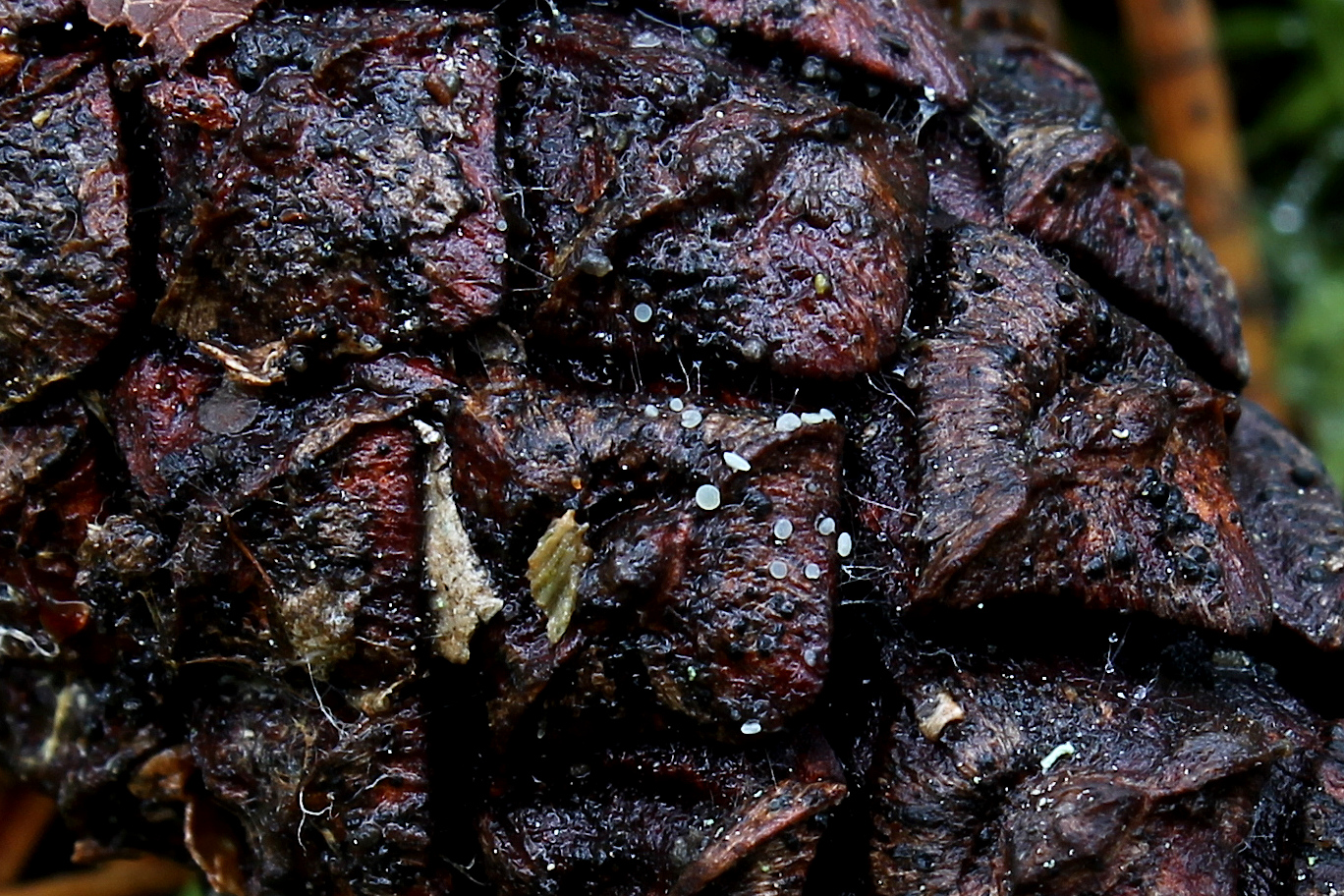 fruitbodies-1-0001.JPG
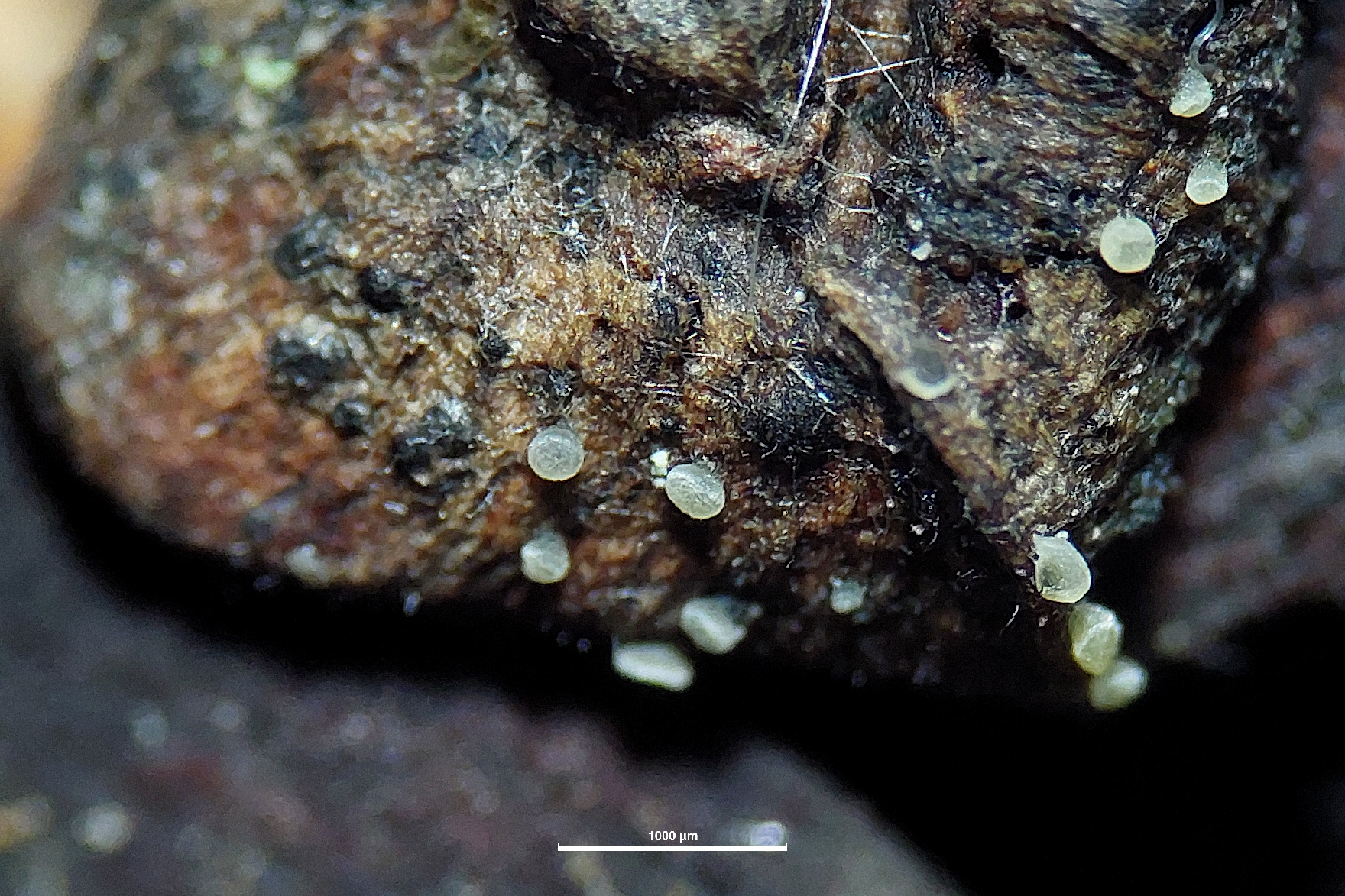 fruitbodies-2-0001.jpg
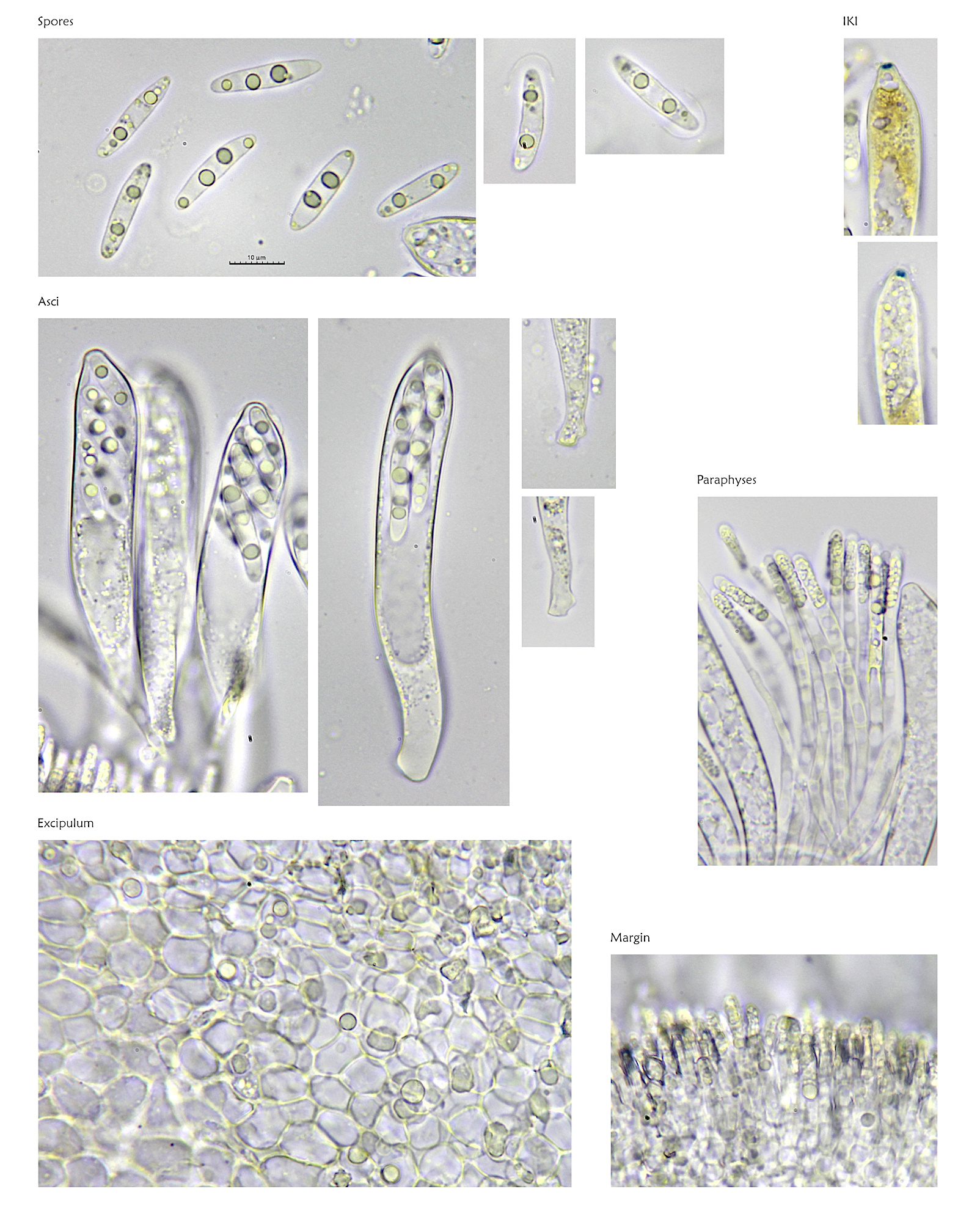 microplate-1-0001.JPG
Hans-Otto Baral,
08-11-2024 18:14

Re : Helotiales on cone again
This doesn't look the same as that on Picea if you mean that.
The apical ring is rather thick and the apex very conical, also the VBs in the paraphyses are restricted to the apex. H. epiphyllus would be multiguttulate in the cortical excipulum.
I am unsure for a genus, rather Calycina than Hymenoscyphus?
Juuso Äikäs,
08-11-2024 18:18
Re : Helotiales on cone again
I mean this one from a little earlier:
The Hymenoscyphus was on a Pinus cone as well (on the core part).
Hans-Otto Baral,
08-11-2024 21:38
Re : Helotiales on cone again
Ah o.k., now I remember. The paraphyses look like in Hymenosc. sparsus but that is a stipitate fungus on leaves, with typical Hym.-type of apical ring.