
12-04-2026 17:56
 Hardware Tony
Found on dead stems in February earlier this year
12-04-2026 15:52
Gernot FriebesHi,I'm looking for help with this anamorph collect
12-04-2026 12:22
 William Slosse
In a dune grassland in Oostduinkerke (Belgium), on
11-04-2026 15:45
 Zuzana Sochorová (Egertová)
Please, could anyone send me this paper?Moyne G.,
11-04-2026 13:34
Artem PtukhaHello, I am seeking assistance with the identific

11-04-2026 10:19
 Michel Hairaud
Chers amis d'Ascofrance , voici une très bonne no
11-04-2026 10:10
Michel Hairaud
Dear Ascofrance members, here is some very good ne
10-04-2026 23:22
Gernot FriebesHi,ascospores are 1- to 3-septate, approximately
10-04-2026 15:51
William Slosse
Hello everyone, On 08/04/26, I found a growth sit
Phaeohelotium on Pinus cone
Juuso Äikäs,
05-11-2024 10:35
These pale-yellow fruitbodies were growing on core of a Pinus sylvestris cone.
I'm wondering whether this is P. epiphyllum or P. lutescens, and what is the best way to tell these species apart.
Spores:
(13.8) 14.4 - 15.9 (16.7) × (4) 4.2 - 4.6 µm
Q = (3) 3.2 - 3.7 (3.9) ; N = 15
Me = 15.3 × 4.4 µm ; Qe = 3.5
Q = (3) 3.2 - 3.7 (3.9) ; N = 15
Me = 15.3 × 4.4 µm ; Qe = 3.5
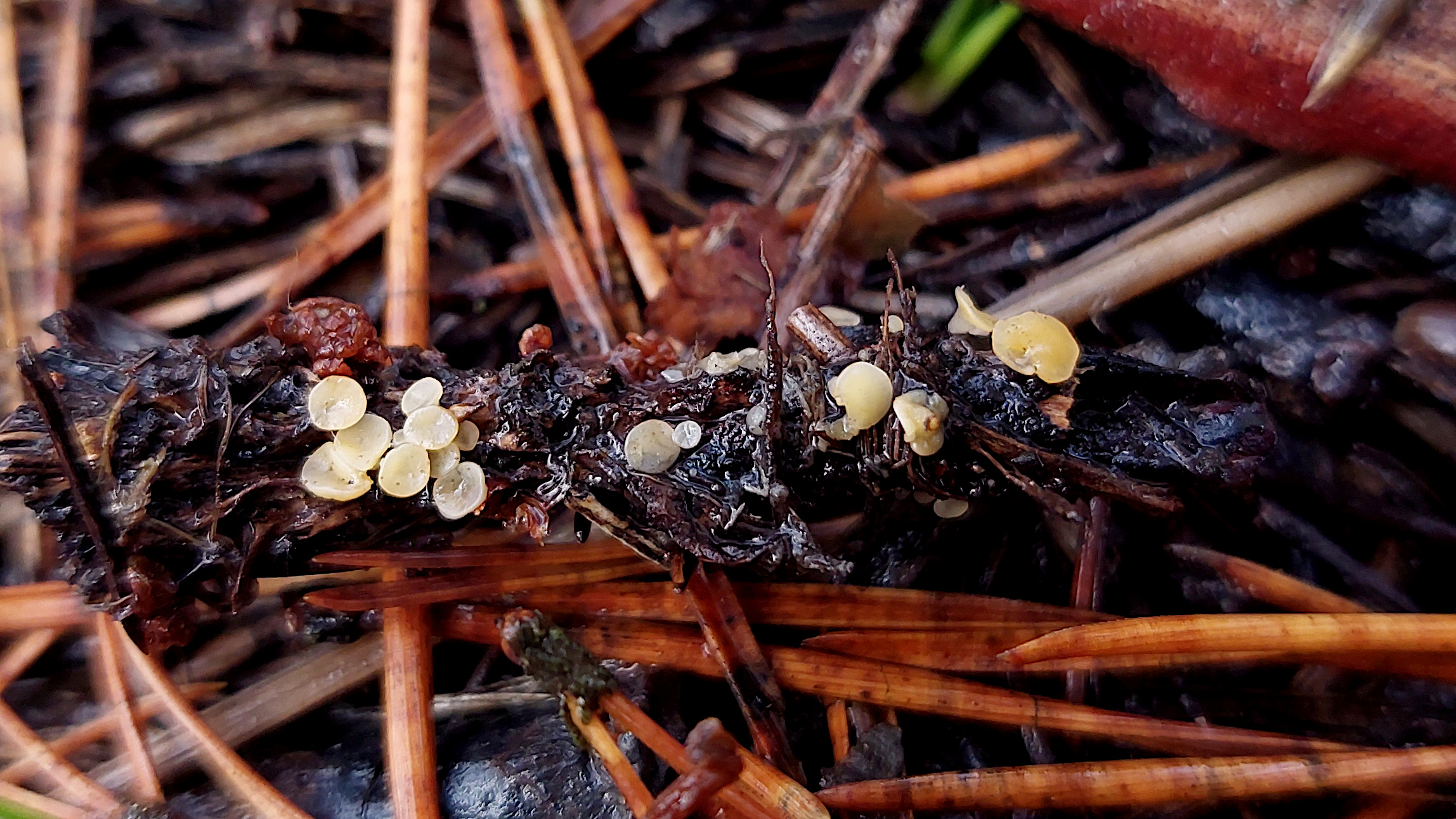 fruitbodies-0001.jpg
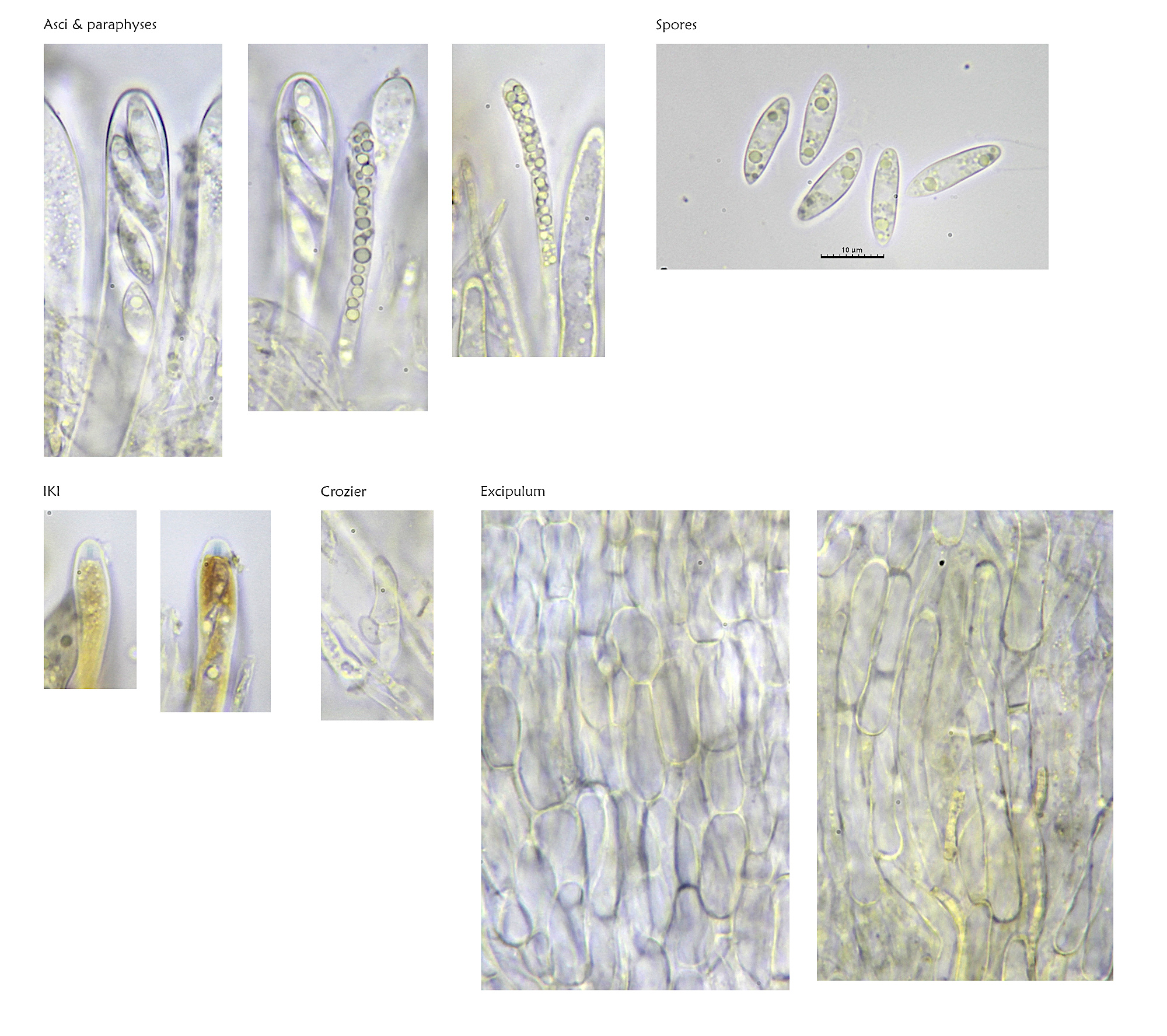 microplate-0001.JPG
Hans-Otto Baral,
05-11-2024 11:01

Re : Phaeohelotium on Pinus cone
P. lutescens seems to fit very well. It may also be that P. epiphyllum differs from P. lutescens in isodiametric cells on the flanks and having only prismatica towards margin.
P. lutescens grows on undecayed coniferous substrate, unlike P. epiphyllum.
Juuso Äikäs,
05-11-2024 15:09
Re : Phaeohelotium on Pinus cone
Thanks again. P. epiphyllum growing on Picea cones / needle debris is pretty common though, if I'm not mistaken.
Hans-Otto Baral,
05-11-2024 17:36
Re : Phaeohelotium on Pinus cone
My key goes after the carotenoids, but that might be a bit questionable, see the specific epithet. Also the oil content is perhaps more variable than stated there:
100. Ap. with carotenoid-LBs, Hym. yellowish to ochre .... 101 -> epiphyllus
Sp. 14-22/3,5-6 µm, oil content 4-4,5
100. Ap. without carotenoid-LBs, Hym. ±whitish .......... 105 -> lutescens
Sp. 11-20/3,5-4,5 µm, oil content 1-3,5
My impression was that the substrate is little decayed, but I might be wrong.
Declercq's key has the two in a couple:
13 Apothecia scutellate, disk yellow, reddening, shortly stalked. Asci (dead) 85-90x7-7,5 µm. Spores slightly shoe-shaped, (dead) 12-15x3,5-4 µm, OCI=3-4. On cones of Pinus sylvestris. Phen.: VII-IX.
----------- Phaeohelotium lutescens (Hedw.: Fr.) Declercq comb. nov. ined.
----------- Phaeohelotium lutescens (Hedw.: Fr.) Declercq comb. nov. ined.
13' Apothecia turbinate with concave to plano-convex disk, fleshy, 0,5-3(7) mm diameter, pale yellowish to yellow, reddening when damaged, subsessile to shortly stipitate. Asci 90-135x9-11 µm. Spores assymetrical fusiform, inequilateral, 0(1)-septate, (9)11-20(24)x(3)4-5,5 µm, with 1(2) up to 3 µm diameter guttules and many small ones at each side, OCI = 4-4,5, becoming 2(?3)-septate and pale greyish brown when overmature. Paraphyses, subhymenium and excipulum with strongly refractive guttules. On plant debris, such as cones and needles of Pinus, catkins of Betula, cupules of Quercus and Fagus, but mainly on leaf litter of Quercus. Phen.: (VIII)IX-XI.
------------------- Phaeohelotium epiphyllum
------------------- Phaeohelotium epiphyllum