
10-05-2026 23:17
 Andreas Gminder
Hello,today we found in a moist steep decidous for
14-05-2026 05:36
Ethan CrensonHi all, I haven't paid much attention to Lachnu
16-03-2011 14:31
roman vargas albertoHi. I would like some opinion about this Peziza
11-05-2026 12:32
 Bernard CLESSE
Pourriez-vous m'aider à identifier cette héloti
13-05-2026 15:26
 François Freléchoux
Bonjour,Voici une récolte faite il y a quelques j
12-05-2026 15:41
 Nicolas VAN VOOREN
Dear Ascolovers, especially interested in Pezizale
13-05-2026 12:05
 Thierry Blondelle
Bonjour à tous,J'aimerais avoir confirmation de c
28-04-2026 20:07
 Lothar Krieglsteiner
... on twig in the air at standing Ceratonia siliq
27-04-2026 20:52
Lothar Krieglsteiner
Found on hanging tiwg of Olea europaea in dried-ou
11-05-2026 20:22
Lothar Krieglsteiner
on attached twig of standing Ficus caricaquite uns
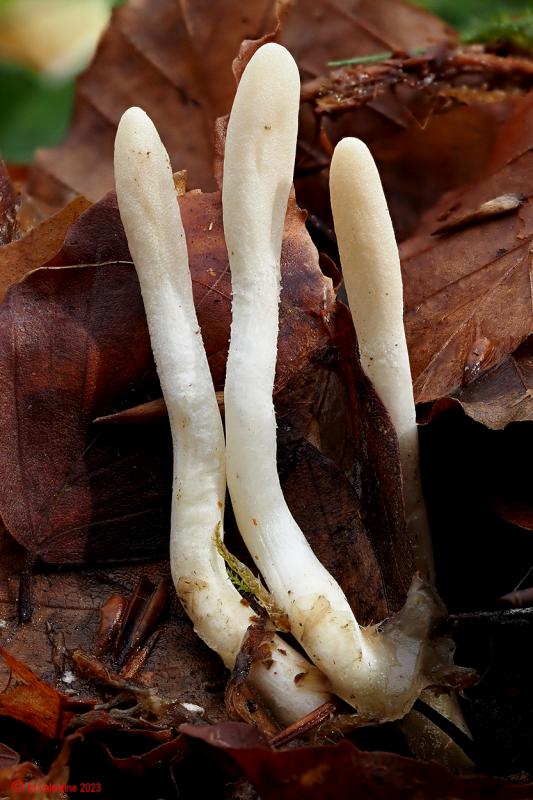
Found on Friday, in the middle of an isolated deciduous area, (mainly Beech & Birch), of a moorland Spruce plantation in north west England.
Around 20 to 30 individual fruitbodies varying in size from 25mm tall to 50mm tall, scattered in an area approximately 10 metres across, on rotting Beech leaf litter, in the above mentioned deciduous part of the forest.
Ground conditions very damp, consisting of mossy hummocks with several inches of rotting Beech leaf debris collected in the troughs between the hummocks.
They have the general looks of Cordyceps, but were definitely attached directly to the Beech leaves.
No signs whatsoever that they could have been/previously had been growing from any sort of dead insect or pupa.
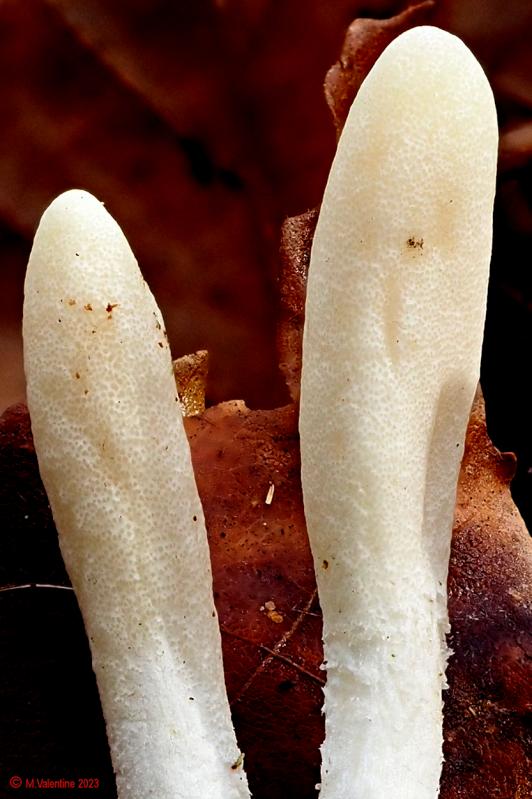
They have a faintly spotted head, with a noticeable delineation between the head and the plain (slightly floccose) white stalk below.
I left the fruitbodies sitting on a microscope slide overnight, and they produced a very substantial white spore drop.
Under the microscope, the majority of spores (in the thousands) were found to be averaging 2.1µ (and almost spherical in shape).
However, there were also quite large numbers of spores (in the hundreds) which were ovoid, averaging 3.9µ in length x 2.1µ in diameter.
No discernible oil drops or other internal features observed in the spores. (In water and also in lactophenol cotton blue, which was readily taken up).
The asci were 16-spored, ranging between 76µ and 89µ in length x 2.5µ to 3µ width. (Average of the measured asci being 85µ x 3µ).
Unfortunately, my microscope camera software has ceased to work following a recent Windows 10 update, and so I cannot include microphotographs.
I would greatly appreciate any suggestions for species / genus.
Kind regards,
Mike Valentine.

Many many thanks for your reply. it is much appreciated.
You are undoubtedly correct!
Without the help of AscoFrance, I doubt that I would have been able to resolve this query!
Best regards,
Michael valentine
I will make contact with Royal Botanic Gardens, Kew Fungarium, and ask if they would like to have the sample fruitbodies sent to them in order to authenticate this find as a UK record.
The samples were dried and sent off to Dr Paul Cannon.
I am greatly indebted to Paul, who has carried out further microscopy etc, and has now confirmed that the find was indeed Trichoderma leucopus.
The find has been accepted as the first verified record for Great Britain and Ireland, and the voucher material etc. will be deposited at Kew Fungarium in due course.
Paul has created a FRDBI species page, (with various micro-photographs and descriptive information etc.), for the record here: -
https://fungi.myspecies.info/all-fungi/trichoderma-leucopus