
05-04-2026 22:46
 Lothar Krieglsteiner
on wood of Ceratonia, Algarve, 3.4.2026.The color
15-05-2026 13:33
Sylvie Le GoffBonjour à tousJe serais très reconnaissante enve
16-03-2011 14:31
roman vargas albertoHi. I would like some opinion about this Peziza
14-05-2026 05:36
Ethan CrensonHi all, I haven't paid much attention to Lachnu
10-05-2026 23:17
 Andreas Gminder
Hello,today we found in a moist steep decidous for
11-05-2026 12:32
 Bernard CLESSE
Pourriez-vous m'aider à identifier cette héloti
13-05-2026 15:26
 François Freléchoux
Bonjour,Voici une récolte faite il y a quelques j
12-05-2026 15:41
 Nicolas VAN VOOREN
Dear Ascolovers, especially interested in Pezizale
13-05-2026 12:05
 Thierry Blondelle
Bonjour à tous,J'aimerais avoir confirmation de c
28-04-2026 20:07
Lothar Krieglsteiner
... on twig in the air at standing Ceratonia siliq
récolte sur Anthoceros agrestis ou punctatus. Spores (10)13-16(18) x (3)3,5-4,8(5) µm, sommet des asques sans réaction dans le melzer et le lugol.
Merci d'avance pour vos suggestions.
Patrice
 Doc1-0042.pdf
Hello Patrice,
for me this has a lot in common with Bryoscyphus dicrani (s.l.) - the substrate is very interesting.
The spore size, form and content is like collections in this group - and the content of the paraphyses is, too.
Best regards from Lothar
I saw B. dicrani like this : http://www.mycocharentes.fr/pdf1/1763.pdf
Spores are bigger.
But you wrote B. dicrani s.l., I understand.
Best regards.
Patrice
I don`t know a lot about how many forms are present in this complex. In the pdf you show the name H. rhytidiadelphi is mentioned, too.
I more than once found specimens on Ceratodon purpureus - and I called them H. dicrani by now. You can compare my measures from the small sketch I add.
In once found a specimen on Rhytidiadelphus triquetrus (I also add a sketch) and I then thought this to be H. rhytidiadelphi. But this taxon is considered a synonym of H. dicrani in most literature (as far as I know).
Best regards, Lothar
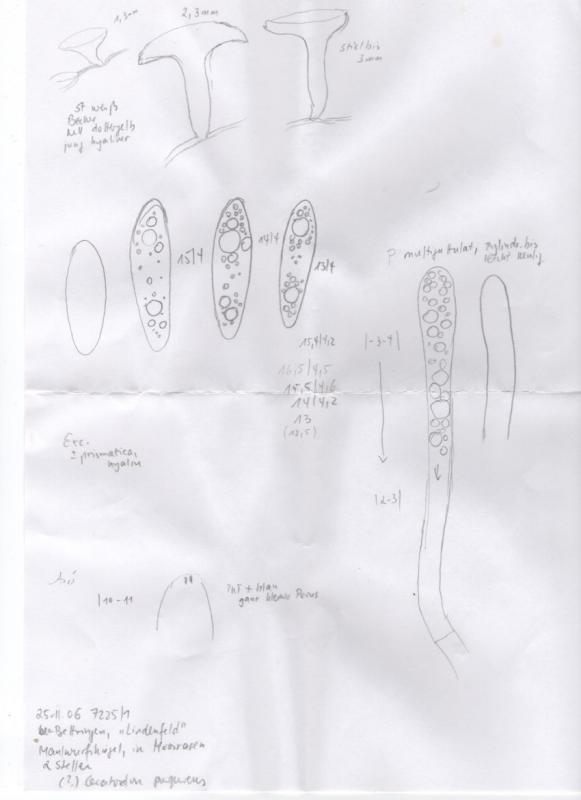
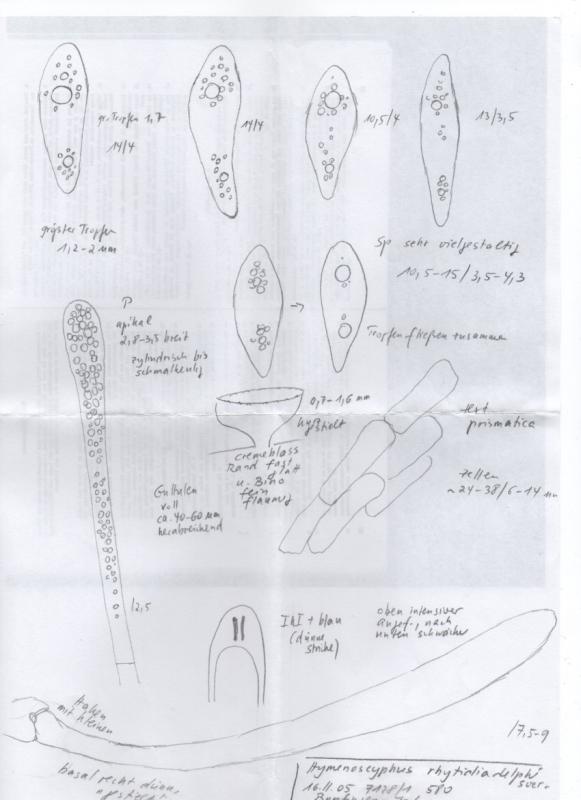

I don't think it is B. dicrani, because
- the spores are distinctly too narrow
- the VBs in the paraphyses are not strongly refractive and especially they are rather large and only in 1-2 rows.
In B. dicrani the VBs are small, strongly refractive, trembling, and multiseriate.
A new riddle. Patrice, do you think your Lugol is good? Because I don't see it on your pics. How sure is it that the asci are inamyloid?
Zotto
OK my lugol is HS, but melzer is perfect (look at my photo of Peziza asci). I try again with melzer x 1000, nothing blue.
You are right Zotto for VBs in the paraphyses wich are bigger, and not strongly refractive because I used contrast of photofiltre to better show them, and x 1000.
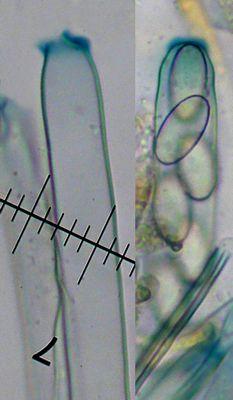
Sorry for HS ("Hors Service" in french) : in english "Out of order".