
12-04-2026 17:56
 Hardware Tony
Found on dead stems in February earlier this year
12-04-2026 15:52
Gernot FriebesHi,I'm looking for help with this anamorph collect
12-04-2026 12:22
 William Slosse
In a dune grassland in Oostduinkerke (Belgium), on
11-04-2026 15:45
 Zuzana Sochorová (Egertová)
Please, could anyone send me this paper?Moyne G.,
11-04-2026 13:34
Artem PtukhaHello, I am seeking assistance with the identific

11-04-2026 10:19
 Michel Hairaud
Chers amis d'Ascofrance , voici une très bonne no
11-04-2026 10:10
Michel Hairaud
Dear Ascofrance members, here is some very good ne
10-04-2026 23:22
Gernot FriebesHi,ascospores are 1- to 3-septate, approximately
10-04-2026 15:51
William Slosse
Hello everyone, On 08/04/26, I found a growth sit
Asco sp.
Yannick Mourgues,
11-05-2008 14:24
 Bon, je change de récolte alors ...
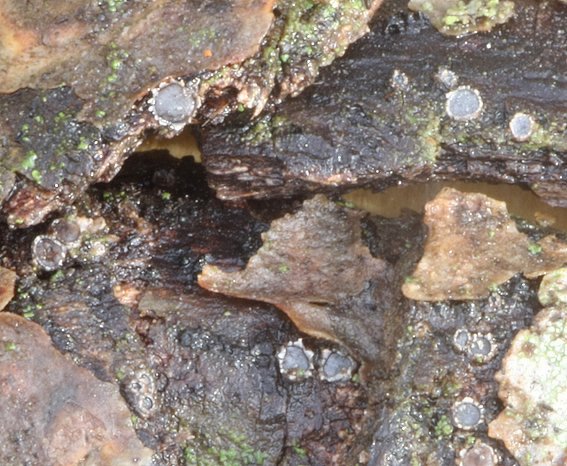
Cet asco a été trouvé sur écorces de branches mortes de marronniers (aesculus) tombées au sol.
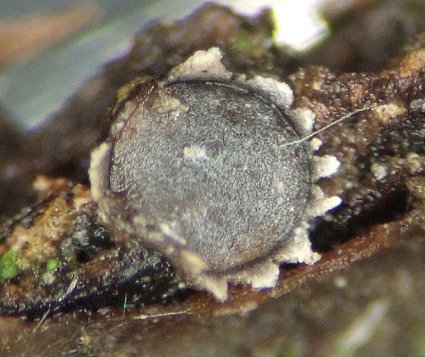
Il se présente sous la forme d'un disque perçant l'écorce, à marge blanches dentelée dressée, à hyménium granuleux grisâtre.
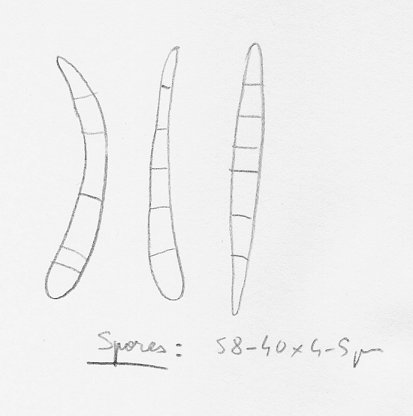
Spores fusiformes/cylindriques, parfois arquées, en général 5-6 cloisons, bisériées, 40-58x4-5 um.
Asques IKI+, cylindriques, 100x10-16 um
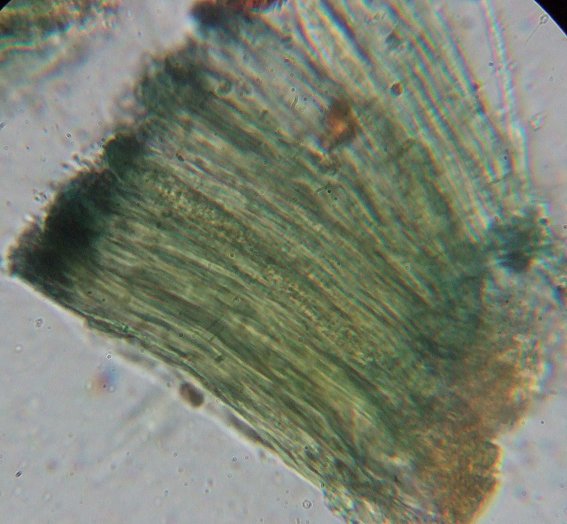
Paraphyses larges de 1-2 um, étroitement agglomérées entre elles au sommet par une sorte de gel, hyaline mais devenant vertes dans le Lugol (voir photo ci-après), et septées.
Pas réussi à voir la Textura.
De quoi s'agit-il ?
Yannick
Yannick Mourgues,
11-05-2008 14:24
Re:Asco sp.
Vu de plus près...
Yannick Mourgues,
11-05-2008 14:25
Re:Asco sp.
Paraphyses vertes dans Lugol + agglomérées au sommet par gel
Yannick Mourgues,
11-05-2008 14:25
Re:Asco sp.
Un dessin des spores...
Yannick Mourgues,
11-05-2008 14:42
Re:Asco sp.
J'en ferai bien Karstenia (cryptodiscus) rhopaloides ...
Qu'en pensez-vous ?
Yannick
Qu'en pensez-vous ?
Yannick
Hans-Otto Baral,
11-05-2008 17:36

Re:Asco sp.
Hi Yannick
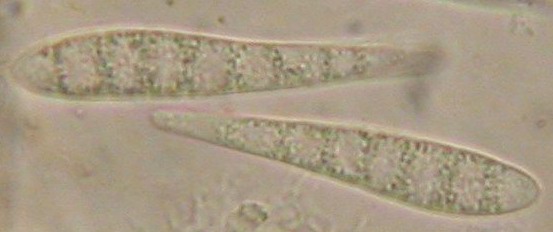
Yes, I think this is Karstenia rhopaloides. The spores are a bit long (I rarely found up to 51 µm in length), but their shape excludes K. idaei. I would be interested about the content of the living spores. I attach an image of typical spores of rhopaloides. Some uncertain collections had a large central LB in each cell, but typically there are only small peripheral LBs.
Yes, I think this is Karstenia rhopaloides. The spores are a bit long (I rarely found up to 51 µm in length), but their shape excludes K. idaei. I would be interested about the content of the living spores. I attach an image of typical spores of rhopaloides. Some uncertain collections had a large central LB in each cell, but typically there are only small peripheral LBs.
Hans-Otto Baral,
11-05-2008 17:39
Re:Asco sp.
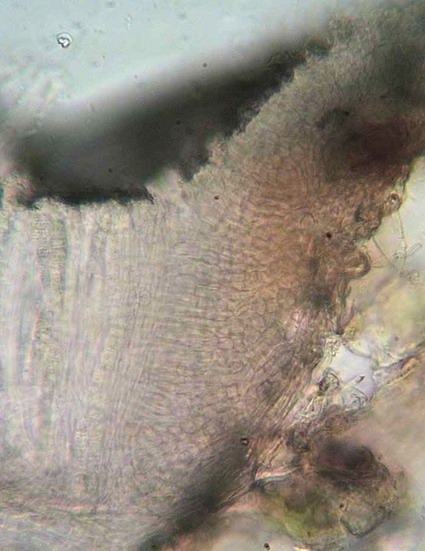
A median section of the margin would also be helpful. Karstenia has always this dense parallel texture of periphyses going vertically towards the hymenium (see an image of Piotr Perz). Finally IKI provokes a hemiamyloid reaction of the whole asci in Karstenia (first blue, at higher concentration redbrown). Maybe your Lugol is too diluted?
Amities
Zotto
Amities
Zotto
Yannick Mourgues,
11-05-2008 22:18
Re:Asco sp.
Hi Zotto.
I wasn't able to make a median section of the margin. Sorry. My Lugol has one year so may be it's not concentrated as it must be. That's why I have seen only a blue reacton.
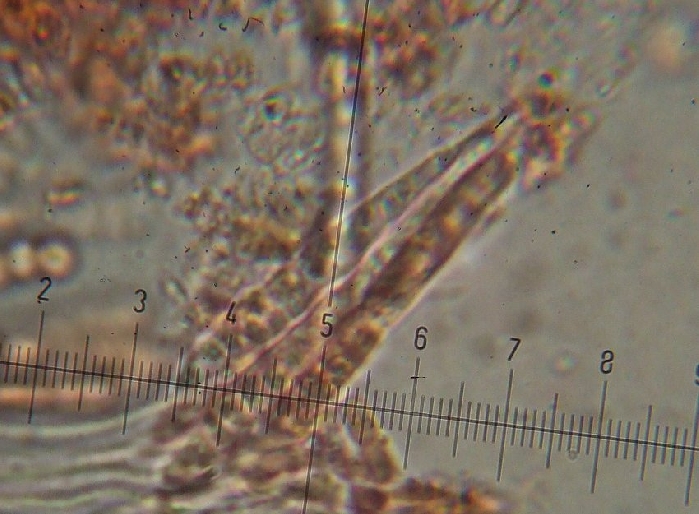
For all spores I have seen, there was a large central, sometimes two LB in each cell. In my collection, I haven't seen any spores with small peripheral LBs. Here is attached a picture (bad pict. sorry) of that.
Thank's again.
Yannick
I wasn't able to make a median section of the margin. Sorry. My Lugol has one year so may be it's not concentrated as it must be. That's why I have seen only a blue reacton.
For all spores I have seen, there was a large central, sometimes two LB in each cell. In my collection, I haven't seen any spores with small peripheral LBs. Here is attached a picture (bad pict. sorry) of that.
Thank's again.
Yannick
Hans-Otto Baral,
11-05-2008 23:14
Re:Asco sp.
Hi Yannick
yes, these guttules do not look typical for rhopaloides. Difficult to say. These Karstenias are all xerotolerant, therefore, if you have not used a dryer you can still study living spores in water.
Your apos look rather large, what is their diameter?
Zotto
yes, these guttules do not look typical for rhopaloides. Difficult to say. These Karstenias are all xerotolerant, therefore, if you have not used a dryer you can still study living spores in water.
Your apos look rather large, what is their diameter?
Zotto
Yannick Mourgues,
11-05-2008 23:16
Re:Asco sp.
diameter = 1 mm
Yannick Mourgues,
11-05-2008 23:23
Re:Asco sp.
Zotto,
Have you already found this specie on Aesculus hippocastaneus ?
Yannick
Have you already found this specie on Aesculus hippocastaneus ?
Yannick
Hans-Otto Baral,
12-05-2008 15:03
Re:Asco sp.
Yannick,
no, I have a lot of substrates but this one not: bark, rarely wood of still attached (rarely fallen) branches (rarely fruits) of Acer, Cedrus, Clematis, Cornus, Corylus, Cotinus, Crataegus, Fraxinus, Fagus, Juglans, Lonicera, Pinus, Populus, Prunus, Robinia, Rubus, Sambucus, Salix, Symphoricarpos, Tilia, Ulex, Viburnum, herbaceous stems of Ephedra, Lupinus, Reynoutria, I-XII, Central Europe, colline to montane (30-670m)
Zotto
no, I have a lot of substrates but this one not: bark, rarely wood of still attached (rarely fallen) branches (rarely fruits) of Acer, Cedrus, Clematis, Cornus, Corylus, Cotinus, Crataegus, Fraxinus, Fagus, Juglans, Lonicera, Pinus, Populus, Prunus, Robinia, Rubus, Sambucus, Salix, Symphoricarpos, Tilia, Ulex, Viburnum, herbaceous stems of Ephedra, Lupinus, Reynoutria, I-XII, Central Europe, colline to montane (30-670m)
Zotto