
12-06-2026 14:50
 François Freléchoux
Bonjour, Voici la brève description d'une Mollis
10-06-2026 21:16
François Freléchoux
Bonsoir,Le dernier du jour, en attendant votre avi
11-06-2026 19:01
 William Slosse
Hello all,In an attempt to make a culture of a sus
11-06-2026 19:03
 Nicolas VAN VOOREN
Chers membres d'Ascofrance,Le site sera placé en

09-06-2026 18:32
Camille MertensSur morceau de roseau immergé 0,5 - 0,7 mm de dia
10-06-2026 12:54
Steve ClementsBonjour encore, Pouvez-vous m'aider, s'il vous pl
10-06-2026 21:07
François Freléchoux
Toutes les tiges de gentianes jaunes de l'an passÃ
10-06-2026 13:41
François Freléchoux
Bonjour à nouveau, Voici une trouvaille d'hier.

Hi again
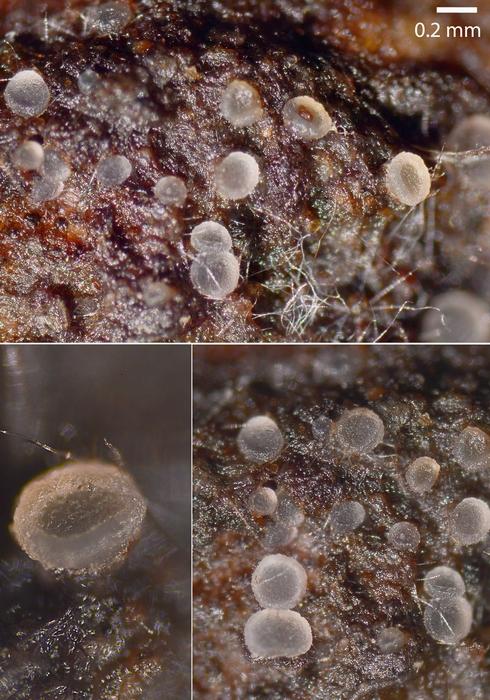
These gregarious, small apothecia (150-300 micr. in diam.), translucent, broadly sessile, minutely downy apothecia were growing on a copious brownish subiculum on a branch of Calluna vulgaris at 1700 m of altitude.
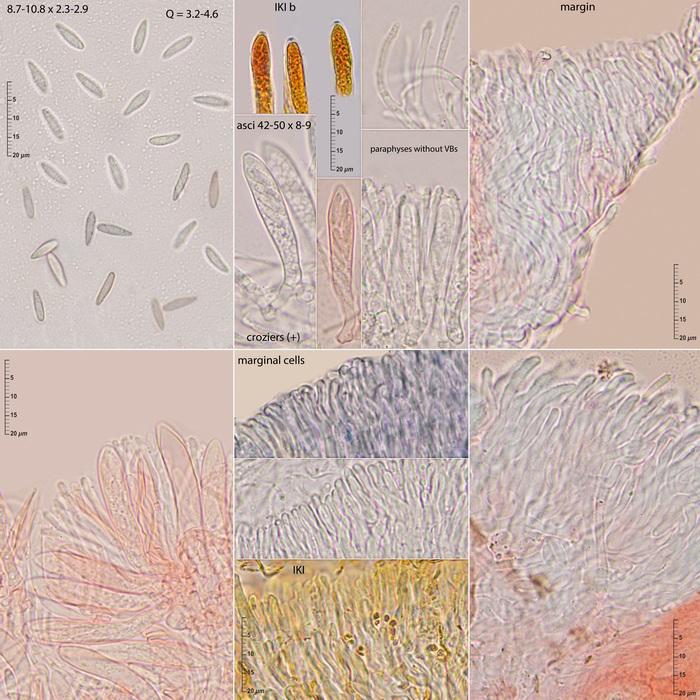
The excipulum is made by cylndrical undulate hyaline hairs denesely packed, perhaps gelified, very difficult to dissociate, with smooth tips and slightly thickened walls. Ascospores with some small polar LBs. Asci IKI b, 8-spored, with croziers. Paraphyses filiform, without VBs.
Maybe could be related with the old genus Pezizella? Have you some idea for me?
Thanks again

yes Pezizella is most likely the genus used for this finding.
There is a Pezizella ericacea D. Read which should be a important mycorhiza partner for Calluna, unfortunately I do not have the article (Trans Br Mycl Soc 63; 381-383 1974) where cultivated apothecia are described.
good luck,
Stip
Hi Stip and Guy
The excipulum of Reid's fungus is very close to the mine, but regrettably I think the somewhat broadly ellipsoid, 5-12 x 3-4 vs the narrowly ellipsoid, subclavate, 9-11 x 2-3 ascospores of my fungus don't fit well.
Anyway many thanks to both
regards,
Stip

I remember Pezizella parasitica Velen. which has a similar excipulum. But there the spores have a high oil content and the asci without croziers. Anyhow, the two species could be congeneric.
A further sample, "parasitica-like H+" on Salix, has exactly the excipulum as yours, look sections named Helotiales on Salix wood, HB 9938-6a, KOH etc. But apothecia are much larger (1-2 mm).
All is in my folder Hyaloscypha.
Zotto
Hi Zotto
Really your HB 9938 is microscopically very similar
Thanks!