
12-06-2026 14:50
 François Freléchoux
Bonjour, Voici la brève description d'une Mollis
10-06-2026 21:16
François Freléchoux
Bonsoir,Le dernier du jour, en attendant votre avi
11-06-2026 19:01
 William Slosse
Hello all,In an attempt to make a culture of a sus
11-06-2026 19:03
 Nicolas VAN VOOREN
Chers membres d'Ascofrance,Le site sera placé en

09-06-2026 18:32
Camille MertensSur morceau de roseau immergé 0,5 - 0,7 mm de dia
10-06-2026 12:54
Steve ClementsBonjour encore, Pouvez-vous m'aider, s'il vous pl
10-06-2026 21:07
François Freléchoux
Toutes les tiges de gentianes jaunes de l'an passÃ
10-06-2026 13:41
François Freléchoux
Bonjour à nouveau, Voici une trouvaille d'hier.

Hi to everybody
This fungus was collected on small cutted branches, up to 10 mm broad, of Genista florida not lying on the ground, at the Natural Park of Somiedo (N of Spain), at 1500 m of altitude. It grew together with stromata of Thyronectria roseovirens.
The fruitbodys are made of several subcuticular, blackish, perithecia more or less circinate, not forming a not well definite ascostroma, in valsoid configuration, with erumpent blackish ostioles.
The cylindrical, shortly stipitate 8-spored asci have a conspicuous apical apparatus NOT STAINING BLUE in IKI and the ellipsoid, brownish, unicellular ascospores have a full lenght germ slit. Paraphyses are present.
I think this fungus belongs to Xyalariaceae and maybe it could be into the genus Lopadostoma but the inamyloid asci don't fit well with this genus.
Have you some idea for help me
Thanks again
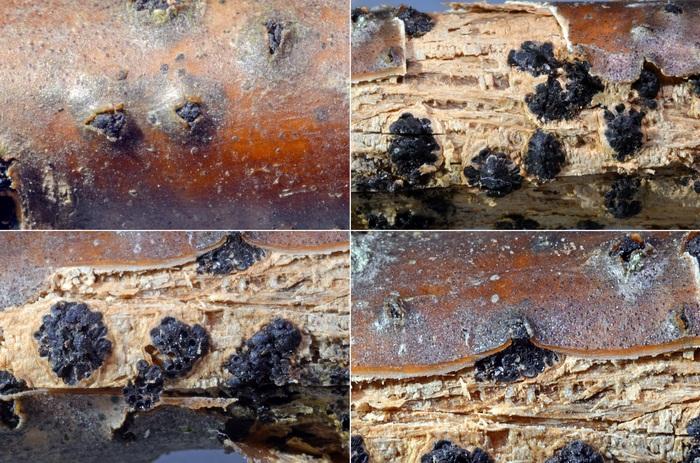
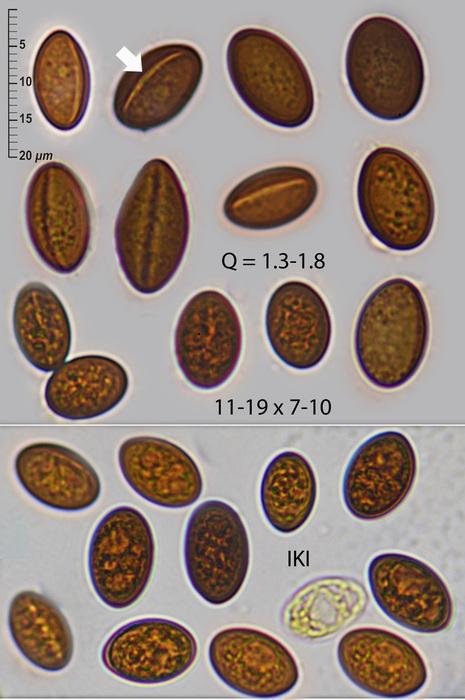
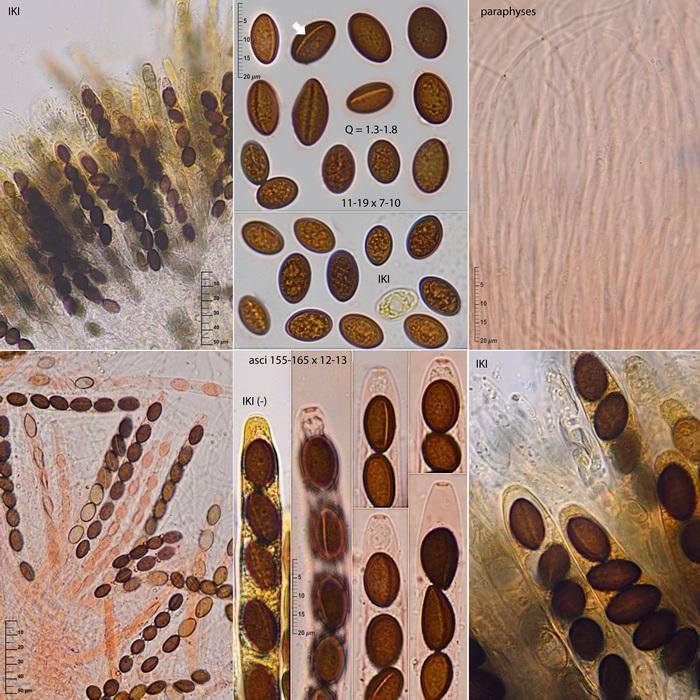

your fungus is indeed very strange. Microscopically it might also fit Coniochaeta but the arrangement of ascomata with apparently converging ostioles piercing the peridium is most unusual.
An alien?
Cheers,
Jacques
Hi Jacques
Yes. I also thought in Coniochaeta, but the ascomata would be very unusual for this genus. The converging ostioles of the perithecia remember me in a way those of Calosphaeria pulchella. I think as you: it seems to be an alien ..
Thanks again, Jacques