
12-06-2026 14:50
 François Freléchoux
Bonjour, Voici la brève description d'une Mollis
10-06-2026 21:16
François Freléchoux
Bonsoir,Le dernier du jour, en attendant votre avi
11-06-2026 19:01
 William Slosse
Hello all,In an attempt to make a culture of a sus
11-06-2026 19:03
 Nicolas VAN VOOREN
Chers membres d'Ascofrance,Le site sera placé en

09-06-2026 18:32
Camille MertensSur morceau de roseau immergé 0,5 - 0,7 mm de dia
10-06-2026 12:54
Steve ClementsBonjour encore, Pouvez-vous m'aider, s'il vous pl
10-06-2026 21:07
François Freléchoux
Toutes les tiges de gentianes jaunes de l'an passÃ
10-06-2026 13:41
François Freléchoux
Bonjour à nouveau, Voici une trouvaille d'hier.
 Hi to all
This fungus forms subcuticular pseudothecia (¿?) under the periderm of stems of Arundo donax. These pulvinate and ostiolate ascomata, arranged in longitudinal lines, are singly or situated on small stromata with some other ones, 0.4-1.5 mm long, up to 0.15 mm high.
The 8-spored asci are cylindrical and I think they are bitunicate altough I can see maybe a small structure near the apex. The golden brown bi-cellular ascospores and the pseudoparaphyses are showed in the pics. I tough could be a Didymella or a close related genus, but I don't know a good genus for this collection.
Have you some ides for it?
Thanks again
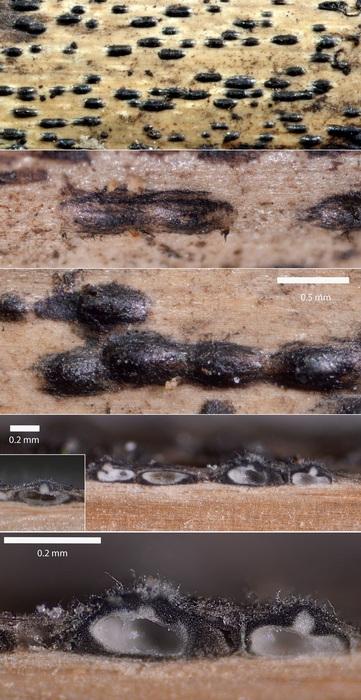
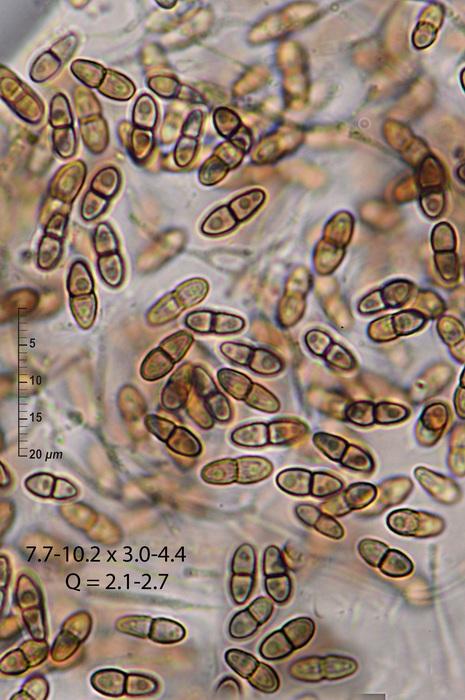
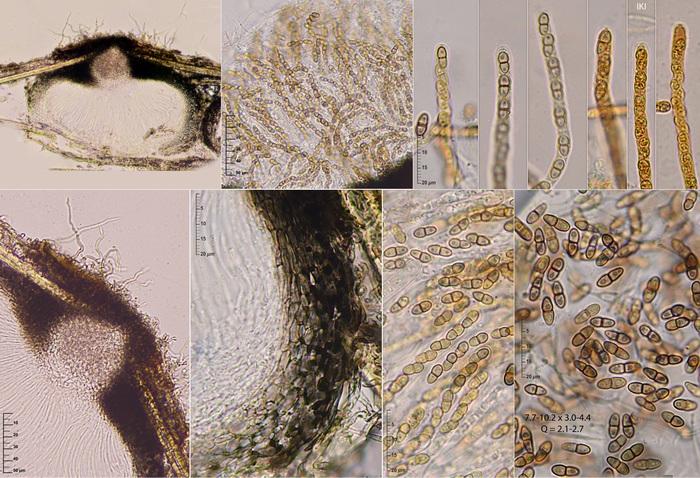

not sure but your fungus looks like a Roussoella. If so the spores should be delicately longitudinally ribbed, it's difficult to see if the preparation is not very thin.
The smaller spores with broadly rounded ends would fit R. donacicola (Speg.) Ju, Rogers & Huhndorf which is common on this host. The slightly larger and more narrowly elliipsoid are less typical of this species and recall a tropical species, R. chiangraina (in Phytotaxa 181(1), 2014).
Saludos,
Jacques
Hi Jacques
Fantastic! I feel you are right, although the faint striate ornamentation is hardly visible. But the rest of the generic characters fits well with this fungus.
Thanks a lot!