
29-05-2026 15:35
daniel FERREBonjour à tous,Je voudrais votre aide pour cette
28-05-2026 16:15
James MitchellHello,Does anyone have the original publication of
28-05-2026 11:06
Thomas Læssøehttps://svampe.databasen.org/observations/10596750
23-05-2026 11:44
 Charles Grapinet
Hello, I am having trouble identifying this copro
25-05-2026 16:44
François BartholomeeusenHi forum members,During an excursion organised by
26-05-2026 21:25
Dirk GerstnerHello everyone, I'm completely stumped by this li
26-05-2026 22:44
Ethan CrensonHi all, I think I have Incrucipulum capitatum her
22-05-2026 14:44
 Lothar Krieglsteiner
in unripe condition citrine yellow, then soon fadi
25-05-2026 16:35
 Bernard CLESSE
Bonjour à toutes et tous,J'ai trouvé récemment,
22-05-2026 13:29
Gernot FriebesHi,I am curious to hear your opinion on this mater

Hi to all
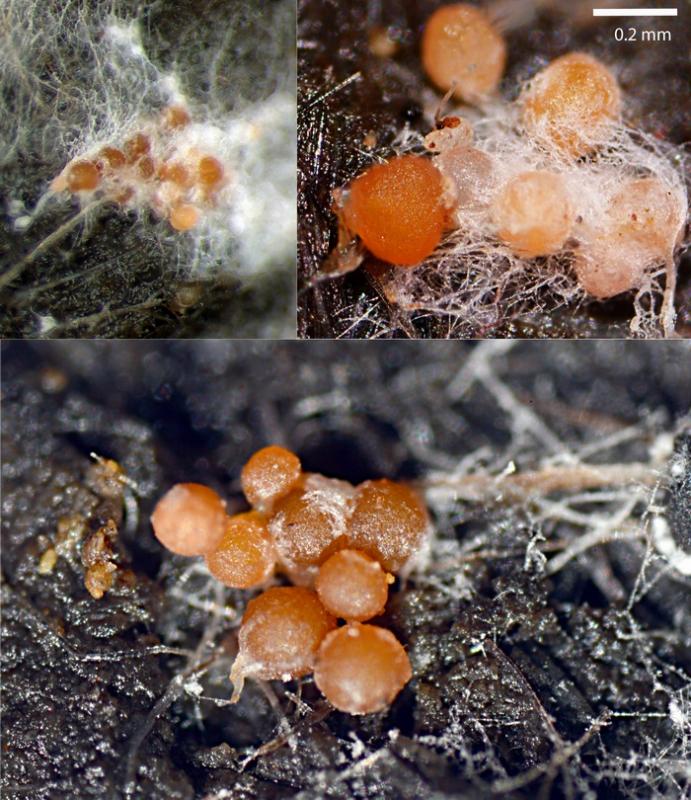
This fungus grew on a culture of fox dung with many rests of animal hairs, and forms small, gregarious, superficial, roundish, yellowish at first, later orange and finally brownish cleistothecioid, smooth, ascomata, growing under a very copious white hypal mat.
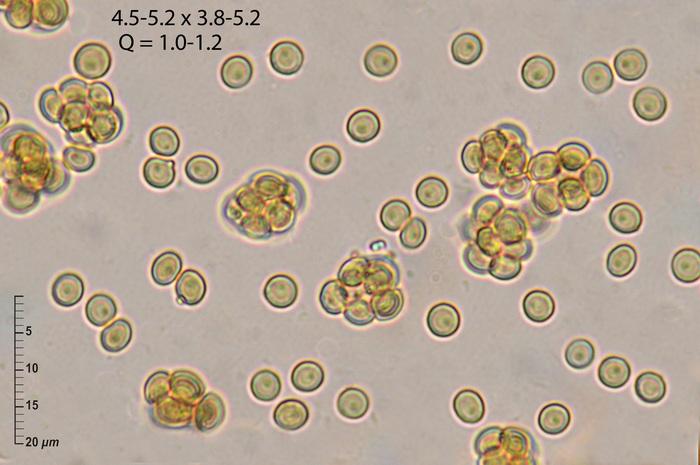
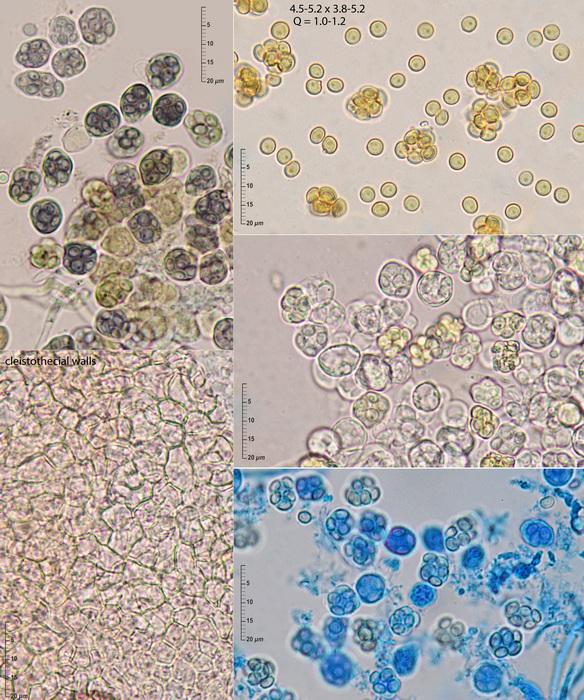
The asci are small, roundish to ovoid, and the ascospores are smooth, yellowish, roundish or very broadly ellipsoid, 4.5-5.2 x 3.8-5.2 microns. Cleistothecial walls built by a yellowish textura angularis.
I feel this fungus belongs to Onygenales and it could be near to Aphanoascus fulvescens, a keratinophilic fungus, but J. Guarro suggest me another possibility: Xanthothecium peruvianum. So I'd like to know your opinion
Many thanks in advance

Les spores de A. fulvescens ne sont elles pas normalement réticulées, ornées ?
Désole de ne pouvoir t'aider davantage.
Michel.
Bonsoir Michel
Les espores de fulvescens sont, selon la litterature, lisses, piquetées ou encore reticulées!
Surprenant!
Merci, Michel