
10-05-2026 23:17
 Andreas Gminder
Hello,today we found in a moist steep decidous for
14-05-2026 05:36
Ethan CrensonHi all, I haven't paid much attention to Lachnu
16-03-2011 14:31
roman vargas albertoHi. I would like some opinion about this Peziza
11-05-2026 12:32
 Bernard CLESSE
Pourriez-vous m'aider à identifier cette héloti
13-05-2026 15:26
 François Freléchoux
Bonjour,Voici une récolte faite il y a quelques j
12-05-2026 15:41
 Nicolas VAN VOOREN
Dear Ascolovers, especially interested in Pezizale
13-05-2026 12:05
 Thierry Blondelle
Bonjour à tous,J'aimerais avoir confirmation de c
28-04-2026 20:07
 Lothar Krieglsteiner
... on twig in the air at standing Ceratonia siliq
27-04-2026 20:52
Lothar Krieglsteiner
Found on hanging tiwg of Olea europaea in dried-ou
11-05-2026 20:22
Lothar Krieglsteiner
on attached twig of standing Ficus caricaquite uns

Bonjour,
Malheureusement je ne peux pas montrer une photo :-).
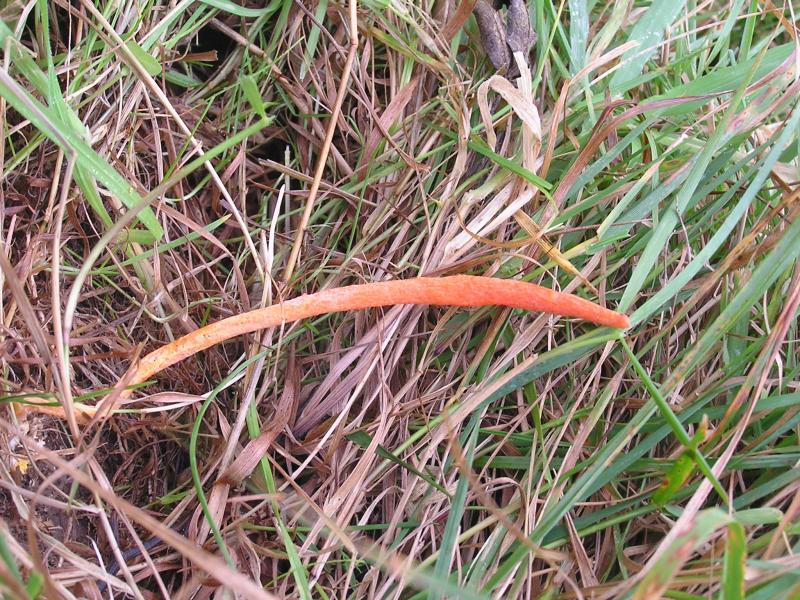
Nous avons trouvé un Cordyceps (ressemblant à militaris) très longue (ca 10 cm).
Les spores qu´on peut voir sont comme les spores d´un Hypocrea et on peut voir avec la loupe quelque chose jaune...
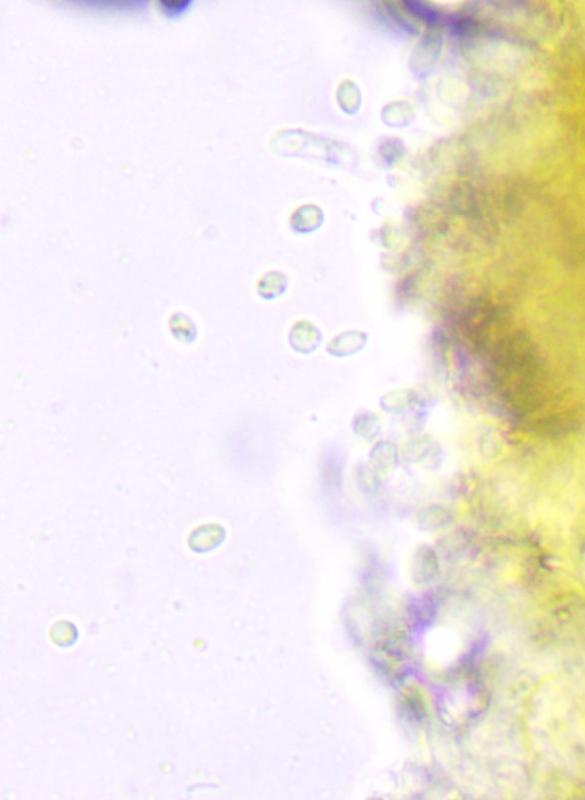
Les spores sont petites, (ca à 4) et prèsque rondes. Elles se séparent dans les ascis déjà.
Est-ce qu´on connaît des Hypocreas ou des autres sûr Cordyceps?
Merci,
Tanja
Hi Tanja,
if your fungus has 16 nearly isodiametrical part spores, it is a Hypocrea (or better a Trichoderma). Species with erect stromata have been classified in Podostroma. But with the colour of Cordyceps militaris this should be interesting. I only know H. leucopus and H. alutacea ,but maybe more species exist?
Regards from Lothar
Hallo Tanja,
schau doch mal bei Podostroma, ob da was passt?
Liebe Grüße,
Andreas :-)
Edit: Oh, sehe grad, dass Lothar auch schon geantwortet hat ....
Hello Thomas,
and what about Hypocrea nybergiana? Doesn't that comes close? Just judging from the key in JAKLITSCH ....
best regards,
Andreas
Hello Thomas,
Tanja said "Les spores sont petites, (ca à 4) et prèsque rondes. Elles se séparent dans les ascis déjà" Means "The spores are small (approx. 4 [µm]) and nearly globose. They are parting already in the ascus"
Therfore I'm interpreting this as Hypocrea spores. Hopefully Tanja will tell us something regarding that.
Hypocrea nybergiana is described in the key of JAKLITSCH (2011) like this:
Stromata large, to more than 10 cm long; fertile part reddish brown to brownish orange, pigment inhomogeneously distributed; distal ascospore cell 3.0–5.5×3.0–4.2 ?m; conidia large, 5–21×3–9 ?m, typically produced on solitary phialides.
May be worth tracing it ....
best regards,
Andreas
Hello,
I´m back home again....
I have one photo of the part-spores, but we also saw them (already divided) in the ascus.
I was really sure we had a C. militaris with a hypocrea/hypomyces on it, because on the fruitbody there were little yellow peritheciums.
best regards,
Tanja
Hello Tanja,
"I was really sure we had a C. militaris with a hypocrea/hypomyces on it, because on the fruitbody there were little yellow peritheciums."
This is an information you did not yet give us. A "Podostroma" can be excluded then.
Another information you did not give us (or do I overlook it?: where did you collect the fungus?
Regards from Lothar
Hallo Lothar,
Der Pilz wuchs in Schleswig-Holstein im Gebiet "Winderatter See". Das ist ein altes rinderbeweidetes Grünland mit vielen interessanten Arten (Erdzungen, Keulen, Saftlinge etc.). Normale Cordyceps militaris waren auch reichlich da und eben einige von den superlangen, die eben irgendwie befallen aussahen.
Leider hab ich den Pilz im Gelände nicht ausreichend beachtet und wir haben nur den einen Fruchtkörper mitgenommen. Es war einfach zu viel da...
Viele Grüße,
Tanja
Hallo Tanja,
schau doch mal hier nach:
Moingeon, J.-M. (2004): Hypomyces et genres apparentés. - Bull. Féd. myc. Dauph.-Sav. 172: 31-48.
steht bei uns im Regal ;-)
beste Grüße,
Andreas