
28-05-2026 16:15
James MitchellHello,Does anyone have the original publication of
28-05-2026 11:06
Thomas Læssøehttps://svampe.databasen.org/observations/10596750
23-05-2026 11:44
 Charles Grapinet
Hello, I am having trouble identifying this copro
25-05-2026 16:44
François BartholomeeusenHi forum members,During an excursion organised by
26-05-2026 21:25
Dirk GerstnerHello everyone, I'm completely stumped by this li
26-05-2026 22:44
Ethan CrensonHi all, I think I have Incrucipulum capitatum her
22-05-2026 14:44
 Lothar Krieglsteiner
in unripe condition citrine yellow, then soon fadi
25-05-2026 16:35
 Bernard CLESSE
Bonjour à toutes et tous,J'ai trouvé récemment,
22-05-2026 13:29
Gernot FriebesHi,I am curious to hear your opinion on this mater
23-05-2026 18:57
Sylvie Le GoffBonjour à tousRécolté sur une branchette de Sal
Lachnum clavigerum with bodies in asci
Chris Yeates,
01-06-2015 16:02
 Bonjour tous
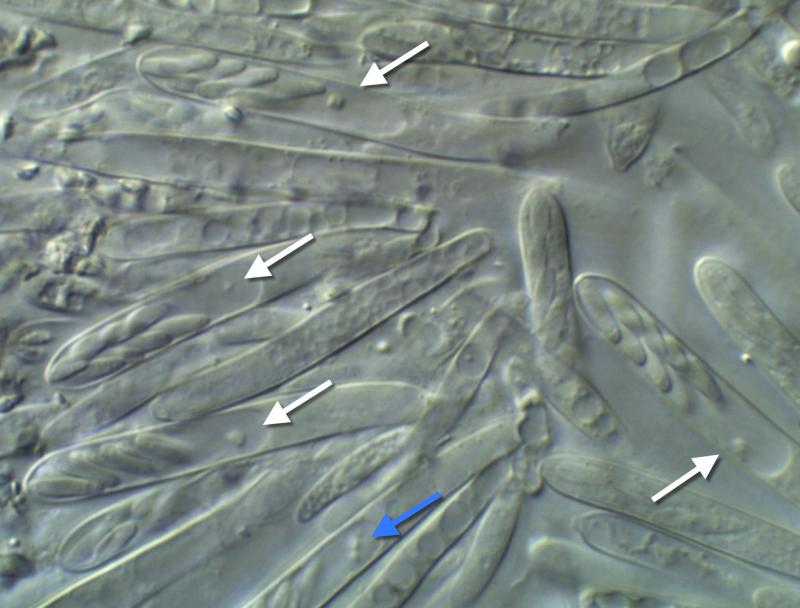
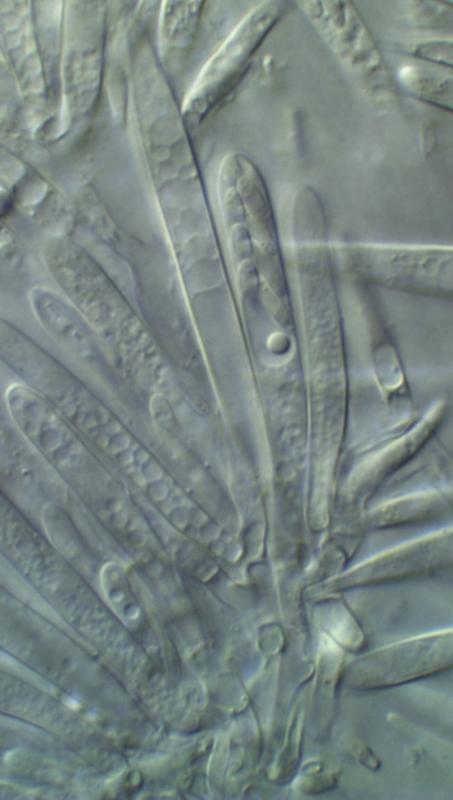
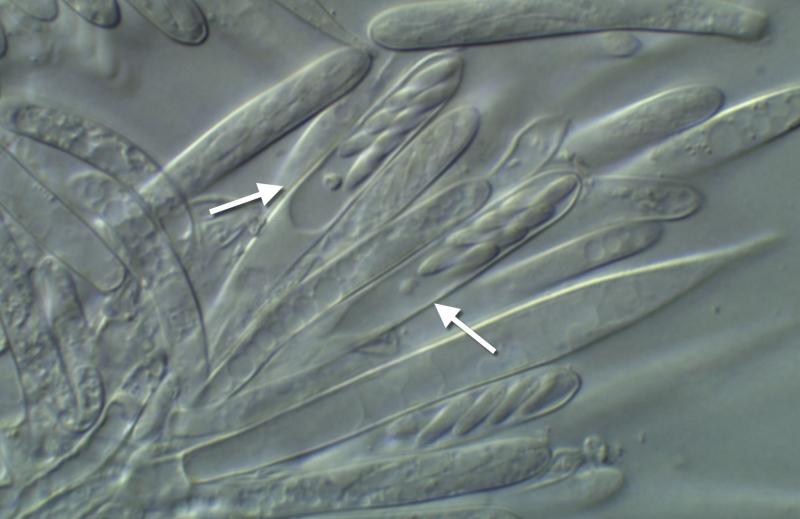
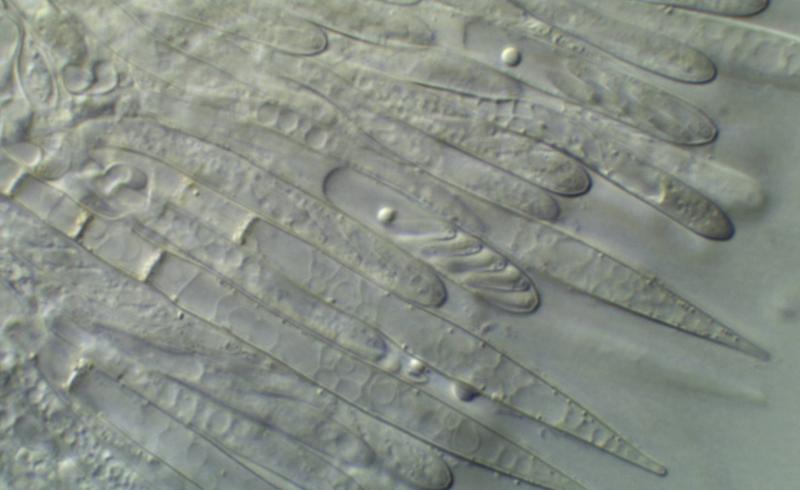
while preparing some images of Lachnum clavigerum on mossy stem bases of Chamerion angustifolium I noticed an interesting phenomenon in many mature asci. This may be a common feature of this or related fungi, but I have certainly not noticed it before.
The asci as they approach full ripeness develop a vacuole in their upper part with the mature spores more or less biseriately arranged towards the apex. In the lower part of these vacuoles there was often a globose body - very active and constantly kept in motion. These varied from perfect spheres to irregularly-shaped globose bodies; in at least one case (blue arrow in illustrations) there was a twin. Perhaps these globules are a by-product of the build up of turgidity in the ascus before the spores are shot out.
As I say, this may be a common phenomenon and I have simply overlooked it, but I would welcome any comments people might care to make. (All photo's are of living material).
Cordialement
Chris
Hans-Otto Baral,
01-06-2015 16:17

Re : Lachnum clavigerum with bodies in asci
Hi Chris
I can only assume that this corresponds to the "Psilachnum-guttule". in that genus it occurs qite frequently, and it is shot with the spores. But in Lachnum I can hardly remeber to have seen it, also my L. clavigerum was without. In Pezoloma i saw it now and then, though often only in immature asci while it disappears in mature asci.
I think with Cresyl Blue it does not stain, but in KOH it always disappears.
No idea about the fuction or composition. Surely it is the Brown's molecular movement that causes the body to move within the vacuolar sap, if this theory is still valid at all today.
Zotto
I can only assume that this corresponds to the "Psilachnum-guttule". in that genus it occurs qite frequently, and it is shot with the spores. But in Lachnum I can hardly remeber to have seen it, also my L. clavigerum was without. In Pezoloma i saw it now and then, though often only in immature asci while it disappears in mature asci.
I think with Cresyl Blue it does not stain, but in KOH it always disappears.
No idea about the fuction or composition. Surely it is the Brown's molecular movement that causes the body to move within the vacuolar sap, if this theory is still valid at all today.
Zotto
Chris Yeates,
01-06-2015 18:53
Re : Lachnum clavigerum with bodies in asci
I have now had a good look at the Psilachnum folder on the Cubby site - this looks to be very similar, I shall keep an eye out for it in these and other genera.
ich danke dir wie immer Zotto!
LG
Chris
ich danke dir wie immer Zotto!
LG
Chris