
28-05-2026 16:15
James MitchellHello,Does anyone have the original publication of
28-05-2026 11:06
Thomas Læssøehttps://svampe.databasen.org/observations/10596750
23-05-2026 11:44
 Charles Grapinet
Hello, I am having trouble identifying this copro
25-05-2026 16:44
François BartholomeeusenHi forum members,During an excursion organised by
26-05-2026 21:25
Dirk GerstnerHello everyone, I'm completely stumped by this li
26-05-2026 22:44
Ethan CrensonHi all, I think I have Incrucipulum capitatum her
22-05-2026 14:44
 Lothar Krieglsteiner
in unripe condition citrine yellow, then soon fadi
25-05-2026 16:35
 Bernard CLESSE
Bonjour à toutes et tous,J'ai trouvé récemment,
22-05-2026 13:29
Gernot FriebesHi,I am curious to hear your opinion on this mater
23-05-2026 18:57
Sylvie Le GoffBonjour à tousRécolté sur une branchette de Sal
Rutstroemia sur Daphne laureola feuilles / Rutstroemia on Daphne laureola old leaves
Enrique Rubio,
02-07-2007 21:13
 Cher amis du Forum:
Je vous propose une nouvelle question : Ces ascomata, turbinatées, extérieurement tomentoses, de 1mm d'altitude et 1 mm de largeur, croissent sur les feuilles mortes de Daphne laureola à 1700 m d'altitude.
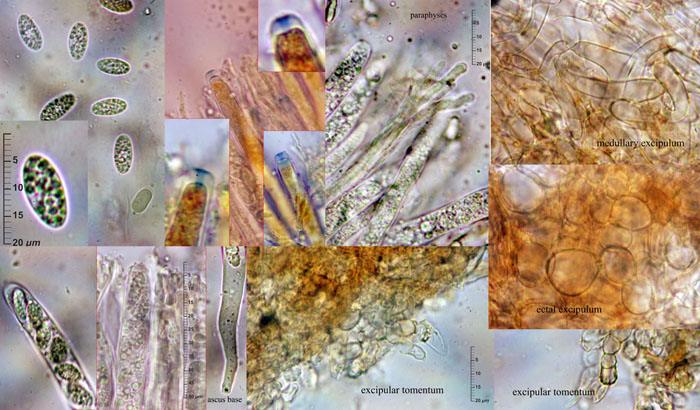
Asques IKI bb, jusqu'à 132 x 11, sans des crochets. Paraphyses avec beaucoup de VBs jaunes - verdâtres. Spores 10.5-16 x 5-8, pleines d'une multitude de guttules refringents. Excipulum médullaire intricata et ectal globulosa.
Je pense a Rutstroemia sp. parce que sa base apparaît stromatisée et noirâtre et par ses caractères microscopiques.
Avez vous quelque opinion?
Dear friends of the Forum:
I propose you a new question: this ascomata, turbinate, outside tomentose, of 1mm of height and 1 mm in width, grows on Daphne laureola old leaves at 1700 m.
Asci IKI bb, up tol 132 x 11, without croziers. Paraphyses with many VBs yellow - greenish. Spores 10.5-16 x 5-8, full of a multitude of refractive guttules. Medullary excipulum intricata. Ectal excipulum globulosa.
Thank you for your kindly help.
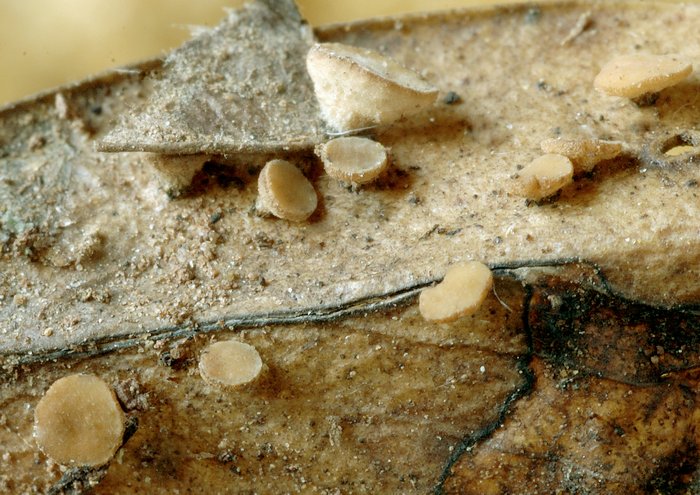
Enrique Rubio,
02-07-2007 21:14
Re:Rutstroemia sur Daphne laureola feuilles / Rutstroemia on Daphne laureola old leaves
Micro
Hans-Otto Baral,
07-07-2007 13:41

Re:Rutstroemia sur Daphne laureola feuilles / Rutstroemia on Daphne laureola old leaves
Dear Enrique
the fine photos of the apical ring unmistakable show that this is a Sclerotiniaceae (or Rutstroemiaceae if that familiy is separated). Although the genera Rutstroemia (t. oblita) and Lanzia (t. prismatica) are generally defined by horizontally elongated cells while Ciboria by globose cells, I would place the fungus in Rutstroemia (= Lanzia in my opinion), because of the multiguttulate spores (high oil content). This combination with a t. globulosa is also the case in R. bolaris, but that species grows on branches of Carpinus and has much longer spores (18-24 x 7-9 µm), also asci with croziers, and of course much larger apothecia. I do not find any Sclerotiniaceae on Daphne in my database but of course it is far from complete. In the case the species is not specific but grows on leaves of various plants then it will not be easy to find out if it is a new taxon.
It will be also necessary to check whether the spores finally (overmature) get septate or perhaps even brown. The genus Lambertella with finally brown spores should be excluded because it is only used for species with t. prismatica. The description of Ciboria cistophila Galán, Raitviir & Palmer in Mycotaxon LIX: 227-236 (1996) on leaves of Cistus, with spores 13-18 x 5-6.5 µm sounds very similar to your species. The spores are multiguttulate and the excipulum of globulosa, also the apos rather small. The spores finally get 1(-2)-septate and produce globose conidia. But the asci are said to arise fom croziers.
Ciboria conformata though without croziers is clearly excluded by the eguttulate spores.
the fine photos of the apical ring unmistakable show that this is a Sclerotiniaceae (or Rutstroemiaceae if that familiy is separated). Although the genera Rutstroemia (t. oblita) and Lanzia (t. prismatica) are generally defined by horizontally elongated cells while Ciboria by globose cells, I would place the fungus in Rutstroemia (= Lanzia in my opinion), because of the multiguttulate spores (high oil content). This combination with a t. globulosa is also the case in R. bolaris, but that species grows on branches of Carpinus and has much longer spores (18-24 x 7-9 µm), also asci with croziers, and of course much larger apothecia. I do not find any Sclerotiniaceae on Daphne in my database but of course it is far from complete. In the case the species is not specific but grows on leaves of various plants then it will not be easy to find out if it is a new taxon.
It will be also necessary to check whether the spores finally (overmature) get septate or perhaps even brown. The genus Lambertella with finally brown spores should be excluded because it is only used for species with t. prismatica. The description of Ciboria cistophila Galán, Raitviir & Palmer in Mycotaxon LIX: 227-236 (1996) on leaves of Cistus, with spores 13-18 x 5-6.5 µm sounds very similar to your species. The spores are multiguttulate and the excipulum of globulosa, also the apos rather small. The spores finally get 1(-2)-septate and produce globose conidia. But the asci are said to arise fom croziers.
Ciboria conformata though without croziers is clearly excluded by the eguttulate spores.
Enrique Rubio,
07-07-2007 21:54
Re:Rutstroemia sur Daphne laureola feuilles / Rutstroemia on Daphne laureola old leaves
Thanks, Hans Otto, for your extensive and detailed explanations. We have tried to gather more mature material, for checking a possible septation of the spores, but the heat has done that new fructifications do not appear. We will have to wait on next year to be able to try it again.
Hans-Otto Baral,
14-07-2007 22:21
Re:Rutstroemia sur Daphne laureola feuilles / Rutstroemia on Daphne laureola old leaves
I have now also studied this interesting species which again arrived rather senescent, i.e., I hardly saw any spores and therefore also no overmature stages. The croziers are actually absent so it cannot be Ciboria cistophila. I did not find the species in Velenovsky 1934 but I don´t have a substrate index. It would be good to consult some substrate indices for Daphne as fungal susbtrate. The black lines on the leaves and at the base of the stipes appear to belong to the discomycete but even that is not sure.
Zotto
Zotto