20-05-2026 12:57
 Ingo Ibelshäuser
Hello everybody, on decayed hardwood e.g. Quercus
20-05-2026 20:08
 Andreas Millinger
Good evening,another quite distinctive find from M
20-05-2026 21:49
Margot en Geert VullingsWe found this Lachnum on Juncus stems mown last ye
20-05-2026 17:47
Margot en Geert VullingsWe found this Mollisia on dead Juncus stems mown l
22-04-2026 20:54
 Enrique Rubio
Hi to everybody.This Pyrenopeziza grew in moist le

19-05-2026 12:55
 Hardware Tony
After checking Gminder and Otto's library I cannot
19-05-2026 10:27
Patrice TANCHAUDBonjour, récolte récente sur terre retournée i
Leatherleaf fungi
Nina Filippova,
14-07-2013 06:23
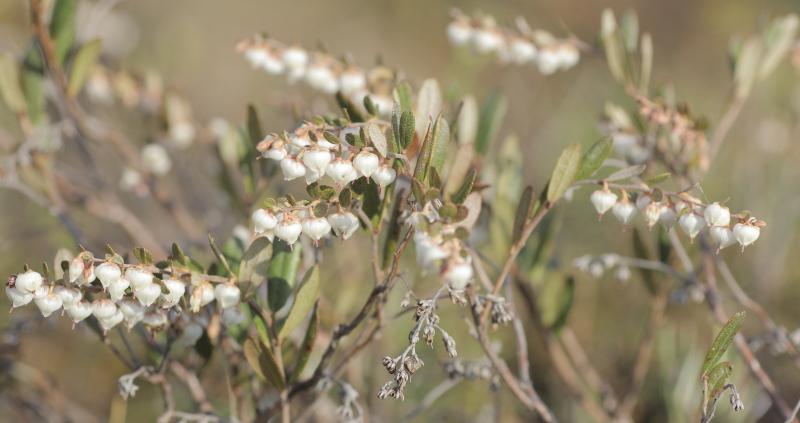
Fungal guild of Leatherleaf (Chamaedaphne calyculata) is a champion by a number of species compared to earlier my searches in this season. It is not surprisingly since there are many of substrates in a shrub, as the leaves, the twigs, the flowers. And these different parts of a plant are inhabited by different fungal lists. Now i have collected by two species from branches and fallen flowers, and 6 species from fallen leaves.
Fresh fallen flowers should be easy source of nutrients, and actually, found in wet places they host several anamorphic species. I have described not all of them, but the substrate was collected and could be incubated later in the laboratory for thorough inspection. There is one of them, some of Demateaceous hyphomycetes. (#4220 - https://www.cubby.com/pl/%234220/_74529dd5c6c94d00b7790b5bc5625884)
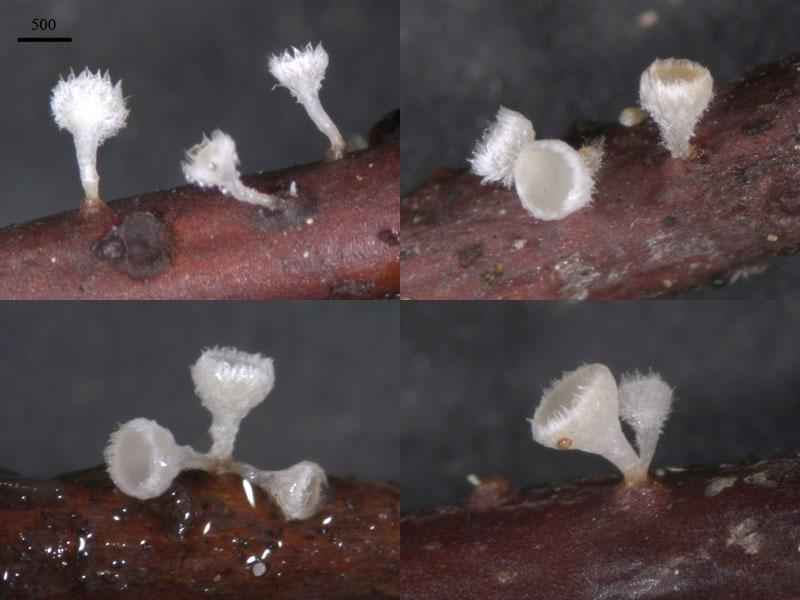
Common and well familiar Dasyscyphella cassandrae emerged at branches, where they are covered by wet litter. (#4210 - https://www.cubby.com/pl/%234210/_d8222ed3be7949f48de97027e4332297)
Another one on branches, Godronia sp. is not so common and i was glad to see its beautiful yellowish-brown goblets. There are several Godronia species on Ericaceous shrubs and the species will be specified later in lab time. (#4211 - https://www.cubby.com/pl/%234211/_f21eda0d776849cc912299a56099112c)
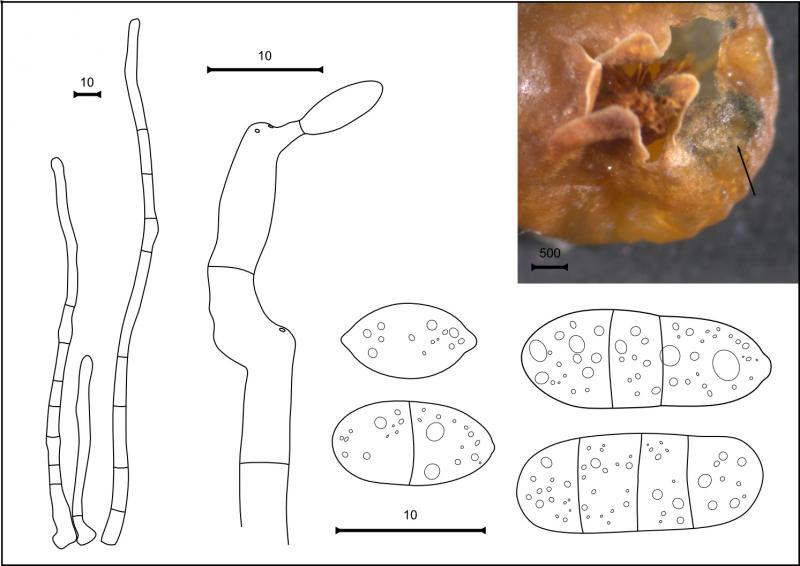
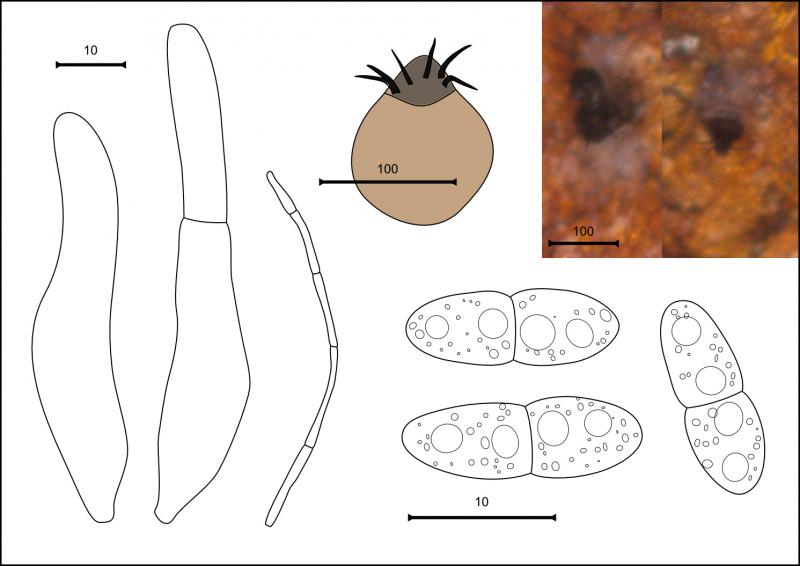
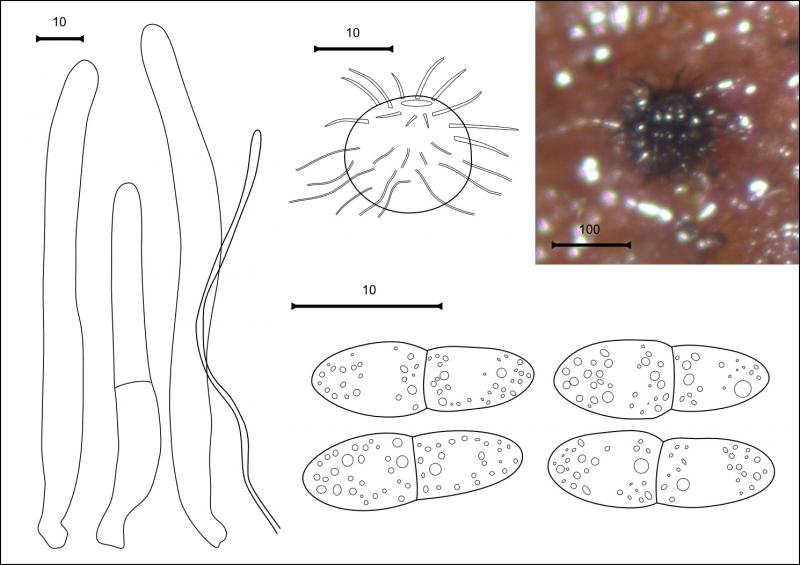
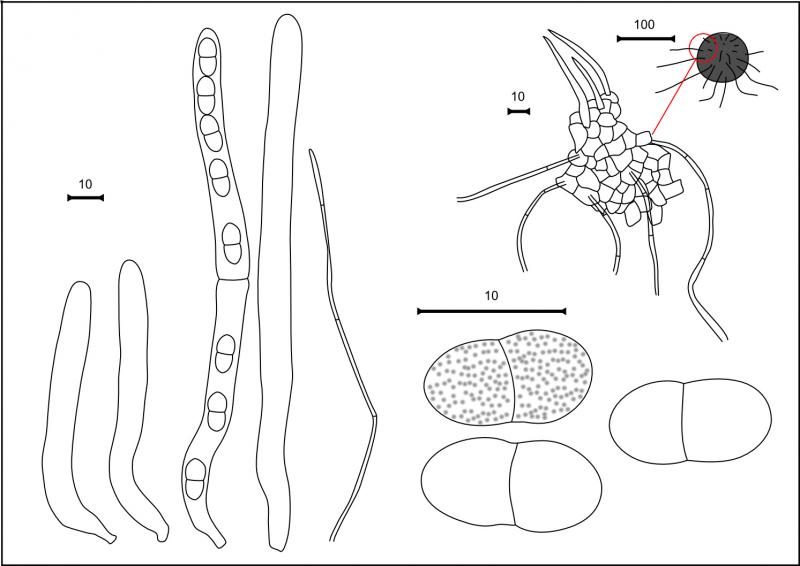
Several species with perithecia and fissitunicate spores easily seen on fallen leaves. Venturia cassandrae has small pear-shaped fruitbodies with sharp bristles at the top. Another one has similar structure of spores and asci, but the larger spherical perithecia. And the third with hairy perithecia, and ellipsoid spores with warty ormanentation.
(#4215 - https://www.cubby.com/pl/%234215/_736f8022b6c544e8a5dcab6fe6786a9d)
(#4217 - https://www.cubby.com/pl/%234217/_2f46703fc7854a278cb1ed015ec64778)
(#4214 - https://www.cubby.com/pl/%234214/_2548118e06bb483ca417e094c80542a5)
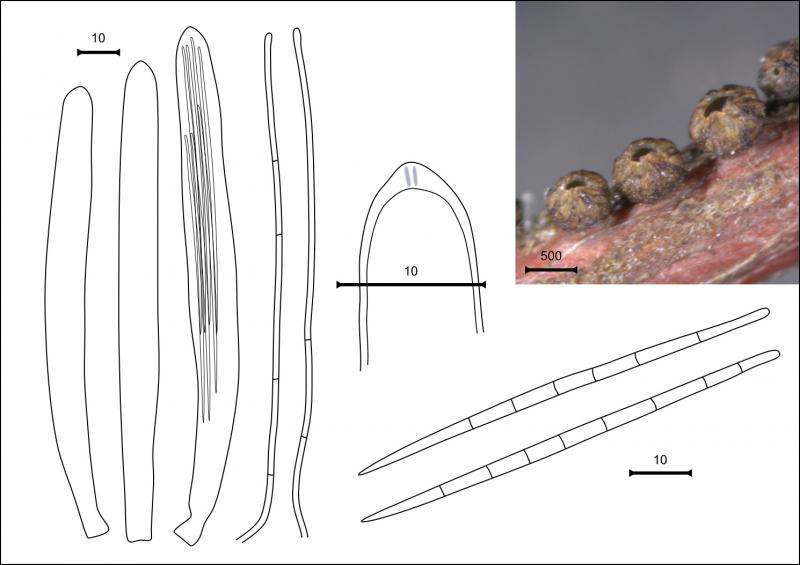
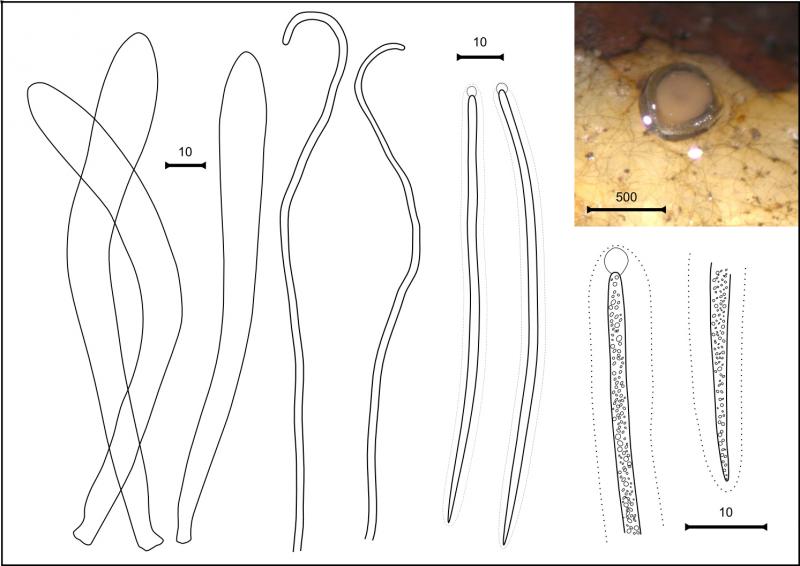
Lophodermium sp. was found at the leaf only once, but i expect to see them more often later in summer. The spores has weak gelatinous sheath, and small circular appendix at obtuse tip. (#4219 - https://www.cubby.com/pl/%234219/_70a0f51ea17441f8a7118b0adb25a615)
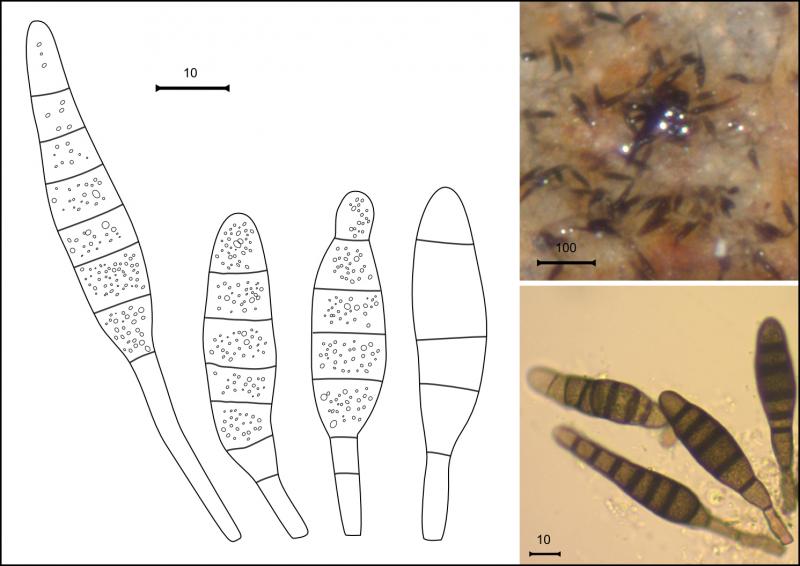
At the end, especially nice conidial species was spotted several times on well decayed leaves. It forms fusoid segmented structures on short stalks. (#4218 - https://www.cubby.com/pl/%234218/_51b46b7793ff43b792793e9ae801b609)
Hans-Otto Baral,
14-07-2013 21:18

Re : Leatherleaf fungi
Suppose you have Godrionia cassandrae, as you already posted in February.
Have you also microphotos for the Dasyscyphella ? I have some from you but in dead state.
Zotto
Have you also microphotos for the Dasyscyphella ? I have some from you but in dead state.
Zotto
Nina Filippova,
17-07-2013 04:28
Re : Leatherleaf fungi
Here they are, and the description in vital state:
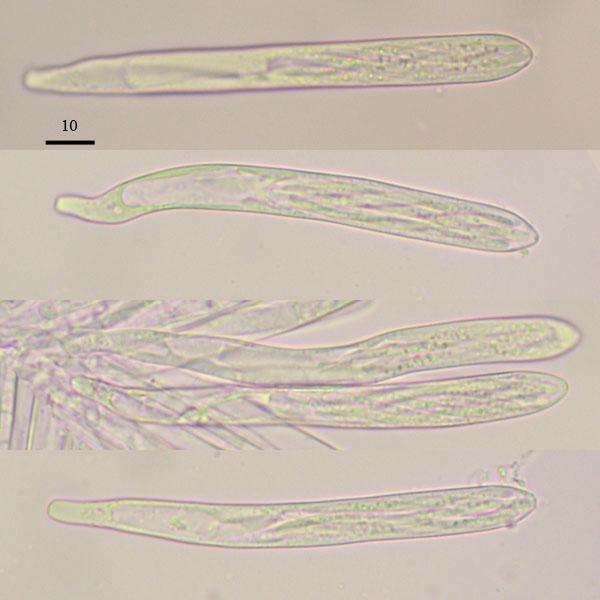
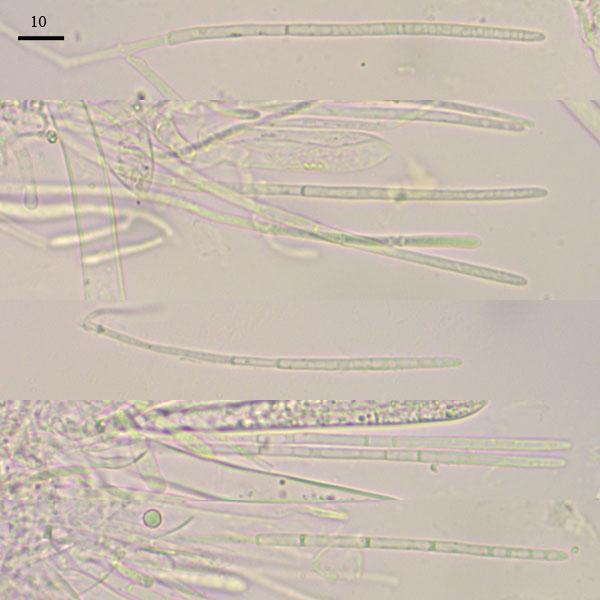
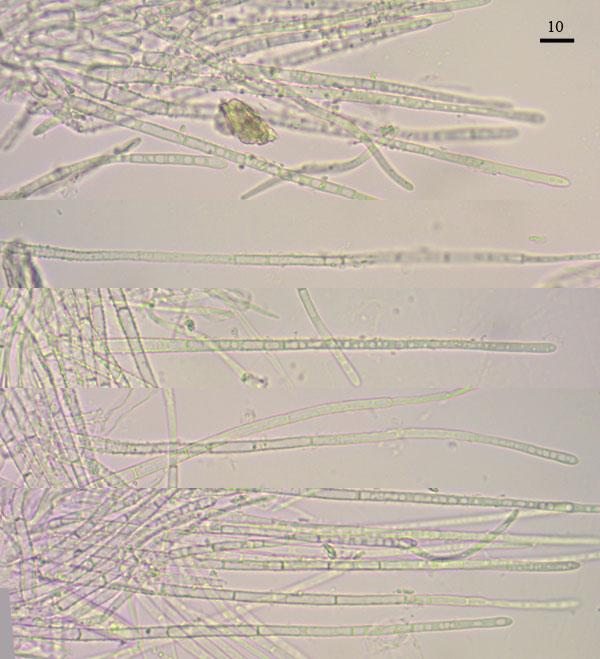
(Dasyscyphella cassandrae, #4210)
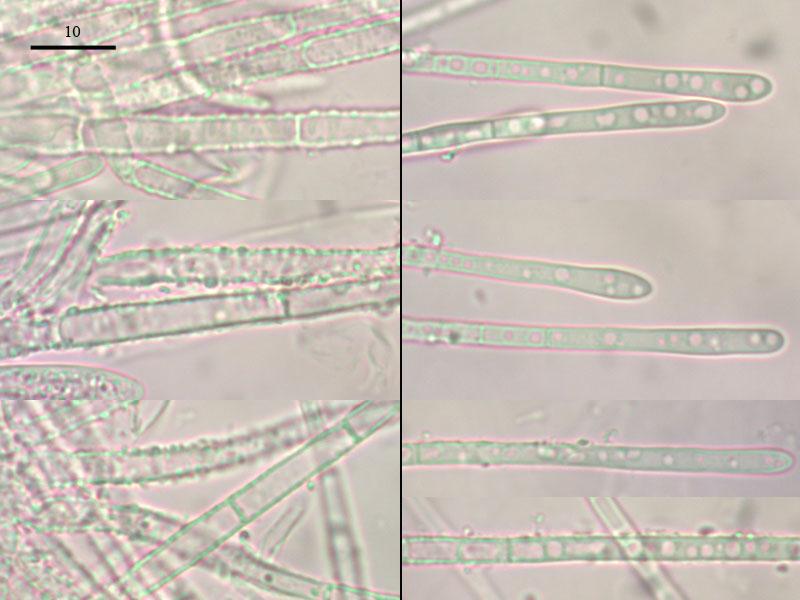
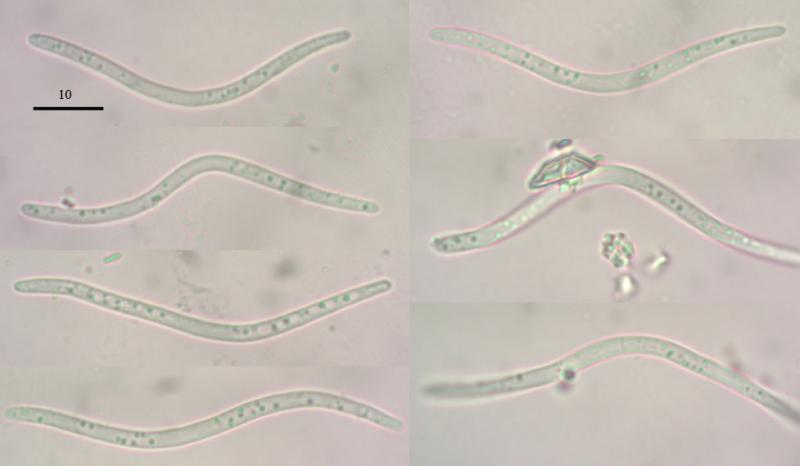
Apothecia cupulate, stipitate, single or in clusters for 2-5, 0.6–1 mm in diameter, 0.7–1.2 mm high; outer surface of receptacle and stem densely hairy, becoming bold to stem base with age, edge well ciliate from long hairs; outer surface and hymenium white. Common on branches of Chamaedaphne calyculata (and probably Ledum palustre, but not sure).
Hairs cylindrical, 120–200 long, surface rough from incrustation at the base and smooth in upper part, about 4 broad at base, 2.6 in upper part (the most tip could be slightly enlarged), asci without crozier, 84–108 x 9.4–10.5; paraphyses cylindrical, segmented, with elongated along segments VBs, medium size 100 x 2.6; spores vermiform, with tiny scarce oils, dead spores with a central septa, 55–58 x 2.2–2.7 (n=6).
(Dasyscyphella cassandrae, #4210)
Apothecia cupulate, stipitate, single or in clusters for 2-5, 0.6–1 mm in diameter, 0.7–1.2 mm high; outer surface of receptacle and stem densely hairy, becoming bold to stem base with age, edge well ciliate from long hairs; outer surface and hymenium white. Common on branches of Chamaedaphne calyculata (and probably Ledum palustre, but not sure).
Hairs cylindrical, 120–200 long, surface rough from incrustation at the base and smooth in upper part, about 4 broad at base, 2.6 in upper part (the most tip could be slightly enlarged), asci without crozier, 84–108 x 9.4–10.5; paraphyses cylindrical, segmented, with elongated along segments VBs, medium size 100 x 2.6; spores vermiform, with tiny scarce oils, dead spores with a central septa, 55–58 x 2.2–2.7 (n=6).