
12-04-2026 17:56
 Hardware Tony
Found on dead stems in February earlier this year
12-04-2026 15:52
Gernot FriebesHi,I'm looking for help with this anamorph collect
12-04-2026 12:22
 William Slosse
In a dune grassland in Oostduinkerke (Belgium), on
11-04-2026 15:45
 Zuzana Sochorová (Egertová)
Please, could anyone send me this paper?Moyne G.,
11-04-2026 13:34
Artem PtukhaHello, I am seeking assistance with the identific

11-04-2026 10:19
 Michel Hairaud
Chers amis d'Ascofrance , voici une très bonne no
11-04-2026 10:10
Michel Hairaud
Dear Ascofrance members, here is some very good ne
10-04-2026 23:22
Gernot FriebesHi,ascospores are 1- to 3-septate, approximately
10-04-2026 15:51
William Slosse
Hello everyone, On 08/04/26, I found a growth sit
Dear Dr. Malloch,
we saw in the forum your chat with Pimpek and we're interested in Scopinella's papers, too.
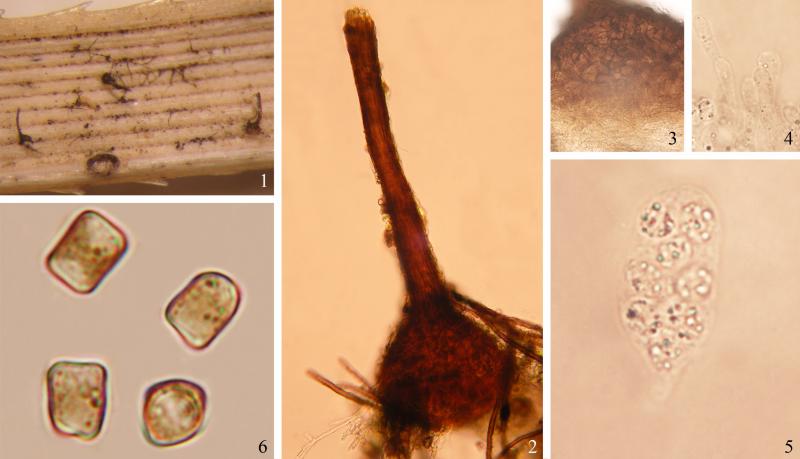
We have found a specimen of Scopinella on leaves of Cortaderia selloana (Poaceae) and we think it could be a new species. However we haven't got bibliographic material about S. gallicola and S. pleiospora.
We attached a plate. The ascospores are 7.5-9.5 x 5.5-8.5 µm.
Best wishes,
Lucrecia, Virginia and Romina

(if I may "chip in") nothing on S. pleiospora, but this the description of S. gallicola (from "Scopinella gallicola, a new species from rust galls of Endocronartium harknessii on Pinus contorta" A . TSUNEDA AND Y . HIRATSUKA (CJB vol. 59)
TYPUS: In gallis Endocronartii harknessii (J. P. Moore) Y . Hiratsuka in Pinus contorta Dougl . var. latifolia Engelm. , CF B 20831.
Ascocarps nonstromatic, superficial; bases globose, at first hyaline and semitransparent, then becoming dark brown to black, 80-230 p.m diameter, with thick-walled peridial hyphae, hyaline, brown at the base, up to 150 x 5 p.m; necks straight or slightly bent, dark brown to black, pale or hyaline at the apices, slightly tapering toward the apices, mostly 230-370 u.m long, (18—)30— 45(-55) p,m wide; ostiolar hyphae rarely present.
Ascocarp peridium, dark brown to black, two- to five-layered, 9-25 p-m thick. Peridial cells isodiametric in surface view, 3-17 p.m diameter, 2- 7 p.m thick, with moderately thick walls 1-2 p.m thick. Paraphyses moniliform, 2.5-8.0 p,m diameter. Asci lining sides of the centrum wall , hyaline, 2- to 4-spored, clavate, usually short-stipitate, soon becoming evanescent, 12 - 26 x 5.0-7.5 p.m. Ascospores unicellular, barrel-
shaped, pale brown, brown to black in mass, hyaline at the ends, smooth, 3.5-8.0 x 2.9-6.5 p.m. ?
clearly a different taxon to what you have found
un cordial saludo! / best wishes
Chris
Hello Chris,
you're right, S. gallicola has nothing to do with our species. Thank you very much for the information!!!
Regard to S. pleiospora, we found it in the Index Fungorum (www.indexfungorum.org) list of Scopinella's species and we don't know when it was rejected as a member of the genus.
Cordialement,
Lucrecia, Virginia and Romina