

10-06-2026 12:54
Steve ClementsBonjour encore, Pouvez-vous m'aider, s'il vous pl
09-06-2026 18:32
Camille MertensSur morceau de roseau immergé 0,5 - 0,7 mm de dia
10-06-2026 21:16
 François Freléchoux
Bonsoir,Le dernier du jour, en attendant votre avi
10-06-2026 21:07
François Freléchoux
Toutes les tiges de gentianes jaunes de l'an passÃ
10-06-2026 13:41
François Freléchoux
Bonjour à nouveau, Voici une trouvaille d'hier.
10-06-2026 11:53
Steve ClementsBonjour, This disco is abundant on dead stems of
10-06-2026 10:45
François Freléchoux
Bonjour à nouveau, Encore une détermination qui
08-06-2026 10:16
 Spooren Marco
I don`t have a clou about this fungus,it is not in
10-06-2026 09:24
François Freléchoux
Bonjour, J'imagine que cette détermination ne do
Lophiostomataceae
Gernot Friebes,
16-03-2010 21:10
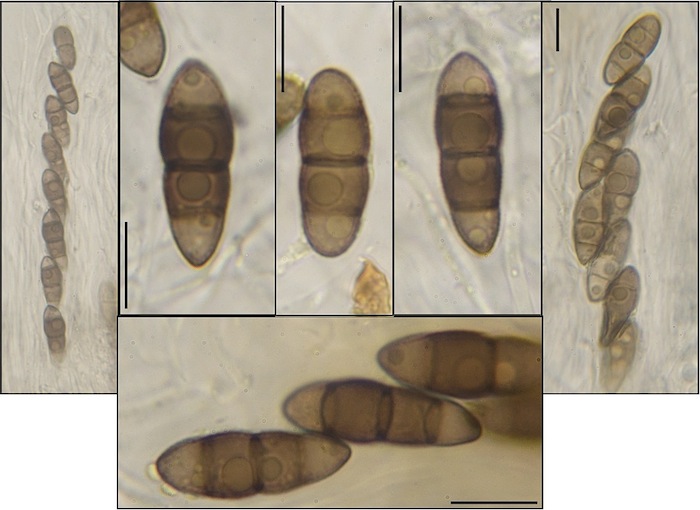
here I have a second indeterminate pyreno which grew on the bark of a living Fraxinus. The ascomata are very conspicuous because they can be from Navicella-like with a small, slit-shaped neck to even Ceratostomella-like with a long and thin neck (I checked that they really are of the same species). The spores are 22,5-25 x 8-9 µm, mature always 4-celled and slightly rough, often with two paler end-cells. The asci are bitunicate and 8-spored. I didn't find a species within the Lophiostomataceae which would fit with my species.
Best wishes and many thanks,
Gernot

Gernot Friebes,
16-03-2010 21:11
Re:Lophiostomataceae
micros (scale=10 µm):
Christian Lechat,
16-03-2010 21:16

Re:Lophiostomataceae
Hi, Gernot,
I think your fungus is maybe Lophiostoma maculans H. Fabre
All the best,
Christian
I think your fungus is maybe Lophiostoma maculans H. Fabre
All the best,
Christian
Gernot Friebes,
16-03-2010 22:18
Re:Lophiostomataceae
Hi Christian,
thank you very much! The photos of your find and the description by Saccardo fit quite well. It seems to be a rare species, at least there is apparently not much literature on it. Even google provides only few hits.
Best wishes,
Gernot
thank you very much! The photos of your find and the description by Saccardo fit quite well. It seems to be a rare species, at least there is apparently not much literature on it. Even google provides only few hits.
Best wishes,
Gernot