
16-09-2009 16:53
 Luc Bailly
Trouvé en lisière d'une pelouse calcaire, sur Eu

13-09-2009 17:46
 Beñat Jeannerot
Bonjour à tous, Je souhaite confirmation de ce
08-09-2009 18:26
 Pablo Chacón
Salut des amis, Dans cette occasion il me plair
07-09-2009 00:17
 Hans-Otto Baral
The other on Quercus pubescens bark could be Amphi
04-09-2009 22:52
Marja PennanenFruitbodies 0,1 to 0, 3 mm wide. Spores 9-2 x 2-3
Pezicula(?)
Gernot Friebes,
29-08-2009 23:46
this asco grew on cones of Picea amongst Hyaloscypha britannica on and next to old pyrenomycetes. Because of the asci which sometimes have a reddish porus in lugol and the septated spores I thought of Pezicula but I am not sure about this. I would appreciate your opinions!
Best wishes,
Gernot
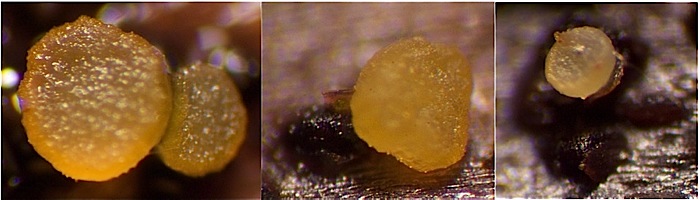
Gernot Friebes,
29-08-2009 23:47
Re:Pezicula(?)
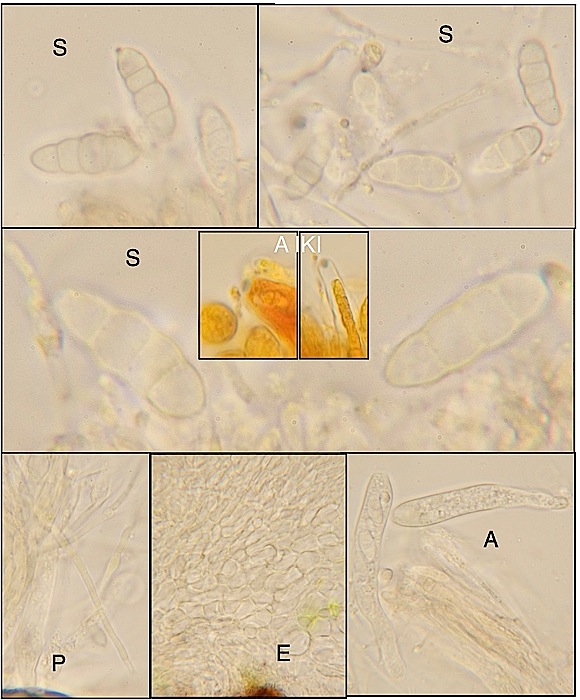
S...spores (4-celled, 16-19 x 6-7 µm)
A IKI...Asci in lugol (some asci with a dirty reddish porus but most with a blue one)
P...paraphyses (filiform, up to 2,5 µm wide, sometimes furcate)
E...excipulum
A...asci in water (up to 90 x 5 µm, I did not see any croziers)
A IKI...Asci in lugol (some asci with a dirty reddish porus but most with a blue one)
P...paraphyses (filiform, up to 2,5 µm wide, sometimes furcate)
E...excipulum
A...asci in water (up to 90 x 5 µm, I did not see any croziers)
Gernot Friebes,
29-08-2009 23:48
Re:Pezicula(?)
asci in lugol again

Hans-Otto Baral,
30-08-2009 00:58
Re:Pezicula(?)
I have presently no idea but it is surely no Pezicula because 1. the reaction is not purely red but blue at lower concentration, and 2. the spores are not filled with oil drops and they seem to get 4-celled prior to being ejected.
The apothecia remind me a bit of taxa I place provisionary in Naeviopsis, but those have inamyloid asci and obvious carotenois oil drops in the paraphyses
Again, is this from a kontaneous site?
Zotto
The apothecia remind me a bit of taxa I place provisionary in Naeviopsis, but those have inamyloid asci and obvious carotenois oil drops in the paraphyses
Again, is this from a kontaneous site?
Zotto
Gernot Friebes,
30-08-2009 09:07
Re:Pezicula(?)
Hi Zotto,
thanks for your opinion of these two fungi. Both were found in a raised bog in the Thüringer Wald, so yes, they are from montaneous site.
Best wishes,
Gernot
thanks for your opinion of these two fungi. Both were found in a raised bog in the Thüringer Wald, so yes, they are from montaneous site.
Best wishes,
Gernot
Hans-Otto Baral,
30-08-2009 20:52
Re:Pezicula(?)
Hallo Gernot
now I know what you have. It is what I identified as Coryne terrestris Velen. 1934: 113, see DVD. My two drawings should be in dir. Calycellina, subdir. terrestris. One was on Picea cone, the other on sandy soil. Calycellina is only a tentative genus for this apparently rare fungus because the apically flexuous and branched paraphyses are unusual there.
Zotto
now I know what you have. It is what I identified as Coryne terrestris Velen. 1934: 113, see DVD. My two drawings should be in dir. Calycellina, subdir. terrestris. One was on Picea cone, the other on sandy soil. Calycellina is only a tentative genus for this apparently rare fungus because the apically flexuous and branched paraphyses are unusual there.
Zotto
Gernot Friebes,
30-08-2009 21:13
Re:Pezicula(?)
Hi Zotto,
many thanks, your drawings look similar to my fungus. But I have one question left: what is the "right" name for this fungus? In Index Fungorum Coryne terresttris is a anamorphic Ascocoryne. Is it OK to call it Calycellina terrestris (even though Calycellina does not fit perfectly)?
Best wishes,
Gernot
many thanks, your drawings look similar to my fungus. But I have one question left: what is the "right" name for this fungus? In Index Fungorum Coryne terresttris is a anamorphic Ascocoryne. Is it OK to call it Calycellina terrestris (even though Calycellina does not fit perfectly)?
Best wishes,
Gernot
Hans-Otto Baral,
30-08-2009 21:19
Re:Pezicula(?)
This is one of many dozends of similar unclear cases. Velenovsky's description is too bad to be sure about the identity, and I never met another description that might fit (though there might exist some). To clarify needs revision of the type material. You can call it ad interim Calycellina. Coryne is of course inacceptable, even Ascocoryne is certainly out of place.
Zotto
Zotto
Gernot Friebes,
30-08-2009 21:28
Re:Pezicula(?)
ok, I will call it Calycellina terrestris ad. int.
A very interesting fungus!
Best wishes and thanks again,
Gernot
A very interesting fungus!
Best wishes and thanks again,
Gernot