
22-04-2026 01:06
 Richard VALERI
Bonjour à tous.Je vous présente cette Nectria s.
21-04-2026 13:36
Gernot FriebesHi,I am out of ideas for this one. I collected Sal
21-04-2026 13:19
Gernot FriebesHi,this Lophodermium on Typha has ascospores measu
21-04-2026 13:05
Gernot FriebesHi,this hyphomycete feels familiar but I was not a
20-04-2026 22:00
 Malcolm Greaves
These pale yellow, hairy ascos were growing on cul
19-04-2026 21:23
Steve ClementsBonjour, I found this anamorphic fungus on old pl
19-04-2026 20:46
Steve Clements1 mm diameter approx spherical conidiophores on pl
12-04-2026 17:56
 Hardware Tony
Found on dead stems in February earlier this year
Petit asco indéterminé
François Freléchoux,
25-08-2025 17:37
 Bonjour,
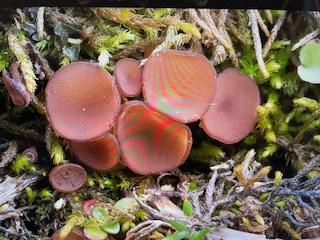
Nous avons trouvé samedi dernier à l'étage alpin à Ovronnaz (VS), région du Grand Muveran, un petit ascomycète stipité dans une combe à neige (Salicion herbaceae), en présence de Saxifraga aizoon, Soldanella alpina, Vaccinium vitis-idaea, Salix herbacea.
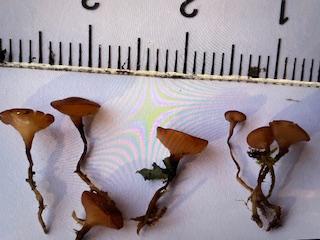
Macro. Cupule 1-6 mm de diamètre, 2-4 mm de hauteur, brune à marge un peu plus foncée. Pied jusqu'à 12 mm de long x 0,5 mm de diamètre, sinueux, noir en haut, incolore en bas. Il ne semble pas pourvu d'un sclérote et semble lié aux mousses.
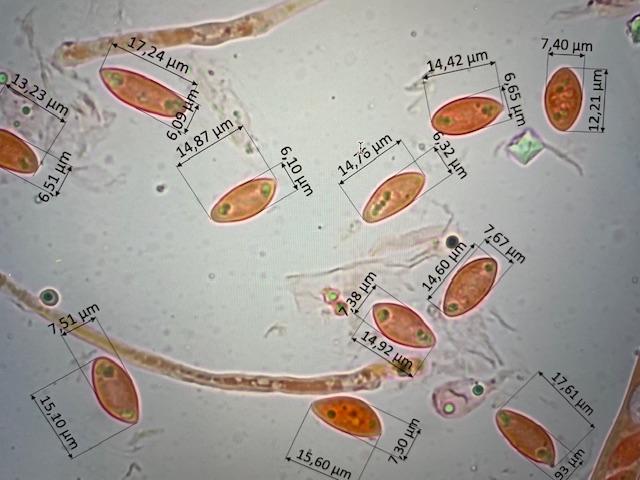
Micro. Asques I+, 140-160 µm x 9-11 µm. Spores 14-17 x 6-7,5 µm, fusiformes et semblent amyloïdes (au moins sur une extrémité). Paraphyses env. 110-140 x 2-3,5 µm, un peu élargie à l'extrémité qui semble pourvue de matière amorphe. Excipulum ectal avec cellules rondes. Il semble y avoir dans la chair des structures produisant des conidies.
Auriez-vous une idée du genre ou de l'expèce ?
Plus important encore : Auriez-vous de la littérature à me proposer ?
Merci d'avance
François
Hans-Otto Baral,
26-08-2025 08:51

Re : Petit asco indéterminé
You do not have the fungus fresh? Important would be the nuclear number in the spores and possible VBs in the paraphyses.
I am a bit in doubt that the apos are connected to moss. Usually there is some remnants of mummified plant substrate or a sclerotium.
Surely the spores are not amyloid.
A possibility is Sclerotinia trifoliorum, did you look if 4 spores are smaller in the ascus than the other 4?
François Freléchoux,
26-08-2025 09:01
Re : Petit asco indéterminé
Hi Zotto,
I took a lot of microphotos. I will send them to you privately soon.
Best regards,
François
I have already dried the samples. They will be sequenced. I still have one fresh sample.
I found a rhizome of a phanerogam (Saxifraga aizoides) in the moss, possibly linked to the fungus.
I took a lot of microphotos. I will send them to you privately soon.
Best regards,
François
Hans-Otto Baral,
26-08-2025 09:21
Re : Petit asco indéterminé
Please don't overload me with pictures. If they are in Congo like the below one it does not help me much. A mature ascus with spores would be important at first to see if it is S. trifoliorum. When you look again at your fresh apo, please take water and do not press on the slip.
François Freléchoux,
26-08-2025 09:39
Re : Petit asco indéterminé
Ok, I'll observe matures spores in the water. And indeed, in several asci, the two sets of four spores are clearly different in size.
François Freléchoux,
27-08-2025 10:16
Re : Petit asco indéterminé
I looked at the spore nuclei. It seems to me that there are several, but their outlines are unclear. On the other hand, I checked the ectal excipulum, which is indeed textura intricata (for Sclerotinia).
François Freléchoux,
27-08-2025 10:18
Re : Petit asco indéterminé
The material will be sequenced by A. Gross at the WSL.
Hans-Otto Baral,
27-08-2025 11:50
Re : Petit asco indéterminé
Sclerotinia has an ectal excipulum of t. globulosa. The large spores of S. trifoliorum are 4-nucleate. This species exists several times in GenBank (ITS), e.g. EU082465, with 98.8-100% similarity, but some of them are misidentified as S. sclerotiorum.