
12-06-2026 14:50
 François Freléchoux
Bonjour, Voici la brève description d'une Mollis
10-06-2026 21:16
François Freléchoux
Bonsoir,Le dernier du jour, en attendant votre avi
11-06-2026 19:01
 William Slosse
Hello all,In an attempt to make a culture of a sus
11-06-2026 19:03
 Nicolas VAN VOOREN
Chers membres d'Ascofrance,Le site sera placé en

09-06-2026 18:32
Camille MertensSur morceau de roseau immergé 0,5 - 0,7 mm de dia
10-06-2026 12:54
Steve ClementsBonjour encore, Pouvez-vous m'aider, s'il vous pl
10-06-2026 21:07
François Freléchoux
Toutes les tiges de gentianes jaunes de l'an passÃ
10-06-2026 13:41
François Freléchoux
Bonjour à nouveau, Voici une trouvaille d'hier.
 • Macro and habitat seem hyaloscyphoid.
• Hairs and spores suggest Hyaloschypha (s.s.).
• Simple septa, rings, hairs, spores and substrate seem to suggest H. herbarum.
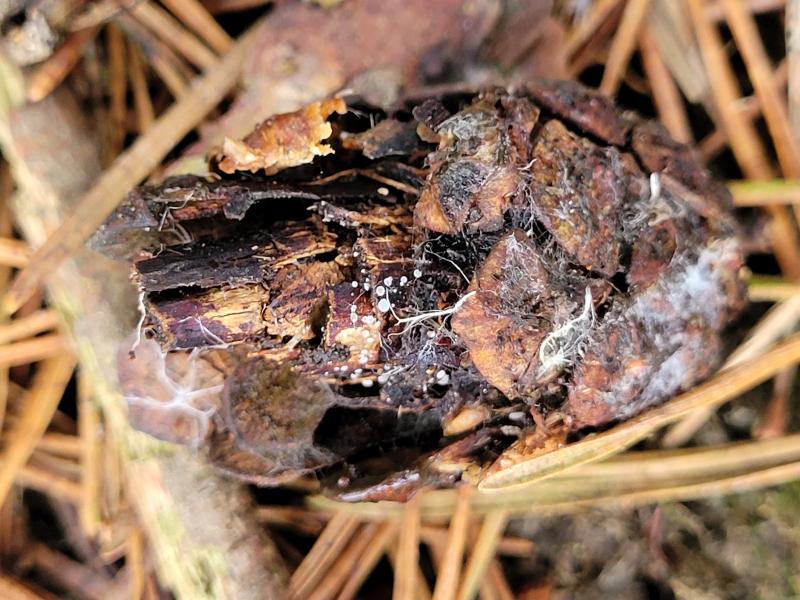
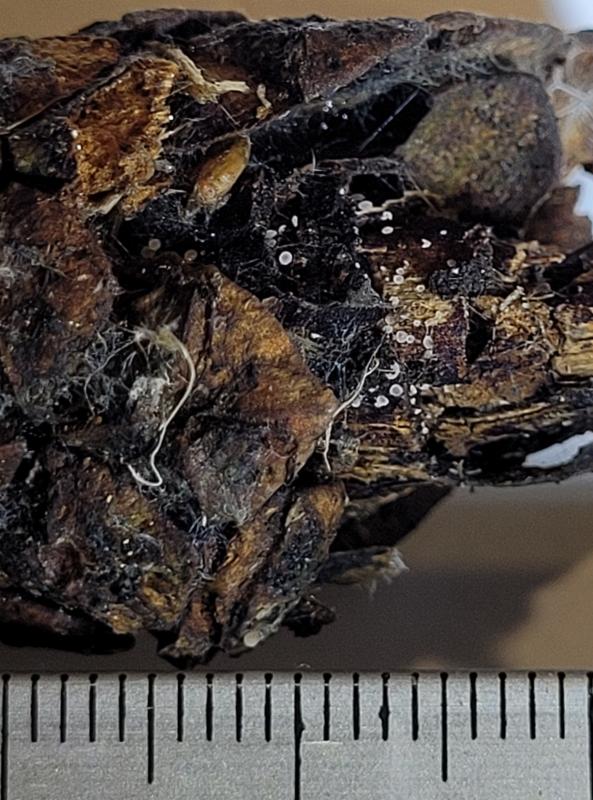
Habitat: On a decaying cone of Pinus sylvestris, mostly on the more sheltered inner parts, damp when found, on the floor with litter, under several large trees, on a sparsely wooded hillside, 197 m alt., Old Lodge nature reserve, Ashdown Forest, High Weald, southern England, early-November.
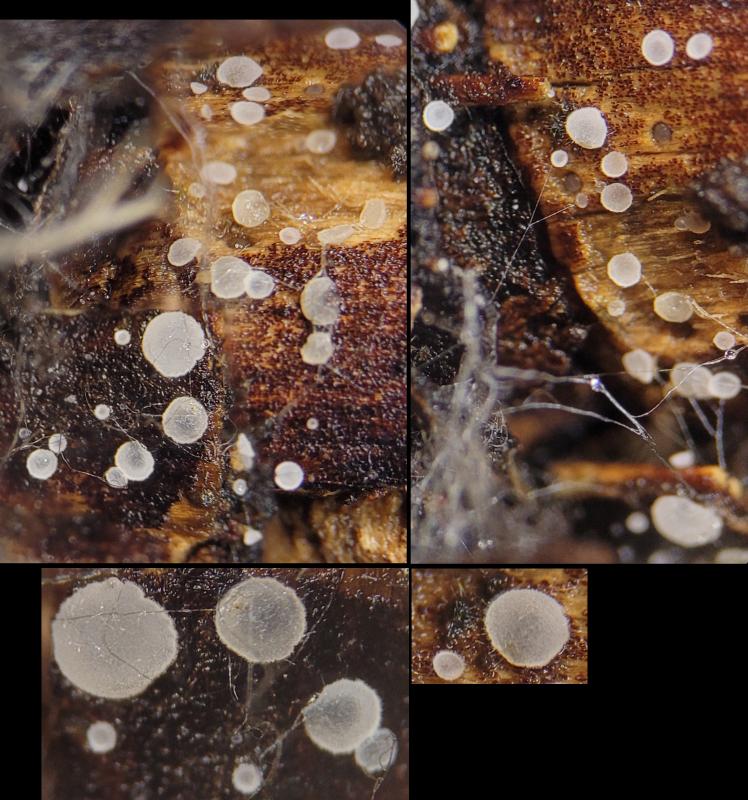
Apothecia: Tiny whitish discs, gregarious to 2-caespitose, sessile.
Macro: Diameter < ~0.5 mm, whitish-translucent, occasionally yellowish, initially more cupulate, then discoid-pulvinate and +/- appressed, margin more whitish, becoming flattened and often slightly uneven, with dense and short whitish hairs pointing outwards and some longer ones, disc distinctly convex in maturity, more translucent with the dark substrate showing in the centre, grainy appearance (hymenial cells).
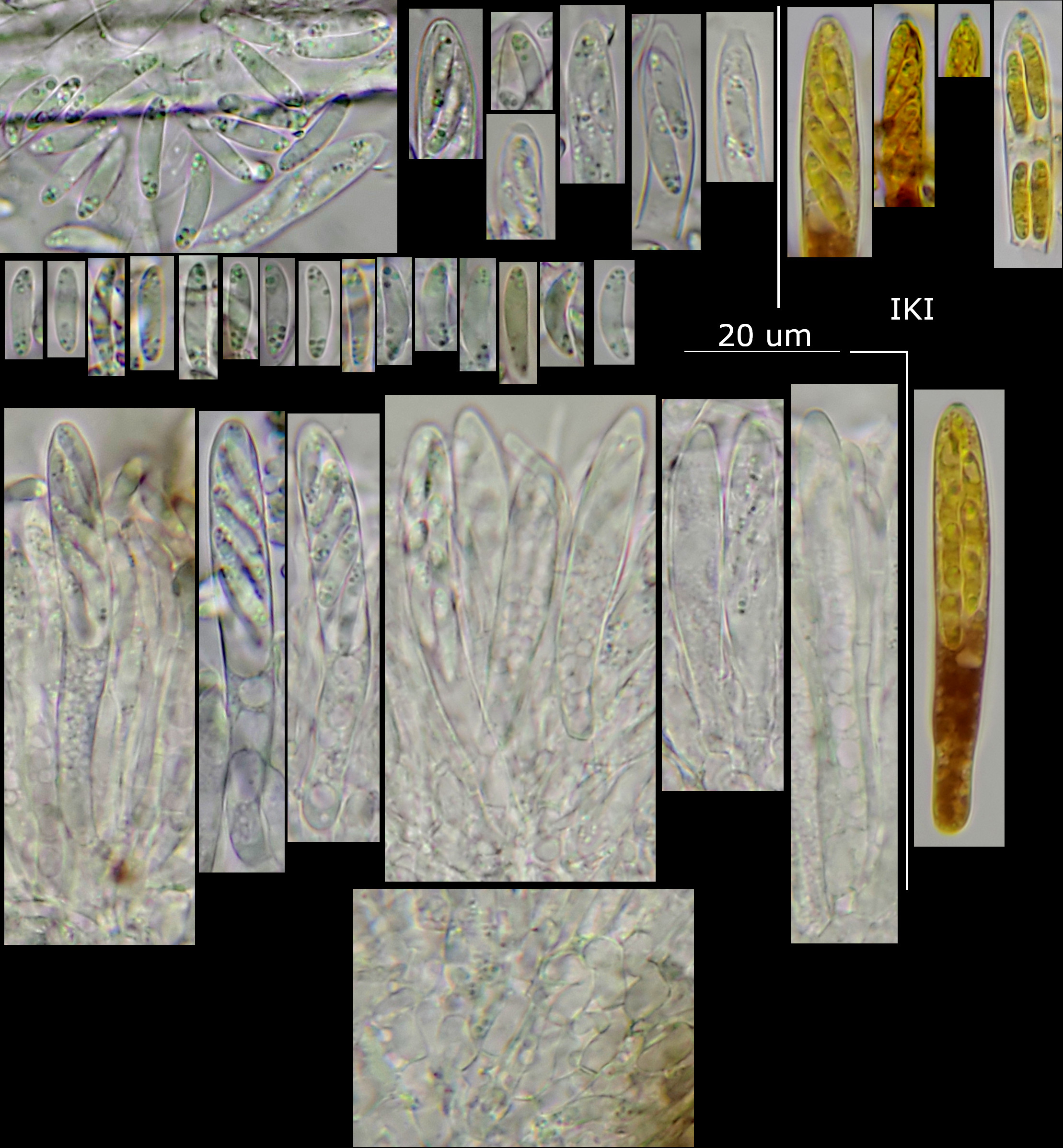
Asci: Turgid ~(45) 50-60 x 7-8 um, simple septa, rings bb.
Spores: Cylindrical-allantoid to slightly clavate, usually approx. homopolar, ends rounded, tapering slightly, usually ~3-5 small LBs grouped at each pole, OCI 2-3, asymmetric or sometimes slightly to distinctly curved.
Free living spores in water:
(9.4) 10.3-13.1 (14.7) × (2.2) 2.6-3.0 (3.2) µm, Q = (3.5) 3.7 - 4.9 (5.3), N = 35, mean = 11.9 × 2.8 µm, Q mean = 4.2.
Paraphyses: Cylindrical, apex not noticeably inflated, width ~2-2.5 um.
Medullary: Some horizontal hyphae seen, otherwise ?
Ectal: Text. prismatica, at the base more round, slightly larger cells at the flanks and often branching before becoming hair-like, general dextrinoid reaction.
Marginal hairs: A few long and cylindrical, length ~70-100 x 2-3 um, apex rounded, otherwise short and tapering, ~25-40 x 5 um, at the apex ~1 um wide, conical to distinctly lageniform, with an apical inflation, blunt/obtuse, appearing smooth, possibly a slight amyloid reaction at apices.
 Hymenium-0031.jpeg
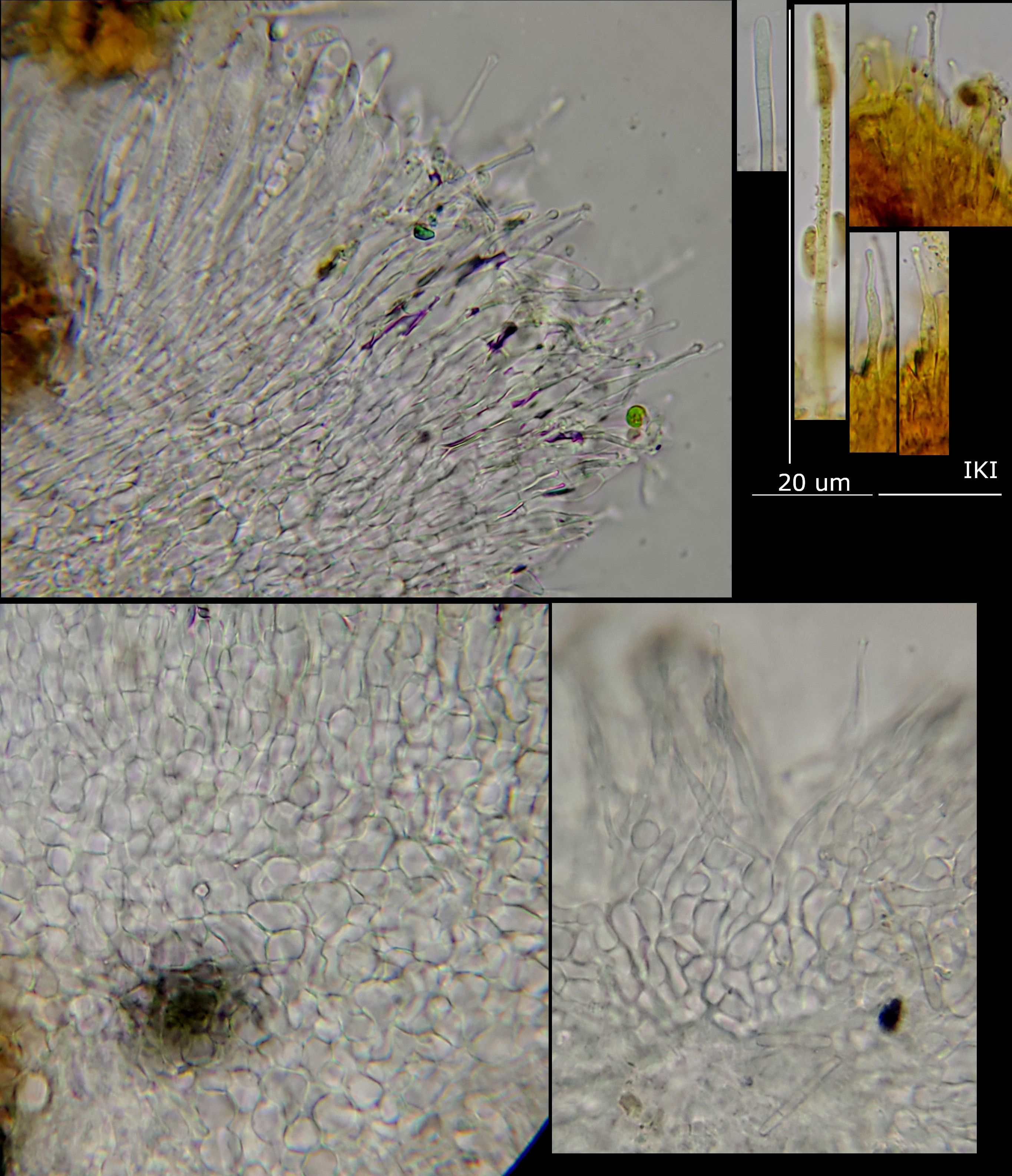 Excipulum-0023.jpeg
Thank you, I guess it's H. herbarum s.l. for now then. It's a shame there isnt enough genetic data to explore your hypothesis. As pointed out by Huhtinen in his monograph, there could also be some confusion with the quite similar H. (fuckelii var.) alniseda.
I thought the morphology seemed to fit with Huhtinen's concept, although there is no mention of the longer cylindrical hairs. The spore length and curvature seem quite variable, but the range of lengths given by Huhtinen is very broad and includes the longest spores in the genus.
I noticed the observation 1.X.2019 in your folder reports spores that are distinctly wider than Huhtinen's range, the asci are also larger, and many of the hairs look longer (possibly also noticeable in macro).
Huhtinen does also comment on the uncharacteristic and wide substrate range of H. herbarum, but suggests the cultures are morphologically similar and also grow faster. The precise substrate range doesn't seem clear but he only reports a single collection on Pinus, on bark, and otherwise they are all on angiosperms. Most records in the UK (with substrate data) report herbaceous material, but one says 'log, fallen, Pinus'.