
10-06-2026 21:16
 François Freléchoux
Bonsoir,Le dernier du jour, en attendant votre avi
11-06-2026 19:01
 William Slosse
Hello all,In an attempt to make a culture of a sus
11-06-2026 19:03
 Nicolas VAN VOOREN
Chers membres d'Ascofrance,Le site sera placé en

09-06-2026 18:32
Camille MertensSur morceau de roseau immergé 0,5 - 0,7 mm de dia
10-06-2026 12:54
Steve ClementsBonjour encore, Pouvez-vous m'aider, s'il vous pl
10-06-2026 21:07
François Freléchoux
Toutes les tiges de gentianes jaunes de l'an passÃ
10-06-2026 13:41
François Freléchoux
Bonjour à nouveau, Voici une trouvaille d'hier.
10-06-2026 11:53
Steve ClementsBonjour, This disco is abundant on dead stems of
 • Macro and habitat seems like Hymenoscyphus s.l.
• Supported by paraphyses, spores and ascus rings.
• The spores, excipulum, and substrate make me think H. s.s.
• Possibly H. caudatus, based on spores, asci, and macro.
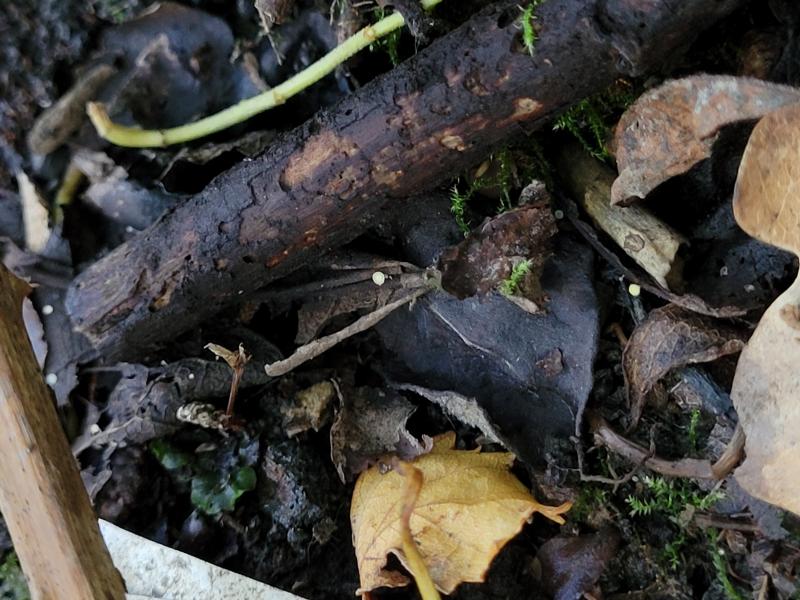
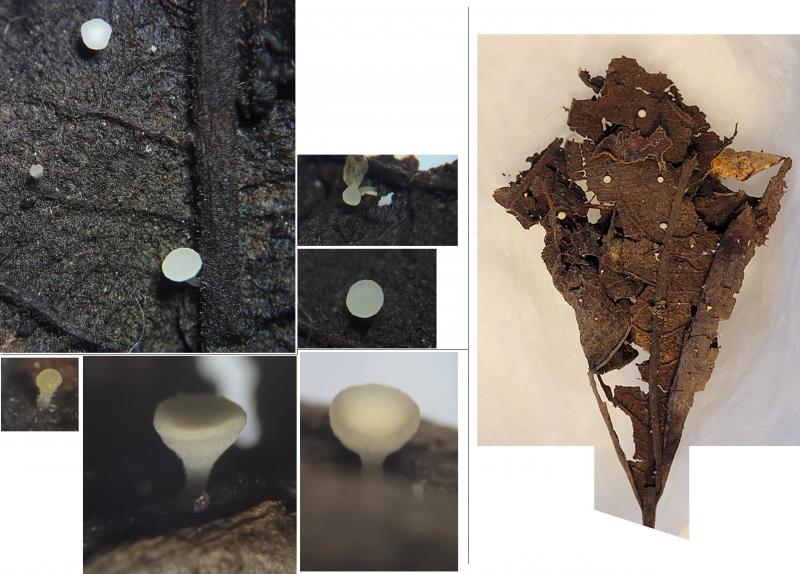
Habitat: On petioles and veins of dead leaves of Salix cf. caprea, possibly on a Betula cf. pendula leaf too (no micro), leaves well decayed, on the top of leaf litter, at the edge of a pond, mixed deciduous woodland, Low Weald, England, mid-September, after rain.
Apothecia: Whitish-yellowish, very small, diameter < 1 mm, short stipitate, receptacle whitish, disc opaquer and more yellowish, eventually plano-convex, margin uneven, relatively indistinct.
Asci: Mature and turgid ~110-125 x 8.5-10 um, cylindrical-clavate, 8-spored, biseriate when turgid, simple septa, rings bb, Hymenoscyphus-type, apex acute-truncate, thickening noticeable when flaccid, collar-like opening.
Spores: Scutuloid, quite variable, constricted in the middle, poles rounded, many smallish LBs in each half, most appearing to coalesce into 1-3 of medium size (in each half), uninucleate and aseptate.
Free spores in water: (13.8) 15.4 - 18.7 (19.3) × (4.2) 4.4 - 5.3 µm, Q = (2.7) 3.1 - 3.7 (4.4), n = 30, mean = 16.6 × 4.8 µm , Q mean = 3.5.
Paraphyses: Narrow cylindrical, ~2-4 um wide, multi-septate, rarely branching towards the apex, Hymenoscyphus-type VBs (apex with many medium-size, globose, dextrinoid VBs), pale yellow/chlorinaceous.
Medullary ex: Possibly textura porrecta (not tangled enough for intricata?), hyaline.
Ectal ex: Textura prismatica, hyaline.
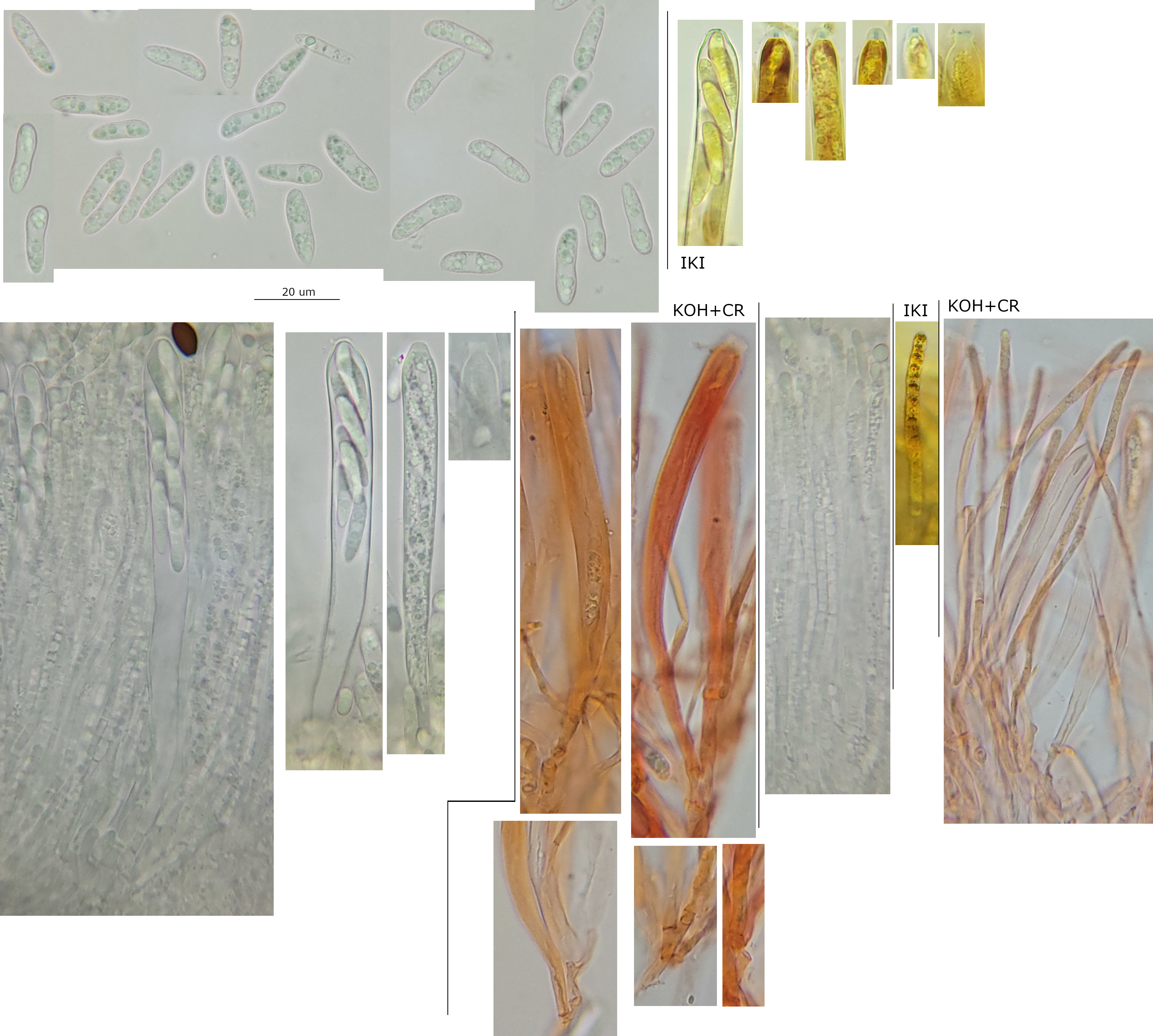 Hymenium-0012.jpeg
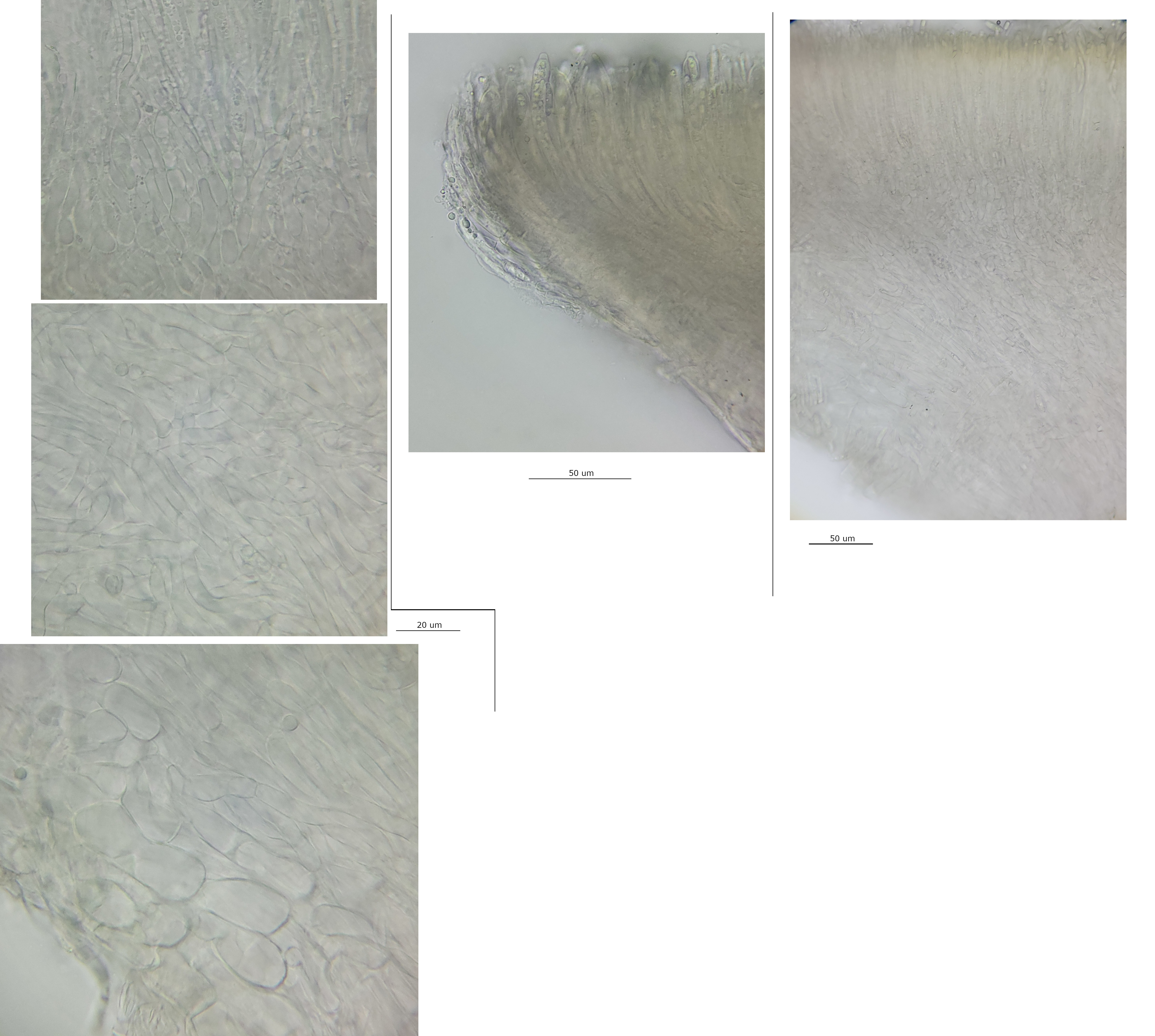 Excipulum-0004.jpeg
I can imagine this is challenging as I found even distinguishing this species quite hard at first, and I noticed some variance in the spore measurements given. However, Declercq's unpublished key does seem to get me there, once I worked out it is in table 2 (low refractive VBs, usually not reddening, folicolous).
Declercq also describes var. constrictus, with small apos, spores with rounded bases, and no reddening with trauma, which seems to fit my observation. There are sequences available for several samples labelled as H. caudatus, do you know if these support heterogeneity or any subgroups?
There are some Chinese sequences under H. caudatus that seem to be related but not identical, but these are very far from my HB 7588c (KM114539) which matches by 0.2% MZ492984 Hymenoscyphus caudatus strain FeF217 from Poland and is a bit more distant to MZ492985 Hymenoscyphus caudatus strain FeF416.
Disturbing is a sequence that is 100% = FeF217, but uploaded as H. albidus:
JX976998 Hymenoscyphus albidus isolate Ha_10203_(VS) (Gherghel et al. 2012 unpubl., 2010 K.H. Rexer, Fraxinus exc.). Clearly this is far from true H. albidus.
The upload of 7588c was not done by me, it lacks collection data: Tübingen, on Fagus cupules. Spores are slghtly constricted, rather broad. A docu is in my caudatus folder.