
09-06-2026 18:32
Camille MertensSur morceau de roseau immergé 0,5 - 0,7 mm de dia
08-06-2026 17:00
François BartholomeeusenGood day everyone, On June 5 2026, I collected de
08-06-2026 10:16
 Spooren Marco
I don`t have a clou about this fungus,it is not in
07-06-2026 15:10
 William Slosse
Hello everyone,On 05-06-26, I found following asco
05-06-2026 11:02
Thomas Læssøehttps://svampe.databasen.org/observations/10596691
07-06-2026 12:09
 François Freléchoux
Bonjour, Voici une brève description de ce qui m
07-06-2026 12:43
Steve ClementsBojour. This was a strange find on a stick on my
12-07-2015 00:05
 Nedim Jukic
This one from the same locality as the previous on
06-06-2026 17:44
Steve ClementsBonjour, This disco was on planed wood 3 x 1.5 cm
Dark ones on Pimus cone
Marja Pennanen,
26-01-2023 15:23
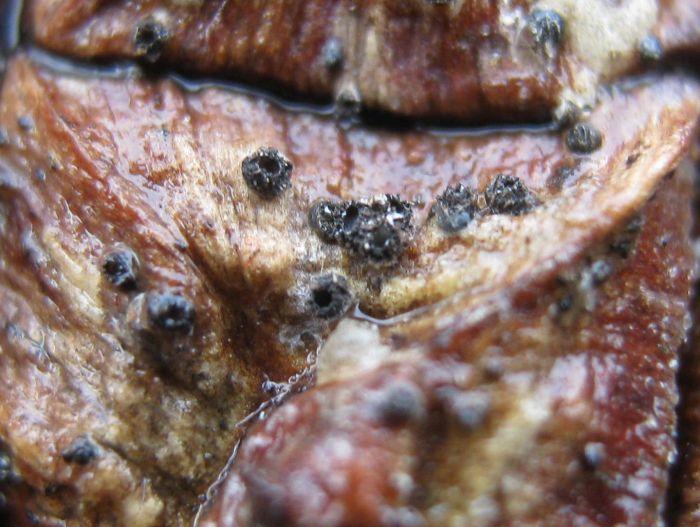
Hello forum.
I collected some dark ones on Pinus cones last spring in Sodankylä, Lappland.
Now I finally studied them. They are now, when dry about 0,2-0,5 mm wide.
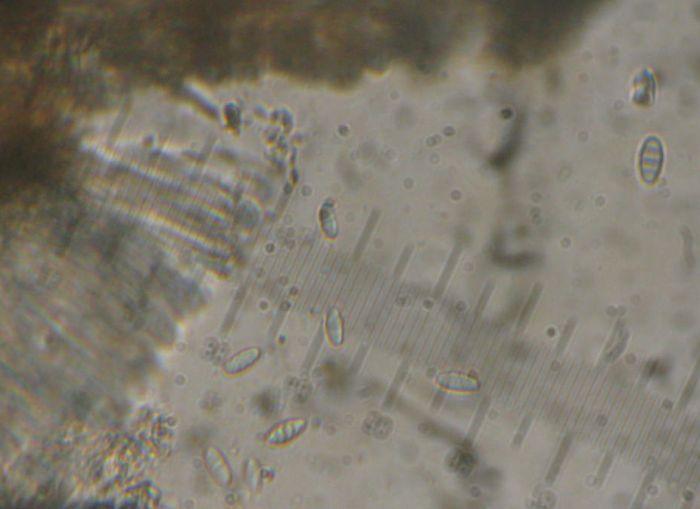
The spores are about 8-10x 3-4 and develop up to 3 septas.
The asci are about 40x6, IKI-.
I have absolutely no idea of, what these may be.
Hopefully someone here knows more about northern species: Marja
Hans-Otto Baral,
26-01-2023 16:51

Re : Dark ones on Pimus cone
Hallo Marja!
Should be ostropalean. You can compare Odontotrema (O. minus). I found the spores larger, 11-13 x 5-6, 3-septate, eguttulate. Also Sherwood says 10-14 x 4-4.5 when dead.
But the hymenium should show some IKI-reaction.
Asci have an apical thickening when dead and paraphyses are multiseptate, uninflated, and a little granular around the tips.
Zotto
Marja Pennanen,
26-01-2023 17:27
Re : Dark ones on Pimus cone
Thank you Zotto!
I just took a fast look at the fungus, so the measurements are few and not very accurate. I do not like dry specimen, they are not easy to handle. But could not take a microscope with me, when I went to Lapland.
This looks like, what I quickly found from Odontotrema.
Greetings to your family, too: Marja
Hans-Otto Baral,
26-01-2023 17:40
Re : Dark ones on Pimus cone
If not too old it can be that the fungus is still alive. Ostropales are generally drought-tolerant. Rehydrate and it is like fresh.