09-06-2026 18:32
Camille MertensSur morceau de roseau immergé 0,5 - 0,7 mm de dia
10-06-2026 12:54
Steve ClementsBonjour encore, Pouvez-vous m'aider, s'il vous pl

10-06-2026 21:16
 François Freléchoux
Bonsoir,Le dernier du jour, en attendant votre avi
10-06-2026 21:07
François Freléchoux
Toutes les tiges de gentianes jaunes de l'an passÃ
10-06-2026 13:41
François Freléchoux
Bonjour à nouveau, Voici une trouvaille d'hier.
10-06-2026 11:53
Steve ClementsBonjour, This disco is abundant on dead stems of
10-06-2026 10:45
François Freléchoux
Bonjour à nouveau, Encore une détermination qui
08-06-2026 10:16
 Spooren Marco
I don`t have a clou about this fungus,it is not in
10-06-2026 09:24
François Freléchoux
Bonjour, J'imagine que cette détermination ne do
Puzzling pyrenomycete
Chris Yeates,
17-10-2020 20:29

Bonsoir tous
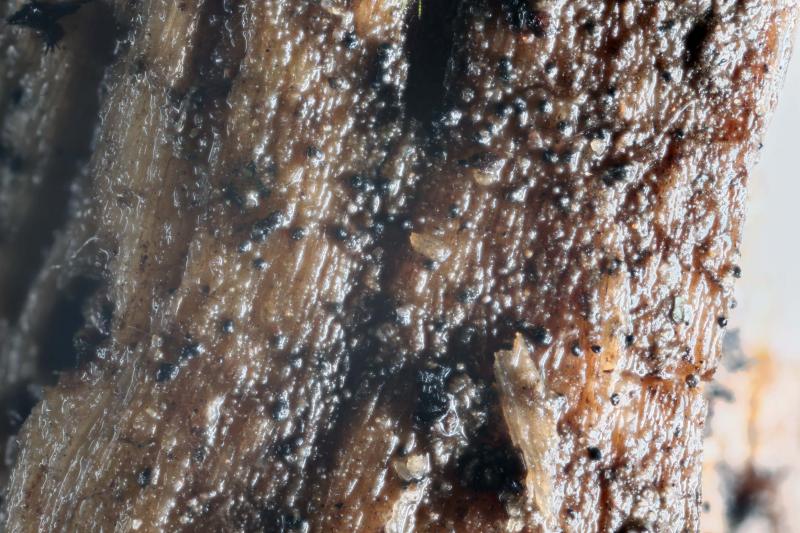
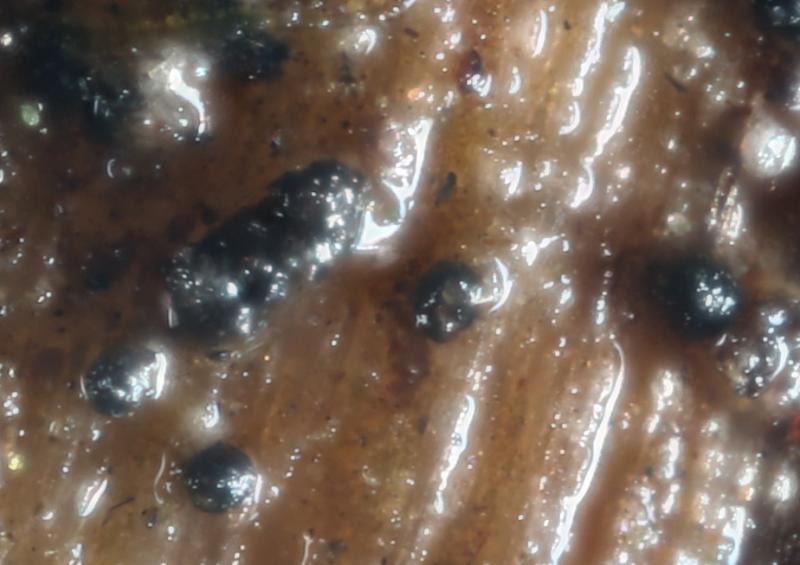
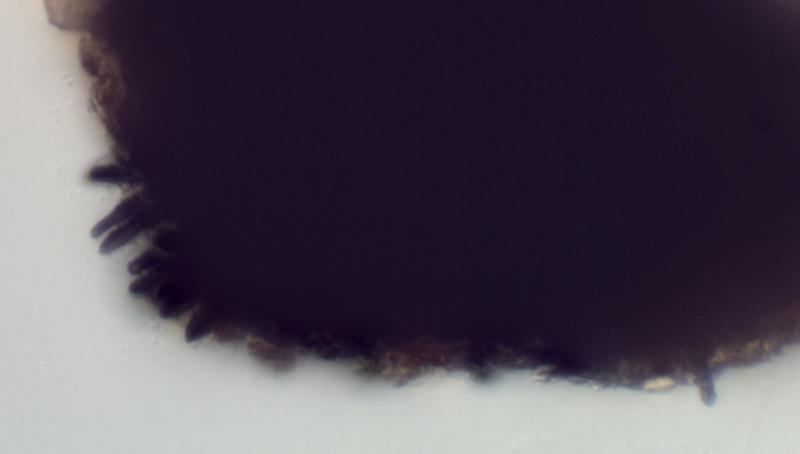
I recently collected, on a decorticated Quercus branch, numerous tiny black ascomata. They are up to 120µm in diameter and very flattened - i.e. not globose. While appearing smooth under the microscope there are short stout setae (less than 20µm long.).
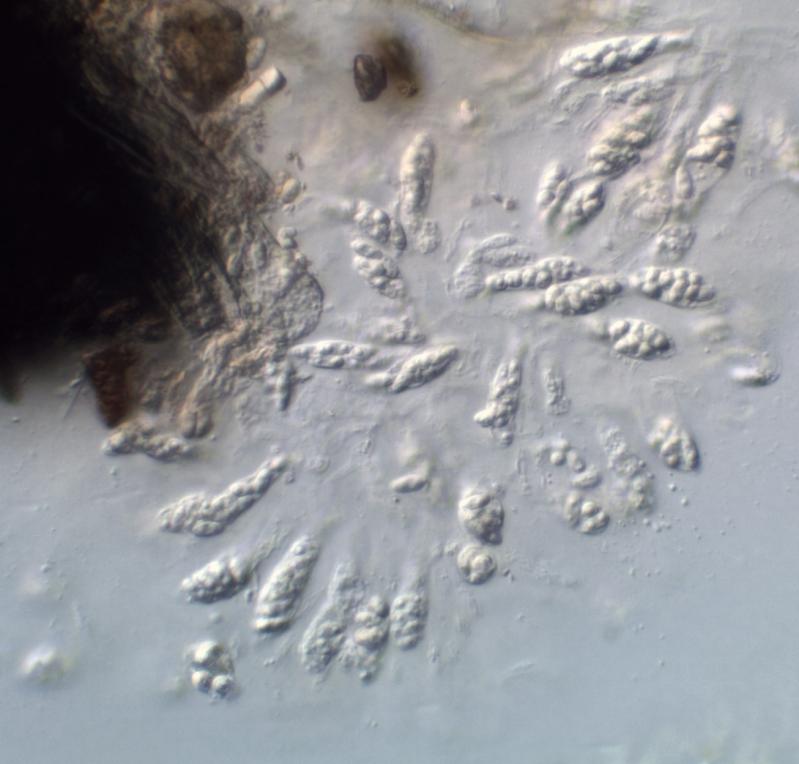
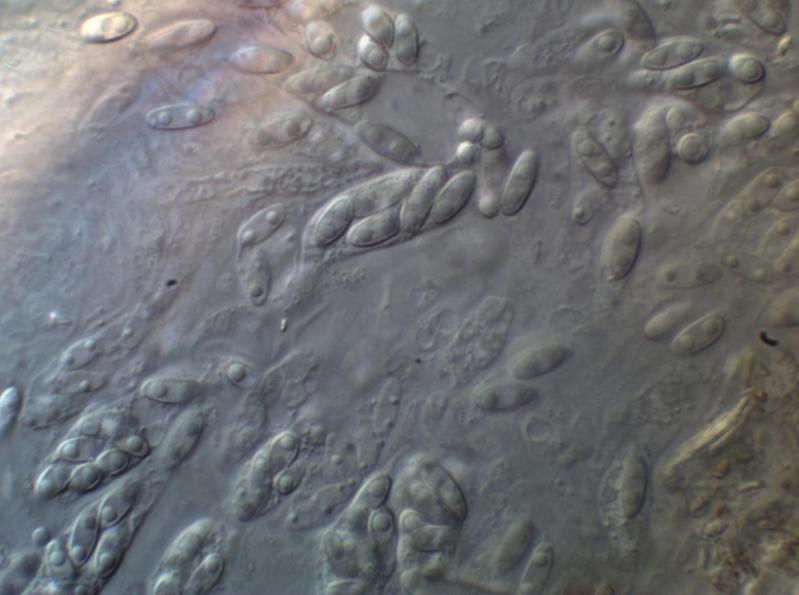
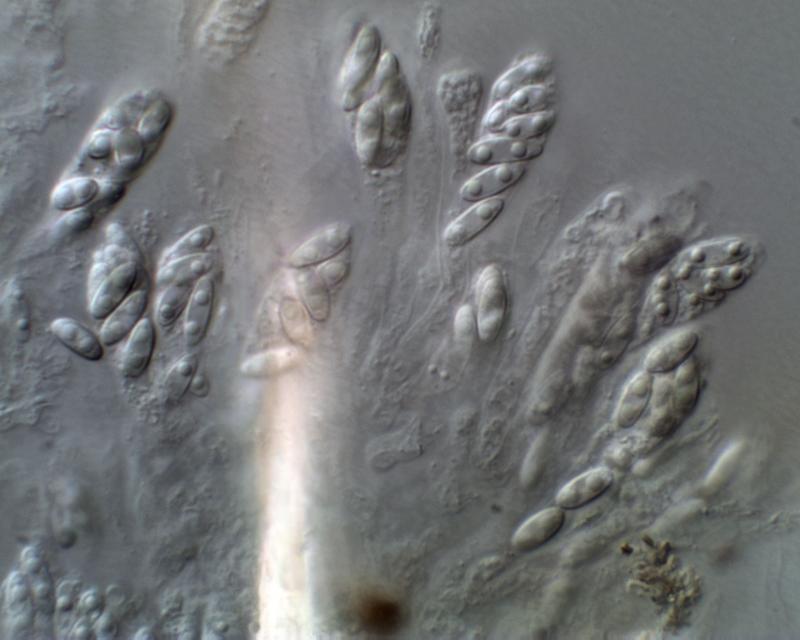
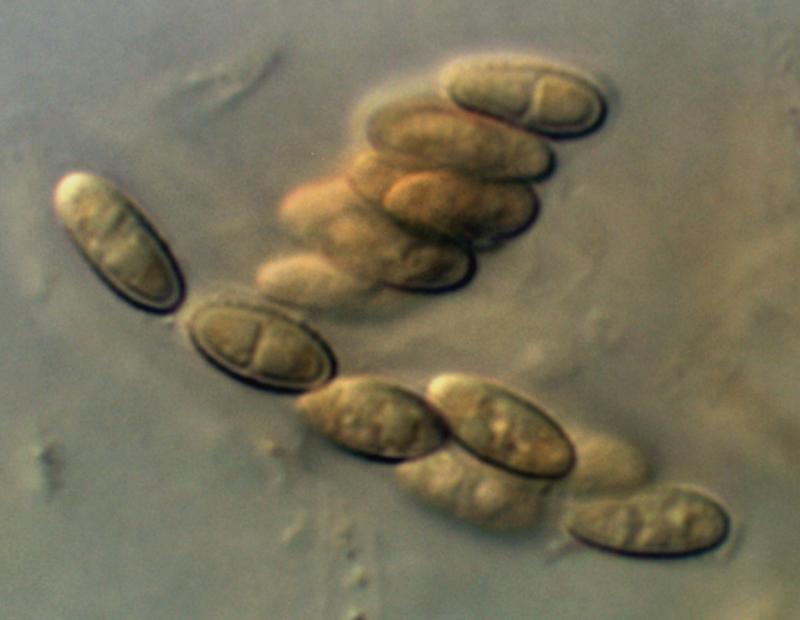
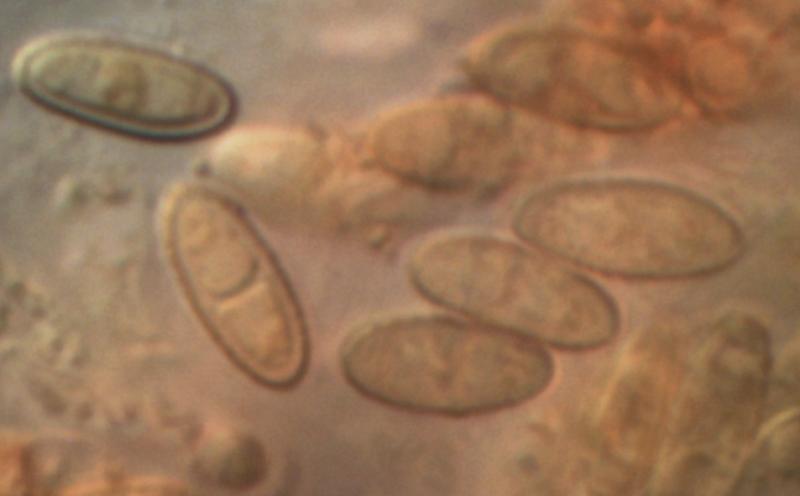
The spores are uniseriate in the lower part of the asci, but clustered/biseriate towards the apex. In the living state they are mostly biguttulate and measure 6.4-8 x 2.7-3.1µm; in strong IKI the VBs break down and the older spores show a (true?) septum and the fact that they are clearly thick-walled.
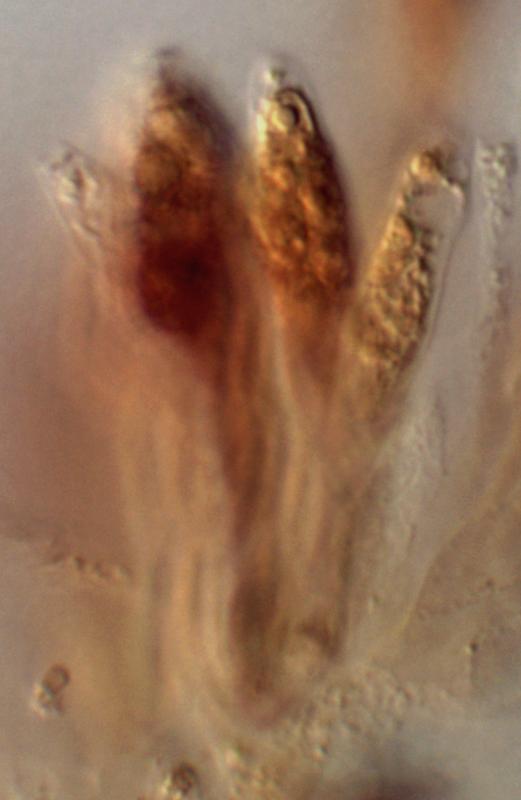
Again in IKI the asci do not show a consistent apical apparatus - there is no blueing, in some cases what looks like a Diaporthales-type apex can be seen (see image) but nothing is visible in living material.
I can't even start to place these in an order and would welcome any suggestions.
Amitiés, Chris
Paul Cannon,
20-10-2020 18:34
Re : Puzzling pyrenomycete
Hi Chris
As no-one has suggested a name for this, I'll venture a suggestion.
It's difficult to see any details of the ascomata from your images (they need to be dry...) but I would look in and around Nitschkia. The genus Acanthonitschkea differs from Nitschkia [both genus spellings are correct, by the way] by the presence of spines on the ascomata/subiculum. However, yours are very small and inconspicuous and it could therefore be a short-spined species of Nitschkia with these being overlooked by previous authors. These things happen...
N. confertula might fit your collection, possibly, but there are other options. See Nannfeldt, Stray studies in the Coronophorales (Svensk Bot Tidskr. 69: 289, 1975), also Huhndorf et al. (Mycol. Res. 108: 1834, 2004) - I can send you if needed.
Good luck!
Paul
Chris Yeates,
20-10-2020 20:55
Re : Puzzling pyrenomycete
Thanks for the comments Paul.
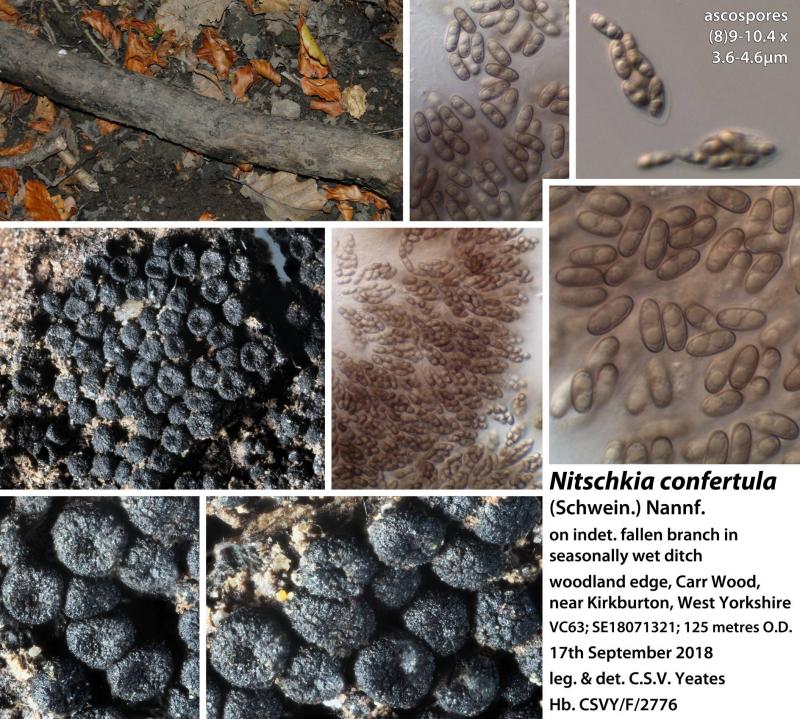
Both the spores, and their arrangement in the asci are, I agree, similar to that one sees in Nitschkia and its allies. However, something I didn't mention in my original post was that the perithecia were thin-walled (no risk to cover-slips!), unlike Nitschkia, and, although black were slightly transparent. I know several of the species in that genus - including N. confertula (see attached). Also the perithecia were at most half the minimum diameter cited for all the likely Nitschkiae. The material is now dried and I shall have another look at it in due course.
Cheers, Chris